Florence Downtown

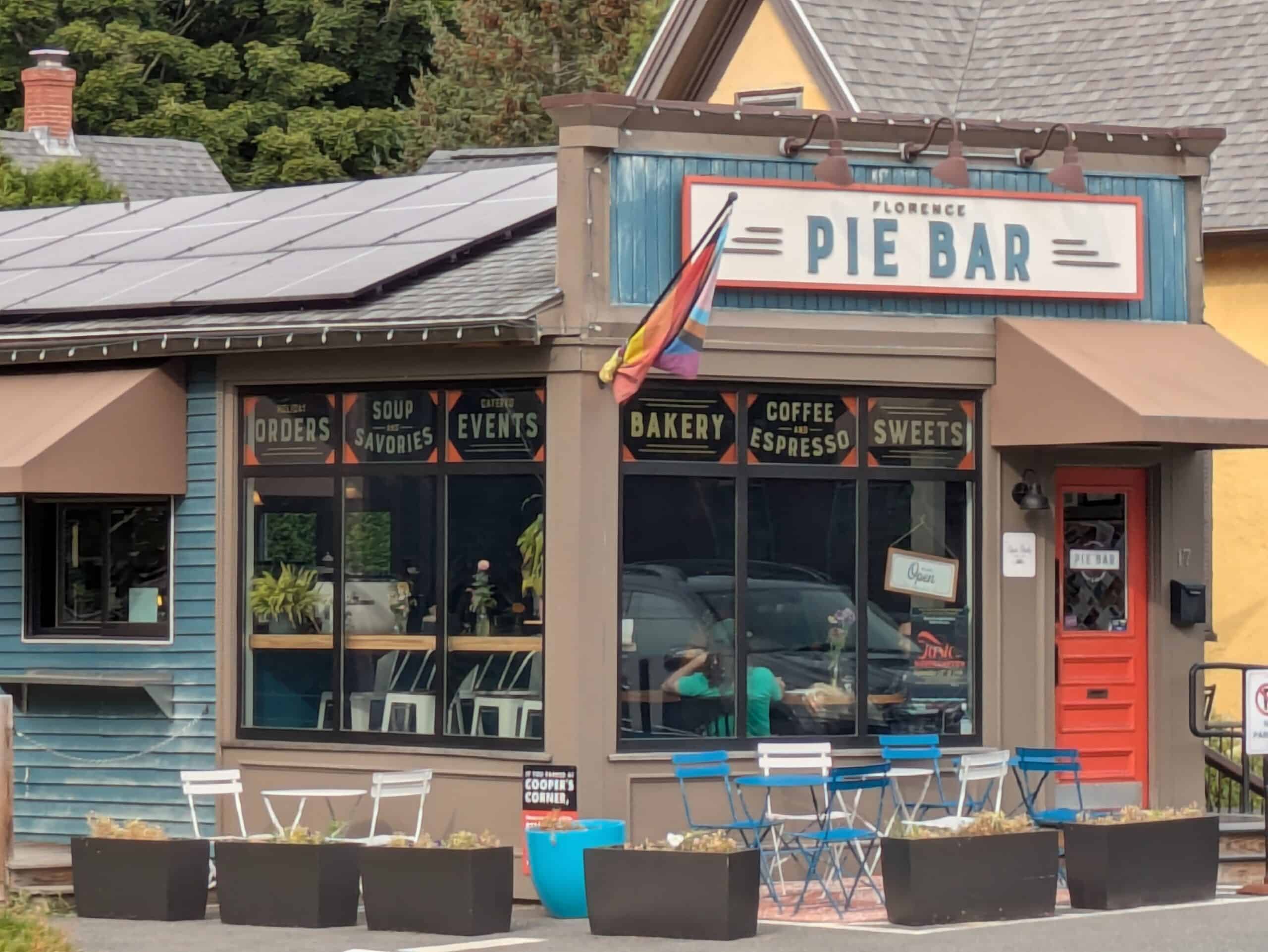
A photograph showing the exterior of the Florence Pie Bar, a single-story bakery and cafe housed in a rustic, wood-paneled building. The building’s facade features a mix of weathered blue siding on the left and a warm, tan-painted storefront on the right. A large, prominent rectangular sign reading "FLORENCE PIE BAR" in bold, white capital letters against a blue background is mounted above the main windows, flanked by three stylized horizontal lines on either side. Below this sign, six large, dark-framed glass window panes showcase the cafe's offerings with smaller, decorative signs reading "HOLIDAY ORDERS," "SOUP AND SAVORIES," "CATERED EVENTS," "BAKERY," "COFFEE AND ESPRESSO," and "SWEETS." A rainbow flag hangs at an angle near the center of the roofline. To the right, a bright orange-red door with window panes serves as the entrance, next to a black handrail on a small set of steps. In front of the building, an outdoor seating area is arranged on the asphalt, featuring several white and blue folding metal chairs and small tables. A row of large, dark rectangular planter boxes filled with low-growing plants lines the front of the seating area.
In the early 1900s, this building was Chancey Frayer’s General Store which sold gasoline (with pumps in front), groceries, confectionery, cigars, coffee and ice cream. The Florence Pie Bar opened in 2015.

Introduction

The village we know now as Florence has seen life as an agricultural area, a thriving industrial center, and a lively business district catering to every need of its residents. We can still see this deep history in the buildings along Main, South Maple, and North Maple streets. 

Scroll to the bottom of the page to take our virtual tour of Florence Downtown.


Background

In 1657, three years after the founding of Northampton, the town set off the land of Florence as the “Inner Commons” devoted to agricultural use. A sawmill was erected at the falls on the Mill River in 1681 and the first bridge over the river was built in 1733. The village, called Broughton’s Meadow, grew slowly. By 1820, the population of the community had only reached 50 people.
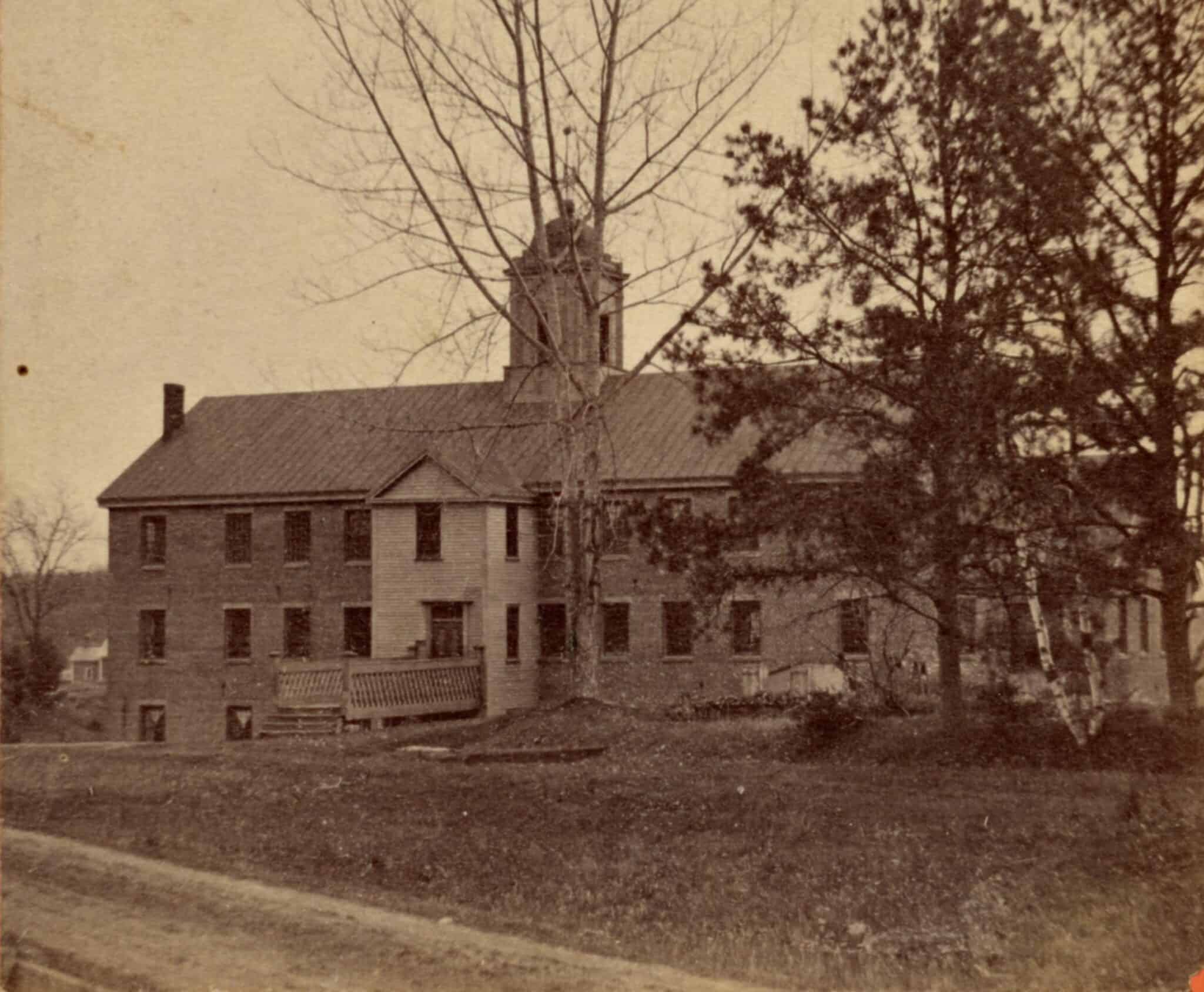
A black-and-white photograph of a multi-story brick industrial building behind several trees on a slight grassy incline. The building features a prominent central cupola rising from its gabled roof line. A wooden porch or ramp with a railing extends from the left side of the structure. In the foreground, a dirt road or pathway runs along the bottom left corner, while bare winter trees and evergreens partially obscure the building's facade.
Combined silk factory and boardinghouse of the Northampton Association. Photographed by the Knowlton Bros. Historic Northampton (ID no. 1982.9.187).

Although some light industry emerged in the 18th century, it wasn’t until the 19th century that Florence started to flourish as a manufacturing center. The 1830s saw the burgeoning of the silk industry, initially from 1832 to 1841 by Samuel Whitmarsh, who hoped to manufacture goods from domestically produced silk. 

The Northampton Association of Education and Industry (1843–47) attracted utopian thinkers and abolitionists to the village. They, too, were involved in silk production from 1842 to 1846 in the interest of providing an alternative to the cotton derived from slave labor in the southern states. The factories producing silk thread were located along the Mill River, south of the junction with Pine Street. The “old mill road,” which connected Elm Street with the mill, was the location of Florence’s first business district as well as the residences of African American and native Irish families. After the Nonotuck Silk Mill was built in 1855 next to the dam, the “old mill road” was renamed Nonotuck Street. 
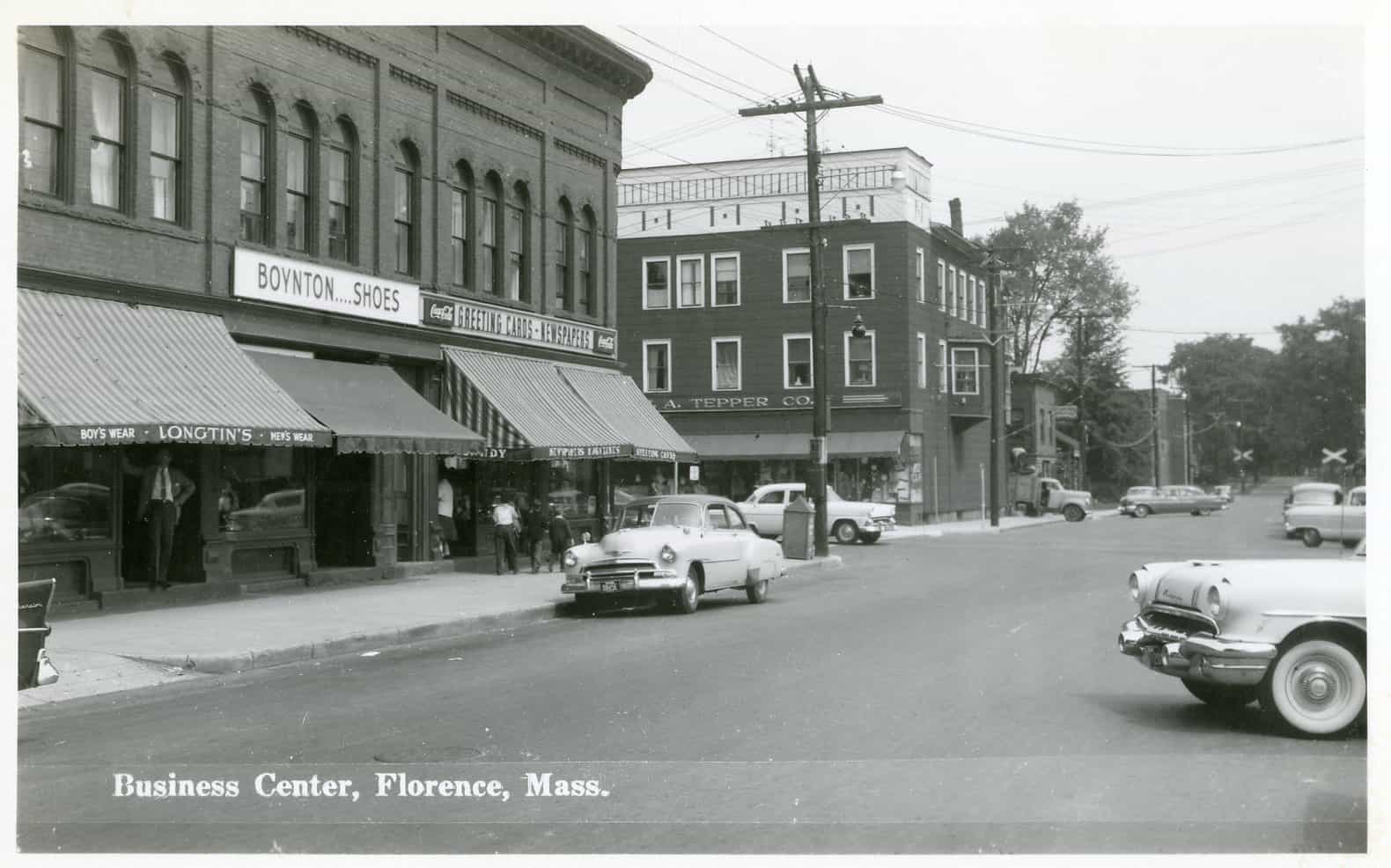
A black and white postcard photograph depicting a street view of the Business Center in Florence, Massachusetts, during the mid-20th century. The perspective is taken from the street, looking down a paved, multi-lane road that bends slightly to the right in the distance, where a railroad crossing with white "X" signs is visible. Vintage mid-century cars are parked along the curbs and situated in the foreground, including a prominent light-colored sedan parked on the left side of the street and the front right fender and whitewall tire of another car in the lower right foreground. On the left side of the street, a multi-story brick commercial building dominates the view, featuring rows of arched windows on its upper floors. The ground floor houses several storefronts protected by large, striped canvas awnings that extend over the sidewalk. Prominent signage above the awnings reads "BOYNTON'S SHOES" and "GREETING CARDS - NEWSPAPERS," while smaller text on the awnings indicates "BOY'S WEAR - LONGTIN'S - MEN'S WEAR." A few pedestrians, including a man standing near a doorway and others walking further down, populate the sidewalk. Across an intersecting side street stands another three-story brick building with the sign "A. TEPPER CO." above its ground-floor storefront. The street is lined with wooden utility poles carrying overhead power lines, and dense trees line the background behind the buildings and along the distant roadway. The bottom left corner of the image features the printed caption text: "Business Center, Florence, Mass."
Postcard with a photograph of the intersection of Maple Street and Main Street in Florence, Mass. Historic Northampton (ID no. 2019.33.71).

The manufacture of silk thread, predominantly in the factories of Belding and Corticelli, continued in Florence and Northampton until 1932, when their plants were closed. McCallum (later Propper-McCallum), a manufacturer of hosiery, switched from silk to nylon in 1936 and continued production in several locations until the 1950s. Their plant at the corner of Locust Street and Straw Avenue (just south of where our walk begins) closed in 1948. 

The village was also the birthplace of one of the first American factories to manufacture plastic, starting in 1843, when A.P. Crichlow began producing a new substance known as the “Florence Compound,” a thermoplastic composition made of shellac, wood fibers, and a coloring agent. The Florence Manufacturing Company—incorporated in 1866 as successors to Littlefield, Parsons and Company—manufactured daguerreotype cases, also known as union cases, made of the Florence Compound.
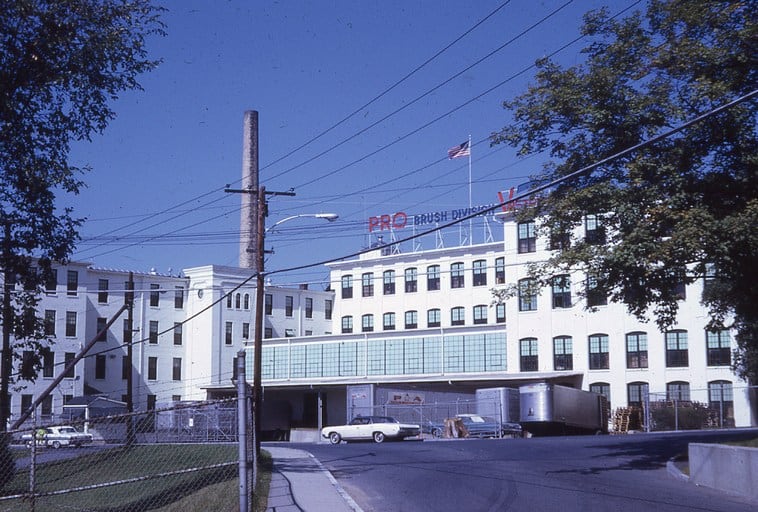
A photograph of the Pro Brush Division factory complex, a large white multi-story industrial building featuring a tall, slender chimney stack and an American flag flying on its roof under a clear blue sky. On the roof, red and blue neon signs spell out "PRO BRUSH DIVISION." The building has numerous rectangular windows and a low, wide entrance with two semi-trucks parked in front. A white classic car is parked near the entrance, and power lines crisscross the sky in front of the building. In the foreground, a paved street curves toward the right, with a chain-link fence on the left bordering a green lawn.
Photograph of the Pro-Brush factory building on Pine Street, Florence, Mass., c. 1965. Probably photographed by Hazel Palmer. Historic Northampton (ID no. 16.16.1).

As the daguerreotype became obsolete, the Florence Manufacturing Company adapted the thermoplastic composition to the manufacture of hair brushes, hand mirrors, and military brushes. In 1885, the Florence Manufacturing Company signed an agreement with Meyer L. Rhein, M.D., D.D.S. of New York City to manufacture, vend, and advertise the “Prophylactic Tooth Brush,” for which Rhein was awarded a patent in 1884. The Pro-Phy-Lac-Tic Tooth Brush became the company’s most famous product and, in 1924, the Florence Manufacturing Company changed its name to the Pro-Phy-Lac-Tic Brush Company. By 1929, it was the largest manufacturer of toothbrushes in the world.

The population of Bensonville, as Florence was known in the early 19th century, grew with the influx of factory workers, families, and a mercantile class. In 1852, the residents voted unanimously to change its name to Florence and the village was granted its own post office.
By 1867, the population had reached 2,000. And that year the railroad arrived, opening transportation links for the various goods being produced in Florence’s factories and mills. The tracks in Florence ran parallel to Main Street and North Main Street. North Maple Street became the focus of railroad-oriented industry, including a depot, and the business district shifted from Nonotuck Street to what is now Main Street. The buildings on our virtual walking tour were primarily constructed during the boom that followed the introduction of the railroad.


Take Our Virtual Tour!

Scroll down to get started, or View tour in full screen mode.