Peggy
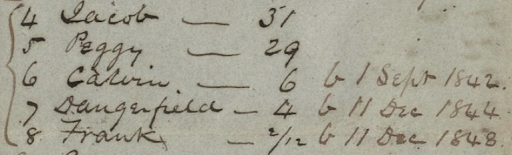
Peggy offers a unique perspective on plantation life, differing from that of many other enslaved women who primarily performed domestic duties within the Watson household. Born around 1821, she was partnered with Jacob and gave birth to their first child, Calvin, on September 1, 1842. Peggy and Jacob fall into the group of individuals enslaved by the Watsons prior to 1843—the year the slave ledgers began—yet they do not seem to have been among the people transferred from Mrs. Peck following Sophia’s wedding.
Peggy’s Labor
According to existing records, Peggy performed two primary roles. She is most frequently noted for her labor as a seamstress. While other enslaved women, such as Ann Maria, performed sewing tasks within the Watson home, Peggy’s role was distinct. She was primarily responsible for finishing “negro clothes” (the garments of other enslaved people) on the plantation itself. “Negro clothes” refers to a cheap and coarse material, usually a plain weave piece of clothes made of cotton, wool, or hemp, that enslaved people would be made to wear. It was known to be an itchy, rough, and stiff material. Because enslaved people only had one set of clothes per season, “negro clothes” were worn to tatters. A letter from January 1852 confirms that Peggy was in charge of making and distributing these clothes, with Sophia informing Henry that “Peggy will finish all the work sent down during this week.”
Given that the plantation often held at least 100 people at a time, this task was significant in both time and labor. It appears Peggy may have worked largely alone, as Sophia mostly mentioned her independently from other enslaved people. In September 1848, Sophia expressed concern that Peggy’s slow progress would prevent her from finishing the season’s work:
“Peggy did but little work in the early part of the season and I feared she would not get through.”
To address this, Lucinda—who had been sent to the plantation due to a suspect pregnancy—was assigned to assist her. By the end of the summer of 1848, Sophia reported that the two were “getting on famously” and predicted the winter clothing would be finished “by the first or middle of October at least” with Lucinda’s help.
Peggy’s visibility in historical records follows a common pattern: the more distant enslaved people were from the main household, the less frequently they appear in the documentation. Her case serves as a confirmation of this trend. Aside from her plantation-based duties, she is mentioned only once away from that setting. Records indicate she was brought up from the plantation in July 1848, at which time she provided Sophia with updates regarding the arrival of new cows during a famine outbreak. Her presence in the family’s direct correspondence remained infrequent.
Reproductive Labor
While Peggy is rarely found in the Watsons’ letters beyond these sewing-related updates, her reproductive labor is frequently documented in the slave ledgers. Peggy unfortunately exemplifies the high rate of infant mortality on plantations. Because of the matrilineal system of partus sequitur ventrem, enslaved women quickly became the means of production of an increased workforce for enslavers.
In American chattel slavery, the status of enslavement passed from mother to child. One significant reason for this law, passed in the British American colonies in 1662, was the common practice of male enslavers sexually abusing the women and girls that they enslaved. Maternal heredity ensured that enslavers could enslave the children that the abuse produced and/or the children whose paternities were unclear. Columbia University professor Jennifer L. Morgan writes:
Their [the legislators’] legal intervention reassured English slaveowning settlers that, in the matter of enslaved people, status passed down not through the father but through the mother: partus sequitur ventrem, or, literally, “offspring follows belly.” The nineteenth-century historian William Henig inserted the Latin into the text; the original simply said, in English, that children would be slave or free “according to the condition of the mother.” For Henig, the Latin served to connect English slave law to Roman antecedents and thereby to a legal argument … that it was only through Roman law that English slaveowners claimed the right to children born into slavery “like cattle.”
Jennifer L. Morgan, “Partus sequitur ventrem: Law, Race, and Reproduction in Colonial Slavery,” in Small Axe: A Caribbean Journal of Criticism 22 (2018): 3.
This was especially true after 1808, when the Atlantic slave trade was officially made illegal and slaveholders now had to rely on reproducing their own labor workforce. As a result, enslaved women became both the workforce and what made the longevity of the workforce for the enslaver possible. This explains why Henry Watson keeps track so closely of enslaved women’s pregnancies in his slave ledgers.
With the high rate of infant mortality, enslaved women had to be constantly pregnant in order to ensure that at least a few children would survive. Besides her first recorded son Calvin, Peggy was pregnant with 10 other children from 1844 to 1864, but only four of them survived, to our knowledge. On December 11, 1844, Peggy gave birth to Dangerfield, who died at 5 years old on July 17, 1850. Emily, Peggy’s first daughter, was born on February 8, 1847, but tragically died on April 1, 1848. Later that same year, on December 11, Peggy gave birth to a son named Frank. Another son, Bryant, followed on August 22, 1850, but he passed away three years later on July 19, 1853. On November 18, 1852, Peggy gave birth to John Greene, who lived to see Emancipation. The use of the last name “Greene” to distinguish him from other children on the plantation with the same name suggests the entire family shared this surname. In 1854, Louisa was born and also survived until Emancipation.

Elijah was born on January 20, 1857, but fell ill in 1858. Sophia Watson noted on July 28, 1858, that “Peggy’s [child] is not expected to live long.” Elijah passed away two months later, on September 15. After a stillbirth in 1859, Randall was born on February 8, 1861. Records became sparse during the Civil War under Sereno Watson’s management, but Randall’s absence from the 1864 ledgers suggests that he died between 1861 and 1864. Finally, in January 1864, at age 44, Peggy gave birth to Matilda, who also survived to experience freedom in 1865.
The staggering rate of infant mortality among Peggy’s children highlights the abysmal living conditions and the systematic lack of care for pregnant enslaved women. In contrast to the continuous care Sophia Watson received from nurses such as Phillis, Ellen, or Lucinda, enslaved women were shut out from medical privileges. Consequently, they established their own support networks, acting as midwives for each other. Through their numerous pregnancies, women such as Hester, Keziah, Fanny, Carolina, and Tabitha gained significant expertise in childbirth and likely shared this vital knowledge amongst themselves.
The Life Trajectory of Calvin
The principle of partus sequitur ventrem is exemplified by Calvin’s trajectory within the Watson household, as he gradually replaces both his mother and father. The Watsons’ correspondence reveals an increase in mentions of Calvin following Jacob’s final appearance in the records in 1848. Calvin was first brought up from the plantation to the Greensboro house in 1851 at age 8 due to illness; there he was likely cared for by other enslaved women such as Phillis. By December 1, 1850, Sophia described him to Henry as “invaluable” and improving daily.
During this period, Calvin served as a companion to the Watson children, with Sophia noting, “The nameless one [new Watson baby] is now playing with newspapers and bright things, he’s on his stomach on the floor and rarely cries. He now lies talking to himself while Calvin and the other two are at play.” Although intended to be temporary, Calvin’s stay became an extended one characterized by an “intimate proximity” to the family, illustrated by Henry’s 1852 note that “Calvin found [him] asleep,” suggesting the child had access to the private bedrooms. Calvin’s unique status was also marked by being provided with a “new cap and shoes and clothes,” a distinction not shared by other enslaved children.
In later years, Calvin moved between Greensboro and the Newbern plantation, a choice that Julia’s February 18, 1858, letter suggests originated with Calvin himself. Indeed, Henry’s sister Julia wrote to Sophia, asking, “Is Calvin as well pleased at the plantation as he used to think he should be?” Ultimately, Calvin assumed the roles previously held by both his parents; he replaced Jacob physically within the Greensboro house and contributed to the sewing labor typically associated with his mother, Peggy.
Peggy’s Husband Jacob
More is known about Peggy’s husband Jacob and her first son, Calvin, than is known about Peggy herself. Jacob is extensively mentioned in the records. Although he does not live in the main house, Jacob still worked mostly in the vicinity of the main house and was trusted by the Watson family. Very early on in 1845, while Henry Watson went on his first business trip and Sophia was left alone in the house, Sophia asked Jacob to sleep inside the house to protect her from any intruders. Jacob refused, saying:
“I am not afraid of any person trying to get in, I am afraid of the evil.”
— Sophia quoting Jacob in letter to Henry, October 3, 1845.
What evil was Jacob referring to here? It is hard to say. However, given southern sexual politics and the fear of “racial mixing,” it is probable that Jacob refused to sleep in the house as an act of self-protection against charges of impropriety with Sophia, especially with Henry being away from the house.
Following that episode, Jacob was still working in close proximity to the house but rarely worked inside. His responsibilities were primarily focused on the estate’s exterior, specifically the orchard and garden. Jacob’s main task was to trim the hedges around the house. Henry appeared to rely exclusively on Jacob for the maintenance of the hedges, as indicated in a letter dated May 25, 1848, where he says, “I think he [Jacob] can do it and do it well. He can easily see where it was chipped before and can chip to the same place.” Henry’s trust in Jacob ends up working out, as Sophia writes on June 12, 1848, noting:
“Jacob trimmed all the hedges on Friday and Saturday and has done it very well. He commenced with the privet hedge around the circle and succeeded so well with that I allowed to go on and trim the myrtle (your (?)), the cedar hedge and the (?) orange hedge near it. He was very much delighted himself with his success… a little encouragement and praise is all that is necessary to make him do his best.”
While Sophia compliments Jacob’s work, she credits this to the “encouragement and praise” given to him by Henry. This comment infantilizes Jacob and feeds into the paternalist narrative that enslavers could be kind and parent-like to the people they enslaved, rather than praising his own skills.
Besides trimming the hedges, Jacob was tasked with overseeing various garden crops, such as corn and potatoes. He demonstrated a notable degree of autonomy in his work, occasionally initiating projects without securing prior permission from Henry or Sophia.
This independence is illustrated in a letter dated July 15, 1848, where Sophia notes that:
“Jacob commenced digging the potatoes yesterday without my knowledge—as soon as I found it out I stopped him, remembering having heard you say you would try a new plan with them this year—let them remain in the ground—say in your next [letter] whether you still wish it, they are very indifferent anyway.”
Jacob’s tendency to act on his own initiative appears to have been a recurring point of contention. In May 1848, Henry expressed frustration regarding Jacob’s lack of preparation for the potato crop:
You spoke of Jacob’s not having been ready for his potatoes and that he needed a direction and his need for instruction. Can you not think and manage for him? I should dislike to bore our crop of potatoes.
Henry seemed to interpret Jacob’s independent behavior as a sign of Sophia’s struggling supervision while he was away in Connecticut attending to his late father’s business.
It appears Jacob actively took advantage of the more relaxed boundaries Sophia provided. In a letter dated August 21, 1848, Sophia admitted to Henry that she permitted several enslaved individuals, Jacob included, to leave the plantation. Doing so, she contradicted Henry’s standing order that they only be allowed one weekly excursion to attend Sunday evening church services. Sophia noted:
“Jake and Antony occasionally ask to go to Ma’s which I have allowed them to do, and once or twice they have gotten permission to go up town to do some trading. They don’t seem to think of going now.”
Given that the movement of enslaved people was severely restricted, Jacob’s experiences highlight how gender could sometimes afford certain individuals slightly more latitude to navigate their surroundings.