Patience

Patience was an enslaved woman on the Watson’s plantation in Newbern. After a long battle with an unknown illness that also infected many of the children the Watson’s enslaved, she died in the Watson home in the summer of 1848.
Arrival on the Plantation
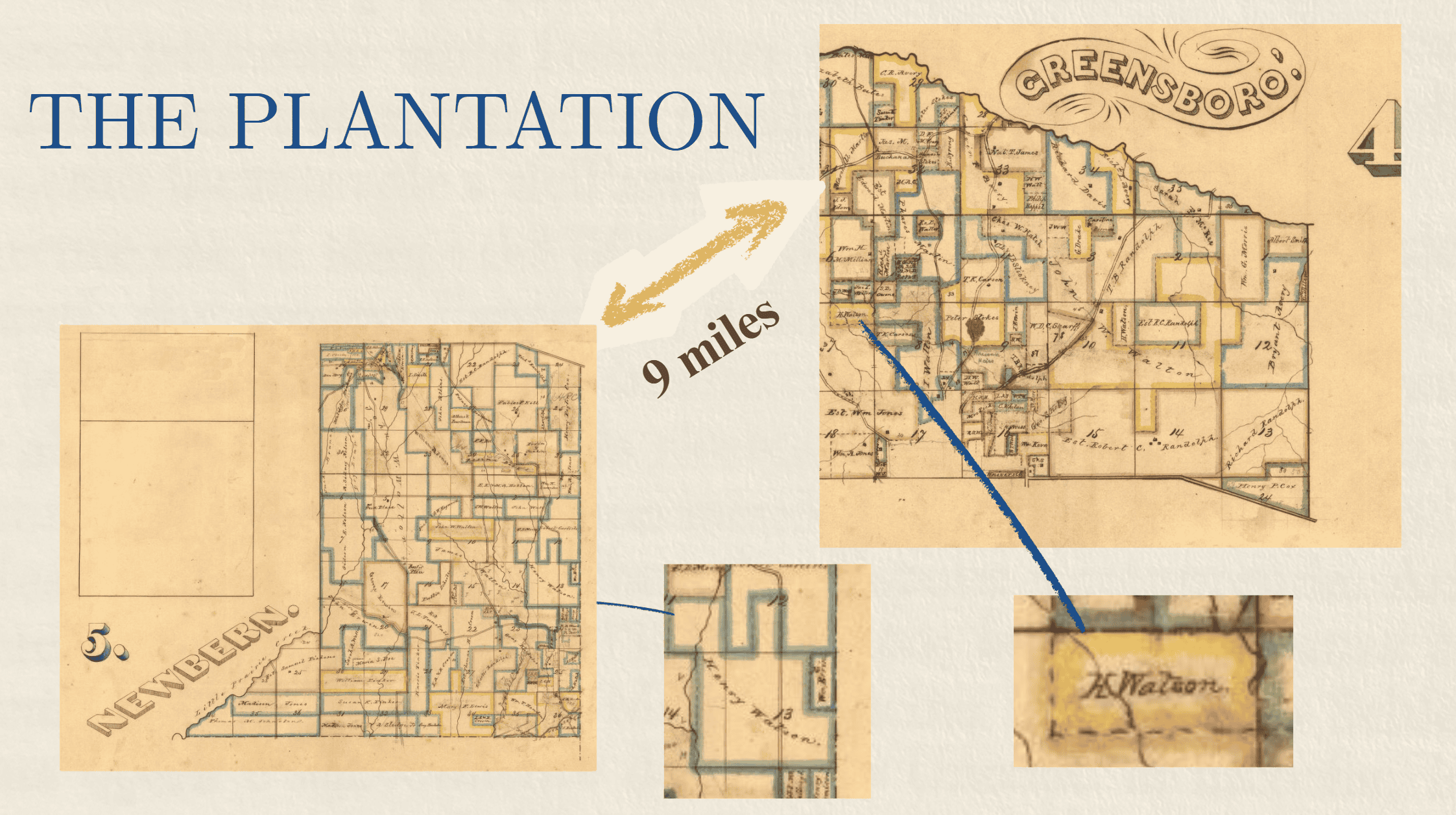
Patience was born around 1824, though we do not know where. Henry Watson purchased her in 1844 with a man named Pleasant and a larger group of young single enslaved people both male and female. Part of his intent in running a plantation was to forcibly breed enslaved people with each other to increase his own wealth. At the time of Patience’s arrival on the Watson plantation, she was already pregnant with her daughter Elizabeth, who would be born the following year in 1845. We do not know who Elizabeth’s father was. The next year, 1846, Patience married Pleasant.
For the first few years of her enslavement to the Watsons, Patience likely picked cotton on Henry Watson’s plantation in Newbern, nine miles away from his home in Greensboro. She would have had limited contact with the enslaved women of the Watson household during that time. She would have gone on picking cotton for Henry Watson had she not gotten sick in 1848.
The Beginnings of her Illness
In April 1848, just over six months after the birth of her son Daniel, Patience contracted an illness that caused extreme pains in her stomach and persistent coughing. Her illness began to spread to other enslaved people, including her young son Daniel. Sophia and Henry decided to bring her up to their house in Greensboro to treat her illness and separate her from the other enslaved people on the plantation in Newbern. On May 2, 1848, Sophia wrote to Henry:
“Patience is not so well as when I last wrote you. Finding she was evidently growing weaker every day and complaining more and more of the misery in her stomach. On Friday morning I told her to go down and see Dr Davis but she thought she wouldn’t not be able to walk and I sent for him to come up. He thought her worse. She coughed a good deal while the Dr was here and spit very freely which gave him an opportunity of examining what was brought up which he said looked badly and spoke of he feared her disease would terminate in consumption if it wasn’t that already.”
Exactly what disease infected Patience is difficult to say precisely. The term Dr. Davis used of “consumption” could indicate any number of consumptive illnesses, including some forms of cancer, but most frequently tuberculosis. As the letters continue it becomes clear that her main symptoms are pain in her chest and bowels, persistent coughing, and gastrointestinal issues. This could indicate severe tuberculosis that had spread beyond just her lungs to infect more internal organs. Tuberculosis was one of the most pervasive and deadly illnesses of the 19th century.
Illness Spreads
In addition to Patience’s own illness, during the spring and summer of 1848, Sophia and Henry’s baby son Frederick got sick with an unknown illness. He was treated with far more care and attention than Patience. During her descent into illness, Patience was still expected to perform labor for the Watson family. Sophia treated Patience with various supposed remedies offered by Dr. Davis, including but not limited to lime water, cherry bark water, magnesium, chalk, and frequently “black drops” as Sophia calls them. We would know these “black drops” today as opium.
By mid May 1848, Sophia seemed to have lost hope in Patience’s recovery, focusing instead on treating the illness of her son Daniel. Though this could be seen as merciful, Sophia choosing to focus her energies on the sickness of a child, there were financial motivations for her too. If Patience were to die, this would be a financial loss to the Watsons, as they viewed her as their property. Henry and Sophia would have seen her death as the damage and loss of their property. Even worse than that, if her son Daniel died too, this would double the financial deficit. This fear in losing Daniel’s life in addition to Patience’s manifested in a debate between Henry and Sophia about whether or not Patience should be allowed to continue to nurse Daniel. Henry wrote on May 18, 1848:
I hardly know what to say about Patience. We must do the best we can and all we can for her, but I doubt much if she ever recovers. Would it not be well to wean her child? It would no doubt be the best for the mother, but we might endanger the life of the child. If weaned, would it be best to feed it upon milk at home? Or instead of weaning let it suck one or two at the plantation? Would this best be doing justice to the other mothers and other children? Again will the health, if not the life, of the child be endangered by letting it suck its sick mother?
The two consulted Dr. Davis again and he suggested that Patience preemptively wean her child to separate him from his mother and prevent potential further infection.
Care from her Community
Patience remained alive but worsened over the next few months. Other enslaved people, including Hester Ann Maria and Tabitha, were permitted to come and visit and care for her in her illness. During this time more and more enslaved people both in the household and on the plantation began to fall sick to infection. Ellen, the frequently mentioned cook of the house, took charge of caring for the growing numbers of enslaved children sent up to the household for care and quarantine. Her counterpart housemaid Eveline specifically took care of Patience. In a June 22, 1848, letter to her husband, Sophia wrote:
“My patients don’t improve much. Little Daniel continues very sick. I have not sent for the Dr for him. I have been attending Fred now so long with the same disease and he seems so much as he was in every respect that I am using the same remedies with him but as yet see no improvement. Elie I think is better though still far from being well. Ellen has her hands full attending to them. But she does it well and cheerfully. Eveline takes charge of Patience and she too required a good deal of attendance now. She rarely leaves her room or her bed. She has seemed better for the last few days at least she suffers less. But I think she is growing weaker all the time. I still give her the iodine regularly twice a day, the Black drops occasionally. The Dr has not been here for the last week. I suppose he thinks there is nothing that can be done for her. Indeed he told me as much when he was here last. She is very anxious to have another Physician called in and Pleasant urged me on Sunday to send for Dr Rittrel but I was sure he could do nothing more than Dr. Davis had done.”
At this point it was clear Sophia thought Patience’s recovery was unlikely, but even when Patience’s own husband Pleasant “urged” her to send for another doctor she refused. In this moment despite watching his wife die, Pleasant would have been powerless to do anything but plead with Sophia for help she did not provide. This passage also reveals an important comparison between how white and Black children’s illness are treated. Daniel, Pleasant and Patience’s son, who she writes “continues very sick,” she suspected to have the same illness as her own son, Frederick. Despite calling again for the doctor to be sure, she used leftover treatments from her own son to attend to his needs.
The Death of her Son
Ultimately hand-me-down remedies and a lack of medical professional’s attention would prove fatal for “Little Daniel.” On July 3, 1848, Sophia wrote to her husband
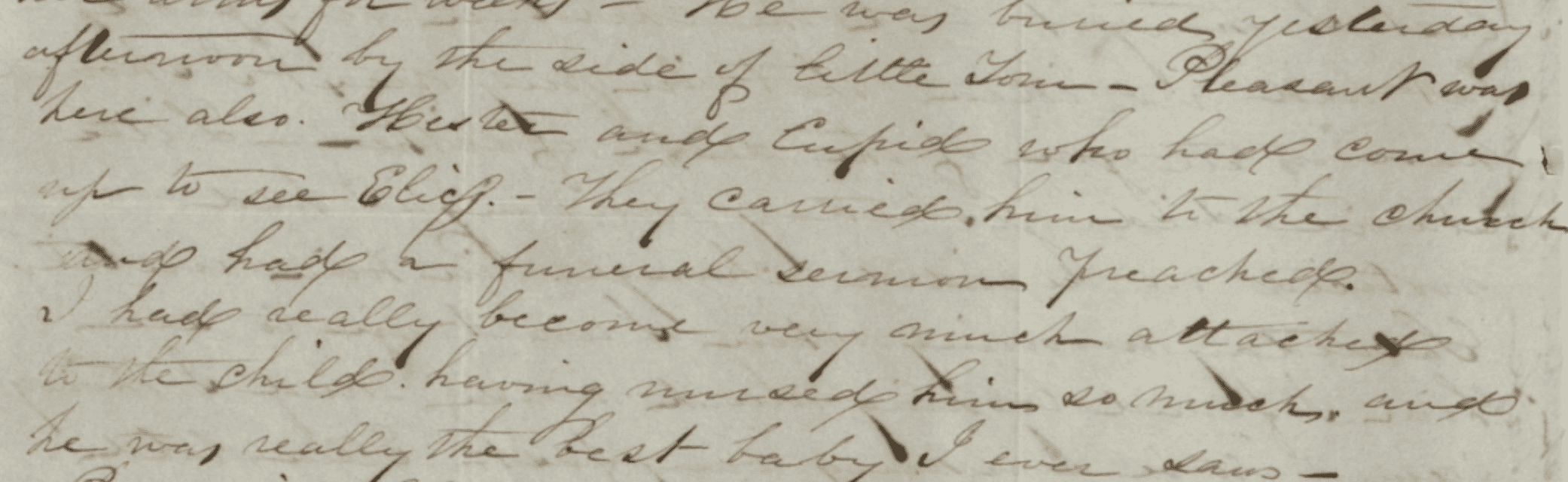
Little Daniel died yesterday morning. I had noticed no decided change in him until Saturday morning when I went in to see him. I found looking much worse and I thought seemed to be sinking very fast. Ellen told me he had been gagging all night as if sick at his stomach and at that time was purging. I sent for the Dr immediately but he was out and did not get here until after dinner. He then on examining his symptoms and inquiring about him told me it was an acute attack of cholera infantum. He left medicine for him but gave me but little encouragement to think he would recover. He gradually sank under the attack and yesterday morning about 2 o’clock died. He was well nursed I think I did all that I could and I think Ellen did her part faithfully. His mother does not seem to grieve much for him. Indeed she is so sick herself that I suppose nothing of the kind would affect her now as it would under other circumstances. She has not been able for a long time to attend to him at all herself. I don’t think she has had him in her arms for weeks. He was buried yesterday afternoon by the side of little Tom… I had really become very much attached to the child having nursed him so much and he was really the best baby I ever saw.
Enslaved Motherhood
While Sophia Watson does acknowledge the likely influence of Patience’s condition on her alleged lack of grief, she neglects to acknowledge that Patience would have been taking daily doses of morphine for months, impairing her mental and emotional capacity significantly. Sophia’s unfair critique of Patience is not unique, enslavers often made claims that enslaved women were cold toward their children in an attempt to further dehumanize them.
Throughout the letters of the illness of 1848, Sophia continually assumes enslaved mothers do not care for their children and this “neglect” as she puts it is to blame for the outbreak of illness, writing on June 26, “I begin very much to fear that the children are neglected at the plantation.”
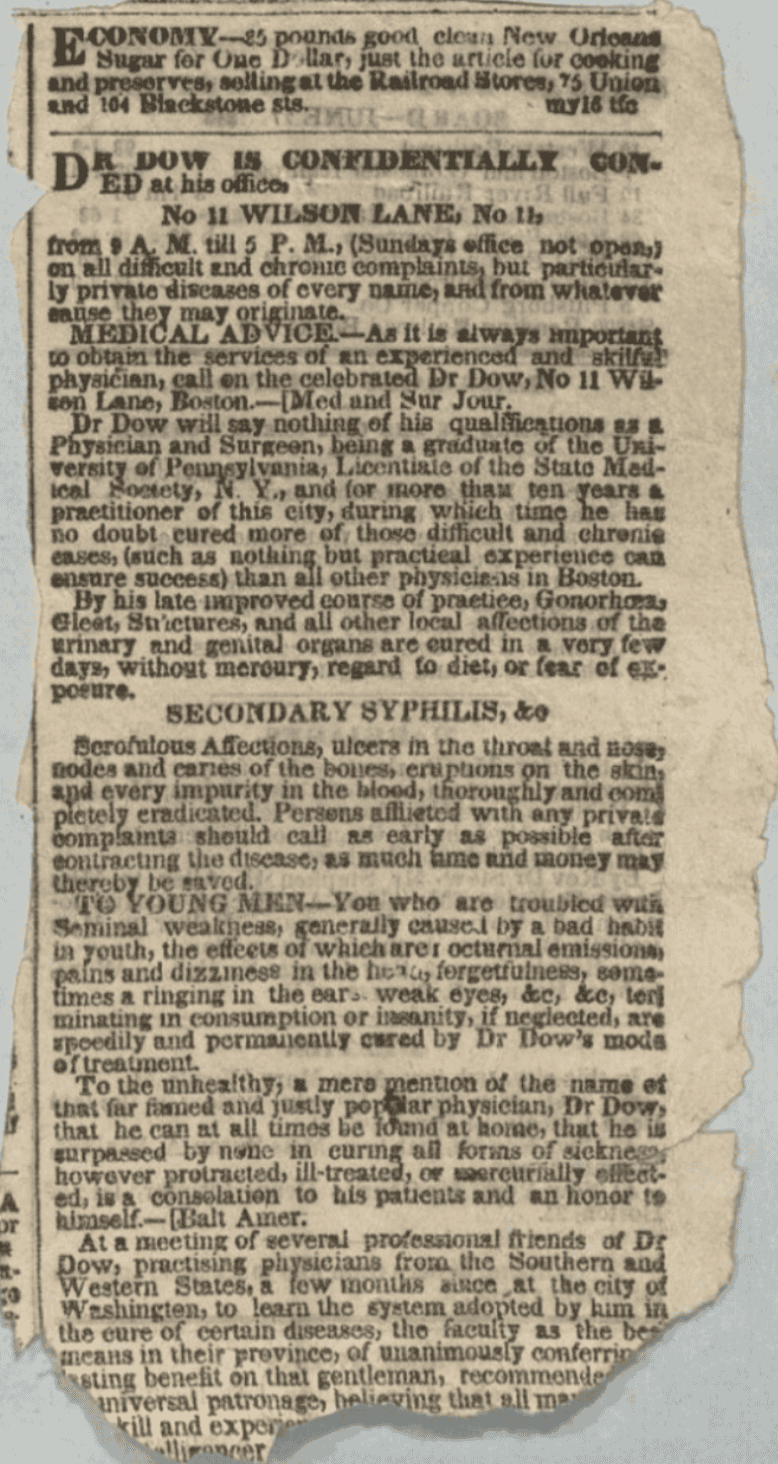
Occasionally she may make allusion to lack of food being a contributing factor, even suggesting to Henry in the same June 26 letter that a cow be sent down to the plantation to feed the nutritionally deprived children. He ignored this request, instead suggesting in his June 29 letter that the cause of illness was syphilis or gonorrhea, both sexually transmitted diseases. Henry’s response thus implies that this mass illness and death was the result of a seemingly inherent sexual deviance among Black people rather than what it was: the cruelty and violence of forced labor under fatally unhealthy conditions.
Sophia’s solution to growing illness and death on the plantation is not to reevaluate the conditions or structure of enslavement but continually to separate sick children from their mothers, who she views as negligent rather than overworked and suffering under the violence of slavery.
Patience’s Death
After the death of her son Daniel, Patience’s own condition continued to worsen until the end of July; she ultimately died the morning of July 29, 1848. Two days later, Sophia wrote a letter to Henry explaining what had happened. She said Eveline, one of the enslaved housemaids, came to wake her in the early morning to ask for more morphine to give to Patience, who was in extreme pain. Sophia wrote in her letter:
I immediately went out, found her lying quiet but breathing differently from usual, her hands and feet were cold. I asked her if she felt any pain. She said no but was chilly she said she thought if she could take a nap she would feel better she was so sleepy. She continued in that quick way, gradually sinking until a few minutes before her death, when she made one or two efforts to throw herself about, called for help and all was over.

Patience’s Conversion
Sophia went on to record Patience’s final moments and a conversation the two of them had, writing:
“Said she felt no fear of death, that she felt prepared to meet her God. So soon as I found there was no hope of her recovery. I felt it my duty to ascertain her feelings and views on the subject of religion, and give her What instructions I could. I found her very ignorant, more so than I supposed any one in this highly favored land could possibly be, even though a slave, but she seemed willing and anxious to talk on the subject and be instructed.”
Sophia wrote that Patience had “seemed never to have heard” of God, Jesus, or heaven. She also claimed that in her final moments Patience enthusiastically accepted Christianity and Jesus as her lord and savior, causing her to “die so calmly, fully sensible too that they were dying…feeling perfectly satisfied that they were prepared.”
While it is impossible to know if Sophia’s tale of Patience’s conversion was true or not, its details put its validity in question. As Henry Watson notes in previous letters, many of the enslaved people that Patience lived alongside were Christians and frequent attenders of church, making it unlikely Patience would have no knowledge of Christianity. Further, this story mimicked many social, religious, and literary conventions of the 19th century. One propagandistic trope was that white women took on a maternalistic role over the people that they enslaved. With this role would come the expectation of teaching their households (children and enslaved people) about the importance of God and religion. Frequently we see white women enslavers leaning toward the promise of heaven to soften the blow of death.
We do not know exactly what happened in the conversation between Sophia and Patience on her deathbed, but we do know that religious reasoning would have been a beneficial framework for Sophia to understand and to explain to her husband what occurred.
She went on to write that this moment of Patience’s deathbed conversion proved to illuminate the true purpose of the suffering she and the household had endured in the recent months of illness and death. She wrote:
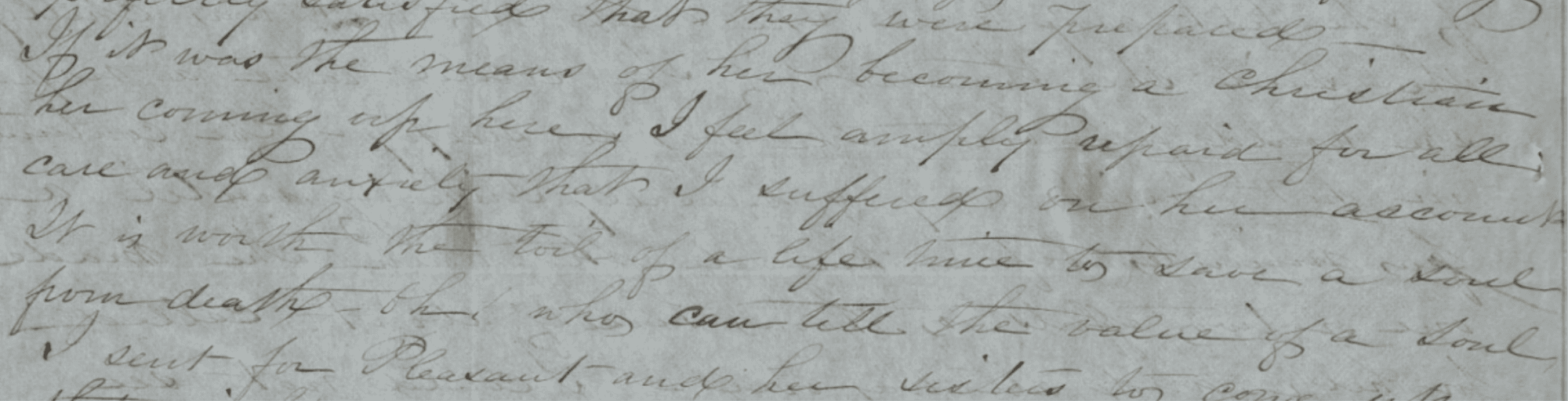
“If it was the means of her becoming a Christian her coming up here, I feel amply repaid for all care and anxiety that I suffered on her account. It is with the toil of a life time to save a soul from death. Oh! Who can tell the value of a soul.”
Sophia used Patience’s supposed deathbed conversion to provide some sort of cosmic justification for not only the illness of the many enslaved people who still surrounded her but also as repayment for her own “care and anxiety that [she] suffered on [Patience’s] account.”
After Patience’s death, Sophia sent for her husband Pleasant as well as her sisters to come up from the plantation. She notified the plantation overseer that other enslaved people were permitted to come up the following morning on Sunday. Allegedly he shared this message with the enslaved people on the plantation, “but only about a half dozen of the men and two or three of the women availed themselves of the privilege.”
A local, presumably white, man named Mr. Roberts made the coffin. According to Sophia, “It was plain but neat.” Despite only about a half a dozen enslaved people coming up to view Patience’s body and likely help prepare it for burial by cleaning and dressing it, many more members of the community attended her service at the church.
Sophia wrote that the pews were overflowing with people and that many were turned away due to lack of seats. Seventy-five people went up to say prayers. Sophia noted that “indeed the interest is confined to no class of persons, all feel the mighty influence.” Clearly Sophia’s story—of the long-borne illness ultimately resulting in a personal conversion experience before ultimately joining Christ in heaven—was especially compelling to attendees, Black and white alike.
Illness, Death, and Care
Patience’s story is a tragic one, but it reveals to us crucial and rarely recorded aspects of southern plantation enslavement. Not only does it detail the day-by-day illness and care of an enslaved woman and mother, but it also illuminates that white women were not passive bystanders in the enslavement of people. In this case, it shows the harm perpetrated by women like Sophia who had, and abused, the power to manage, or refuse, the medical care of the people they enslaved.
There is no way to know whether different treatment for Patience’s illness would have resulted in a different outcome, but what is clear is that Patience and other enslaved mothers like her had little to no influence over the care they or their sick children received. Even when Patience’s husband Pleasant begged Sophia to consult another doctor, it was ultimately neither his nor patience’s decision. This extends to Sophia’s justifications for separating other enslaved children from their parents on the plantation. She believed that her knowledge and care of the people she enslaved were superior to that of their own families, and did not allow the children’s parents to participate in that conversation.
The only enslaved people with power to influence the care Patience and the other sick enslaved people received would have been Ellen and Eveline, the two household women reporting directly to Sophia. They would likely have been the ones doing the majority of the day-to-day care Patience and her son Daniel received. They would have wiped their brows during their fevers, brought them food and water, and counseled them in Sophia’s absence. Their labor and the labor of the countless enslaved women like them was what allowed the Watson household to function in sickness and in health. And it was their labor that was erased when the Watson family moved to Northampton.