Margaret
Margaret was a young woman born in 1838 or 1839, enslaved to the Watson family and trained to be a seamstress. Some Watson correspondence suggests she was at least partially deaf.
Margaret’s Family
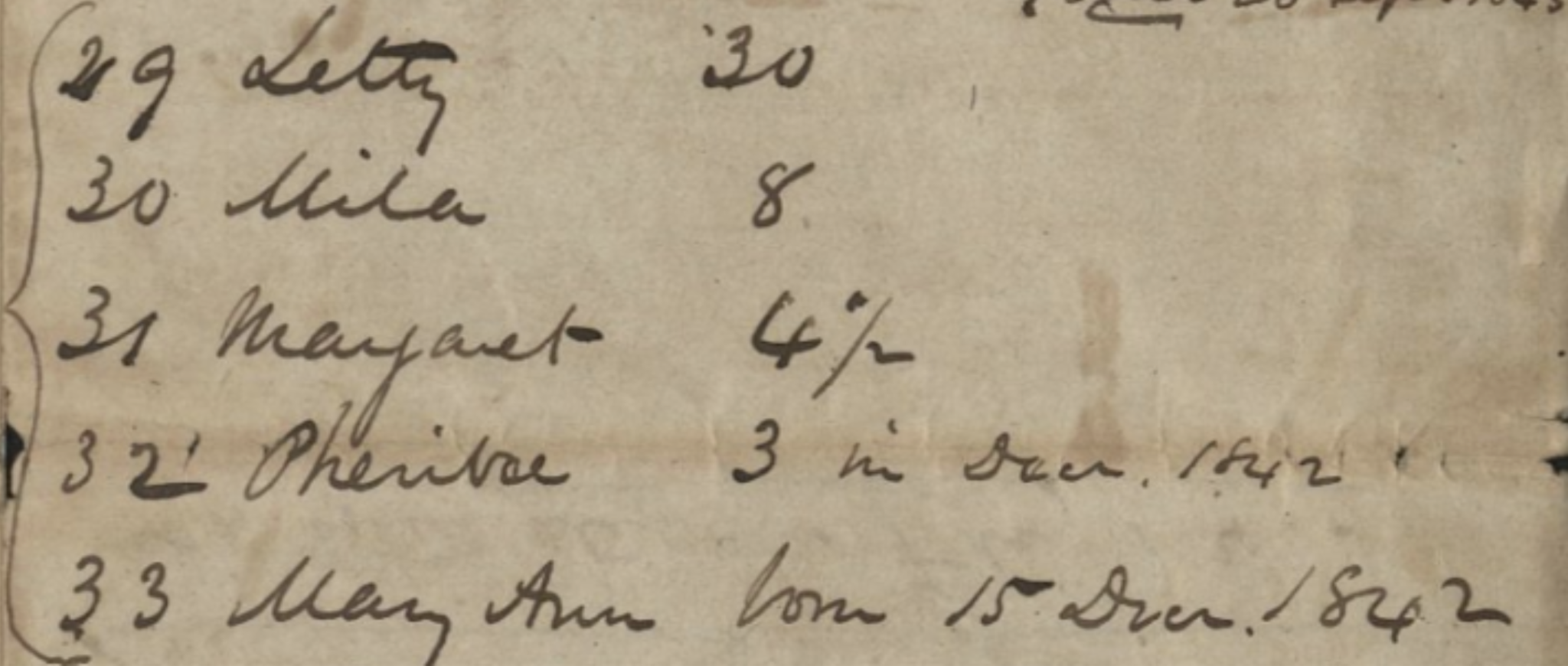
Margaret and her sisters—Mila, Phoebe, and Mary Ann—were born in the late 1830s to an enslaved mother named Letty. When Henry purchased Letty, he also purchased her accompanying children. The five of them appear together as a family in Henry Watson’s slave ledger entry of June 1843. At that time Margaret was 4½. Mila was 8. Phoebe had just turned 3 the previous December of 1842. Her sister Mary Ann had been born two weeks later on the 15th of December, 1842. The four of them grew up on the Watsons’ Newbern plantation in Alabama, where they would have accompanied their mother from a young age, picking cotton from the rich soil of Alabama’s “Blackbelt,” which enriched Henry Watson and his family.
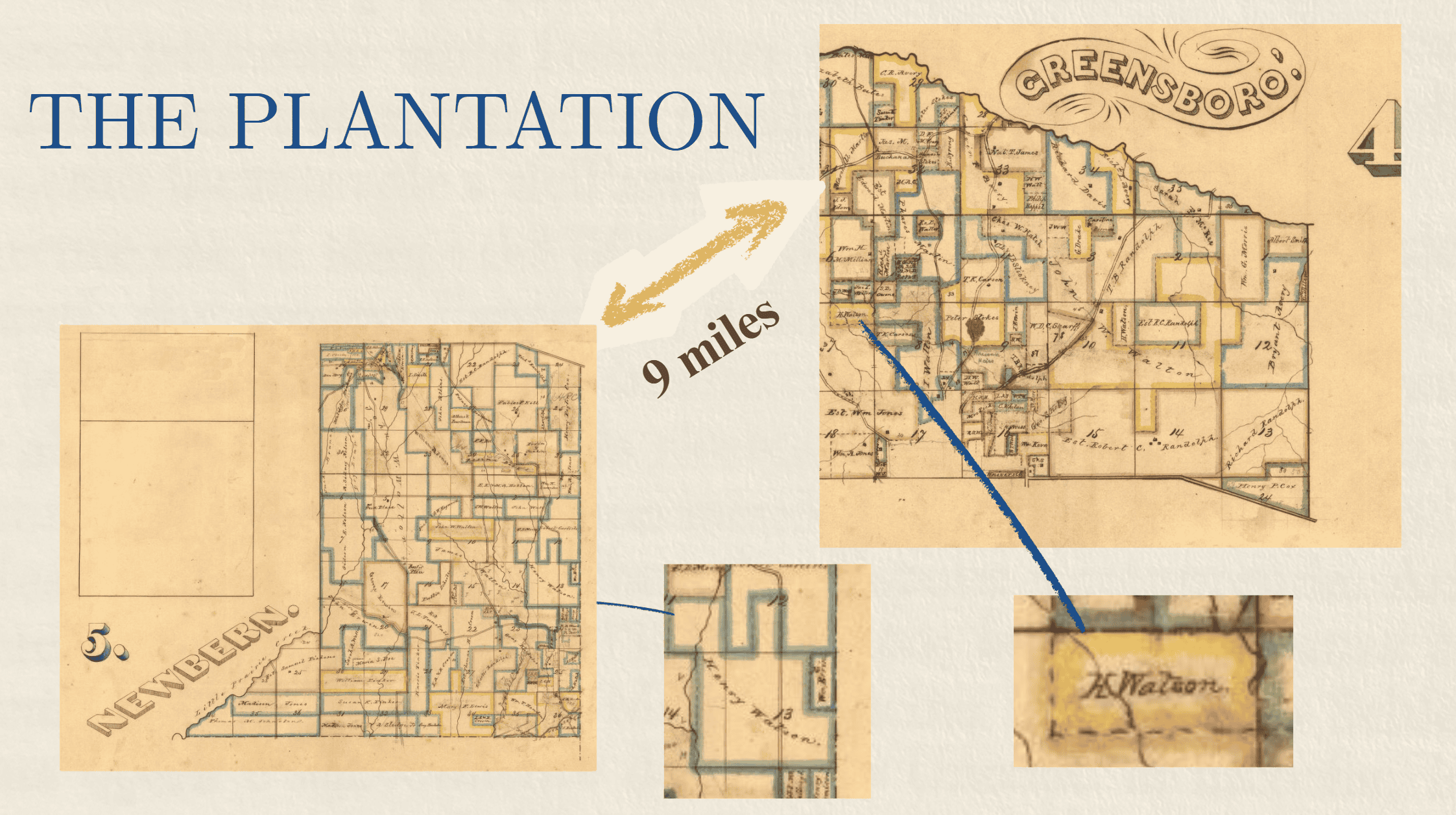
Margaret did not grow up around white people. She would have been surrounded by her family and other families of enslaved Black people in small, cramped slave quarters on the Watson’s Newbern plantation, 9 miles away from Greensboro, where the family lived in a house. She may have seen Henry Watson visit the plantation occasionally, but the main white person she would have known was Mr. Miller, the plantation’s overseer. Mr. Miller traveled back and forth between Newbern and Greensboro, informing the Watsons on the state of the plantation and occasionally bringing enslaved people with him.
Moving Away from the Plantation
When Margaret was 11, Mr. Miller took Margaret with him, separating her from her sisters and her mother. She was taken to the Greensboro house and delivered to Sophia Peck Watson to become a seamstress. This was the preferred method of training enslaved seamstresses in the Antebellum South: white mistresses of plantations would work with overseers to select specific enslaved people to train in textile production skills. Frequently this included sewing, but it could also include weaving and dyeing. Sometimes these girls would continue to perform this labor while living on the plantation with their families. Sometimes it meant being separated and living in the household, as it did for Margaret.
Margaret and Sophia
Separation from her community put Margaret in an especially vulnerable position. Sophia complained to her husband in June 1848:
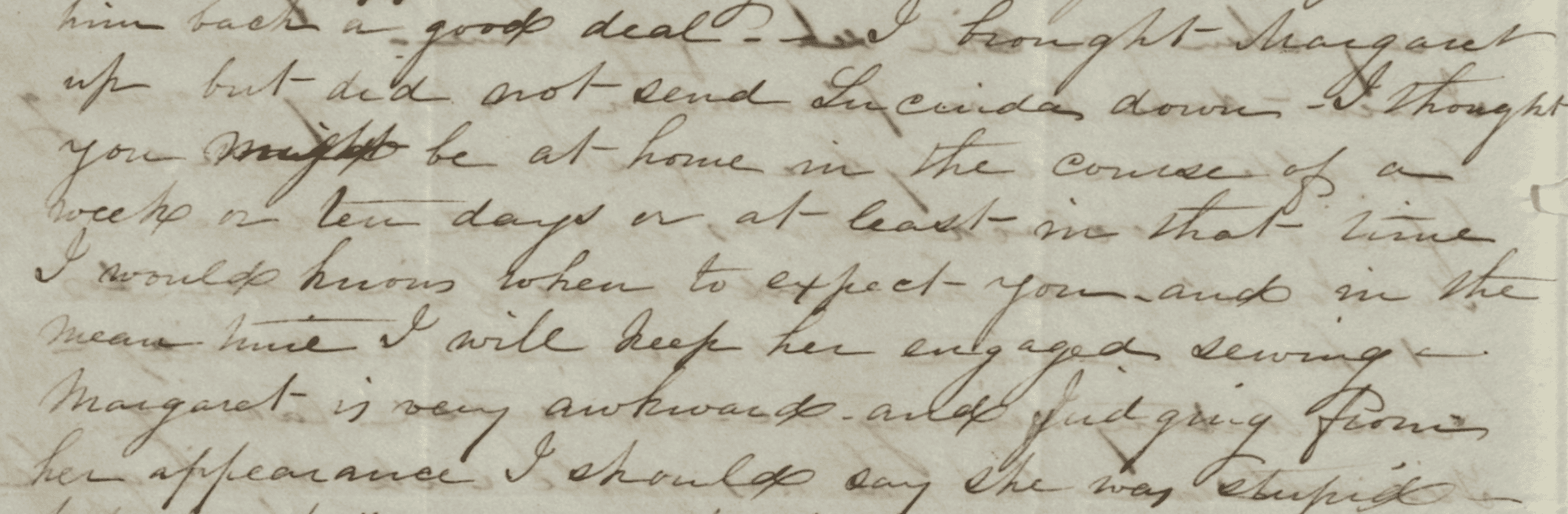
“I brought Margaret up but did not send Lucinda down … I will keep her engaged in sewing—Margaret is very awkward and judging from her appearance I should say she was stupid—but Mr. Miller says she is sprightly much more than Silvia and I hope when her plantation manners wear off she will appear to better advantage.”
Sophia’s comments about Margaret’s “stupidity” and “plantation manners” reveal the differences in how enslaved children such as Margaret would have grown up compared to enslaved children who would have been raised working in a household alongside white people. Sophia continues:
“I carried her over to Ma’s this morning with me and on looking around after I had been in the room some minutes—found she had quietly seated herself in a chaise among the rest of the family so you see she has not much fear of ‘white folks’ as they call them.”
The act of sitting down and relaxing in a chair, though possibly done unknowingly, was a hugely significant act for Margaret, a young enslaved Black girl, to take in the company of her white enslavers. By doing so, she expressed her own view of herself as a person as equally deserving of the privilege of rest and comfort as the family to whom the chair belonged.
Sophia, however, viewed Margaret’s bravery as “stupidity” and her independence as “plantation manners.” Margaret’s simple act of sitting down without the permission of her enslaver was so unusual and so upset Sophia that it warranted inclusion in Sophia’s letter to her husband. It also reveals the kind of limited inter-community socialization a young girl like Margaret likely received while growing up on the Watson plantation.
From Sewing to Nursing
After being brought up to Greensboro as a seamstress for the Watsons, Margaret was given a new job: nursing Sophia and Henry’s youngest child at the time, Julia. Margaret was still only a child herself, 11 years old, when she was made responsible for the care of an infant. She may have had experience caring for her younger sisters, Phoebe, Mary Ann, and Eliza, who was born just three years prior to Julia in 1845. But despite her age, Sophia continued to complain about her deficiencies, writing to Henry on July 7, 1848:
“I find Margaret’s apparent stupidity resulted in a great measure from her not being able to hear well, occasioned I think by a very bad cold. She has been of little service to me so far but I think she may be made a very good nurse, she is willing and obedient but very ignorant.”
Margaret could have suffered from any number of illnesses that can cause fluctuating hearing loss or even complete deafness when left untreated. We do not know when Margaret was sick, but illness among enslaved children on the Watson plantation was common and frequently went untreated, and the children were underfed.
Somehow, Margaret found a way to survive not only her potential disability but also the cruel torments of her enslavers, and continued to care for Julia for at least the next three years. She is mentioned in 1851 as “Julia’s nurse.” In 1855, at the age of 16, Margaret was married to a fellow enslaved man named Major, aged 21. It is likely at this time that Margaret was relieved of her responsibilities caring for Julia and the other Watson children. Her role had shifted from a caretaker to a producer of children.
Reproductive Labor
Reproduction was a key aspect of enslaved women’s labor on the plantation. Margaret would have known this, having seen her older sister Mila give birth to four children by this point. The same year Margaret and Major were married, she saw her sister Mila die with her seven-month-old child, LaFayette. Recent mothers on the plantation were at far greater risk of contracting illness not only from the complications associated with pregnancy but also from their own exposure to their children, whose illness and mortality rates were high. At the end of her life, Mila had lost three of her four children to childhood illness.

A year after Mila and her son LaFayette’s death, Margaret, now 18, gave birth to her own child, a boy named Henderson. Henderson would die 2½ years later in February 1859. 4 months after her son’s death, Margaret gave birth to another boy, whom she named Washington. Two years later, she would give birth to her first daughter, whom she named Mila, honoring her sister. Enslaved people frequently gave their children the names of recently deceased family members as a way to preserve their memory in the absence of gravestones or numerous material objects. Her last child was a boy named Fleming, born in 1864.
A year after the birth of Fleming, Margaret, her husband Major, and her three surviving children (Washington, Mila, and Fleming) would achieve freedom with the end of the Civil War. We do not know what happened to Margaret or her family once they began their free life.