Lucinda
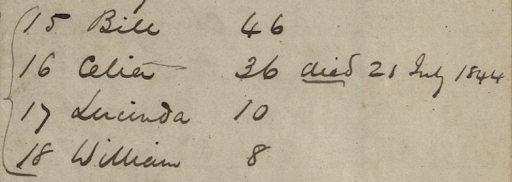
Born around 1833 to Celia and Bill, Lucinda’s name first entered the slave ledgers in 1843 when she was only 10. Her upbringing was characterized by a rapid succession of tragedies: In 1844, her mother died on July 21 shortly after giving birth to a son named Wiley, who himself passed away that fall.
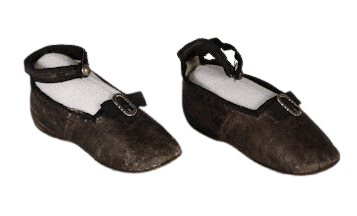
Family and Childhood
Lucinda lived within a family structure created by her enslavers. In 1845, when Lucinda was 12, her 49-year-old father, Bill, was paired with 16-year-old Sally Ann. Along with her younger biological brother, William, Lucinda saw the continuous expansion and contraction of this blended family through the births and deaths of several siblings. These included an unnamed infant who died at two months old in November 1845, a sister named Martha born in 1846, and a brother named Aaron born in 1848.
The cycle of reproductive labor continued with Lucinda herself; at the age of 16, she gave birth to her first child, Charity, on September 27, 1848. Although the identity of Charity’s father remains unknown, Lucinda is coupled with William White, a 19-year-old young man, in 1850. However, the artificial nature of enslaved families in the context of a slave society does not necessarily mean that William White was Charity’s father. Indeed, considering that Lucinda was uprooted from her family at approximately 13 years old to work as a nurse within the Watson household for Frederick, Sophia, and Henry’s firstborn, it is also possible that Charity might have been conceived through sexual violence.
Labor in the Watson Household
Lucinda was first assigned the specific role of nursing within the Watson household. On February 7, 1847, Henry informed his mother that Sophia had the help of Lucinda, “a 12 or 13-year-old girl from the plantation,” to care for their baby, Frederick. This decision to use Lucinda for nursing stemmed from the absence of white women in Greensboro who provided such labor professionally, a contrast to Henry’s experience growing up in the north. On February 7, 1847, he wrote:
“We have no women in this county who make it a business to nurse as they do with you [in Connecticut], but have to depend upon friends and relatives, or negroes.”
This implies that hiring enslaved people to nurse his future children was the absolute last resort, potentially because of the physical proximity to Blackness that it would require.
The temporary nature of Lucinda’s position was evident from its inception. In an inquiry dated January 8, 1848—a full year following Lucinda’s initial hire—Henry’s sister, Harriett, sought news regarding Frederick, pointedly asking, “Is Lucinda with you or has she gone back to the plantation?” Despite her status as a “raw hand at nursing,” Henry regularly speaks highly of her abilities, describing her as “a very good nurse” in a letter to his mother on January 30, 1848. Lucinda’s quasi-maternal influence on Frederick was significant. Sophia observed that the child was more prone to tantrums under her own care and was “much better natured” when she permitted “Lucinda to take him off” (Sophia to Henry, April 22, 1848). Lucinda’s great skills at nursing might come from mentoring by Eveline, another enslaved woman who performed domestic labor within the Watson household, since the latter also took care of both Sophia and Frederick (Sophia to Henry, May 13, 1848).
Pregnancy and Shame
Despite Lucinda’s great skills at nursing, conversations about replacing her quickly arose. Sophia’s correspondence to Henry from June 15, 1848, reveals initial discussions about replacing Lucinda, noting that she had “brought Margaret up but did not bring Lucinda down [back to the plantation].” This tension escalated throughout the summer of 1848 as Sophia expressed persistent unease regarding Lucinda’s presence in the household. Henry mirrored this sentiment in June 25, 1848, expressing a cryptic sense of being “ashamed of Lucinda,” and vocalizing his desire for her prompt removal.
Several factors might have contributed to this atmosphere of anxiety. At the time, Frederick was suffering from a severe illness that was likely brought up from the plantation, as enslaved people such as Patience and Daniel shared similar symptoms. It is plausible that Sophia and Henry, seeing no improvement in Frederick’s condition, began to suspect that Lucinda’s care, or lack thereof, influenced his health negatively.

Another possibility involves Lucinda’s pregnancy. She gave birth to Charity in September 1848, meaning she likely began to show by May or June. As a young, unmarried adolescent, her pregnancy could have been viewed as a risk to the Watsons’ reputation, potentially causing the “shame” Henry referenced. Maintaining an orderly image as enslavers was paramount, and a visible pregnancy of a young unmarried enslaved girl within the household would have contradicted the social standing they wished to project. The increasing frequency of Sophia’s letters on the matter of her “anxiety” suggests that as Lucinda’s pregnancy became more apparent, so did the urgency to remove her from public view, i.e., the Watson household.
Life Back on the Plantation
Attempts to return Lucinda to the plantation were initially delayed. On July 20, 1848, Sophia wrote, “Bill [Lucinda’s father] came up for her, but said the roads were very bad, and she had had a fall of which she was complaining a little, and fearing it might inquire her in some way. I told him to come up early next week again.” Sophia remained “very anxious to get rid of her,” even noting that the overseer, Mr. Miller, intended to put her to work sewing to assist Peggy on the plantation. Lucinda was eventually sent back in August 1848, thus enabling the Watsons to protect their reputation from public scrutiny.
However, even after the transfer, Sophia’s preoccupation with Lucinda continued—a departure from her usual lack of interest in enslaved people sent back to the plantation. In a letter from August 7, 1848, Sophia writes once more:
“I am anxious to see how Lucinda is doing her work. I know she can sew well, if she will, but you know she is a complete eye servant, and to induce her to take pains.”
Here, Sophia implies that Lucinda is a skilled seamstress, but such skills required constant supervision for her to remain diligent. This unusual level of follow-up further indicates that Sophia’s concern may have been rooted less in Lucinda’s productivity as a seamstress and more in the social implications of her pregnancy as a young, unmarried girl.
After this obscure chapter, the historical record regarding Lucinda primarily documents the cycle of tragedy she continued to endure. According to the slave ledgers, Lucinda welcomed a son, Edward, on November 30, 1850, though he unfortunately died on June 7, 1852. A subsequent son, Thomas, was born on February 16, 1853, but passed away on August 2, 1854. Lucinda’s losses reflect the devastating mortality rates for children born into slavery.
Despite these hardships, several of Lucinda’s children survived the arduous plantation environment. She gave birth to her third son, Enock, on January 12, 1855, followed by her second daughter, Nelly, on February 4, 1858. Elisha was born on March 20, 1860, and another daughter, Ellen, arrived in 1862. Lucinda likely named her third daughter after Ellen, her mentor and potential maternal figure in the Watson household, given that Lucinda’s mother Celia passed away when she was still very young. This commemorative practice was very common at the time, especially on plantations, since enslaved people had limited access to material objects being passed down from generations. Her final child of record, Henry, was born in 1864.
Ultimately, Lucinda and her family witnessed their emancipation a year later in 1865, likely remaining in the region as sharecroppers in the years that followed.