Eveline
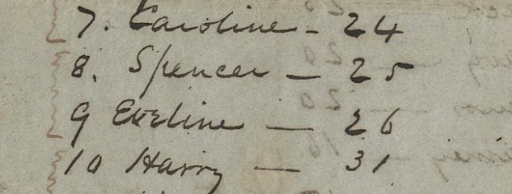
Born around 1820 during the early settlement of Greensboro, Eveline first appears in the slave ledgers in 1843 when she is 23 years old.
Life in the Watson Household
Throughout these records, she is consistently coupled with Spencer, another enslaved man on the Watson plantation who sporadically appears in the Watsons’ letters. Given the domestic nature of their labor—Spencer as a gardener and Eveline as a maid—it is not surprising that the couple lived in close proximity to the Watson household. They would have either lived together in the “negro cabin” on the Greensboro estate or separately—Eveline in the attic of the house and Spencer further away in the cabin.
Although Eveline and Spencer had been paired from the outset, presumably to have children together, however, no pregnancies or births were ever recorded for Eveline. This absence suggests possible fertility challenges or limited opportunity for an intimate relationship.
Learning Together
Eveline and Ellen are frequently likened to one another in the Watsons’ letters, appearing almost as two sides of the same coin. This comparison stems largely from their parallel life trajectories. Both were most likely originally enslaved by the Peck family before being transferred to Henry Watson as part of Sophia’s dowry in 1845. This is evidenced by a letter from December 21, 1846, a few months after the death of Sophia’s father, Frederick. In it, Henry updates his mother about what Mrs. Eliza Peck wants to keep from Frederick’s will: “Mrs. Peck retains Ellen, Susan, Archer and a woman named Eveline and some small children” (Henry to his mother, December 21, 1846).
Despite these similarities, their early lives differed. While Ellen was a young girl when first enslaved, Eveline was less than a year old when she was enslaved. Given that Sophia was born only a year after Eveline, it is highly probable that Eveline was intended as a birthday gift for her—a practice occasionally seen on Southern plantations—or as a potential playmate and, later, ladies’ maid.
The age gap between Eveline and Ellen suggests that Ellen potentially served as a mentor, passing down her domestic expertise to the younger woman. Consequently, both women gained a reputation for their proficiency in household labor. Their parallel journeys can be evidenced by Sophia’s letter from October 1, 1845, in which she writes that she was “resolv[ed] to make Ellen and Eveline quite as industrious as intended to be”— hinting at the fact that they were trained in similar environments, that is, the Peck household. Sophia additionally praises them as she highlights their reliability in a letter to her mother on October 18, 1846, in which she noted, “Ellen and Eveline give us no trouble, they both behave well.” As a result, Eveline and Ellen would often perform comparable duties, such as cutting fabric for clothing when the family established their Greensboro residence in October 1845. Furthermore, both women were tasked with nursing responsibilities, providing care for the Watson children as well as for enslaved individuals who had fallen ill.
Eveline’s Domestic Labor
Correspondence suggests that while both women provided similar domestic labor, Eveline was entrusted with those closest to the Watson family, such as their first-born son, Frederick. Henry, writing to his mother on November 7, 1847, commended Eveline for being “uniformly kind and devoted to [Frederick],” noting that she knew “a great deal about nursing both children and sick people.” However, Ellen’s skills in nursing were contrastingly treated as a racial anomaly. Sophia remarked in a letter to Henry on July 20, 1848, that:
“She deserves credit for her care of [sick children], but few mothers would have been as kind—I mean among the negroes.”
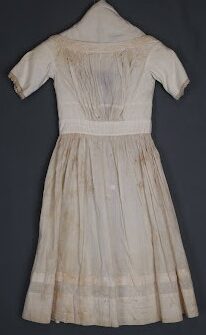
In her role as a nurse for the Watson children, Eveline would have regularly handled garments like the plain white cotton dress pictured above while helping them to get dressed. Enslaved women were frequently tasked with dressing children for daily activities such as schooling, outdoor play, or neighborhood visits. Evidence from the stitching on the bodice suggests that this particular item was altered from an older dress, which was likely worn originally by Henry’s sister, Harriet Watson (born 1833). This new stitching indicates that the bodice was remade to fit one of the Watson children and that an enslaved woman like Eveline would have been responsible for this refashioning of the garment.
Additionally, while Ellen and Eveline both provided care for Patience, another enslaved woman on the plantation, during her several-month illness in 1848, it was Eveline who mostly took care of Patience. As Sophia writes to Henry on June 22, 1848, “Eveline takes charge of Patience, and she too requires a good deal of attention now. She rarely leaves the room or her bed.” Eveline was the one who remained by Patience’s side until her death that July. It was also Eveline who personally informed Sophia of Patience’s soon-to-come passing:
“I almost say without a struggle Eveline who sat up with her the night before came to me early in the morning for some morphine saying she was suffering considerably and had rested badly during the night. Not long after she came again saying she thought death was on her.”
Sophia to Henry, July 31, 1848
While caregiving duties for the ill were typically expected of enslaved women, providing care for Patience and her child, Edie, may have held a more profound and personal significance for Eveline as they shared a similar experience of enslavement.
Eveline’s Relationship with her Enslavers
The deep-seated trust placed in Eveline likely originated from her longstanding and complex connection with Sophia, beginning with the strong possibility that she was presented as a gift to Sophia at the time of her birth. Academic research into Southern plantation life frequently documents such pseudo-familial ties between the children of enslavers and those they enslaved, and Eveline’s experience serves as a clear illustration of these broader power structures.
Sophia and Eveline’s shared childhood development almost certainly cemented the intricate relationship they maintained. For instance, Sophia relied specifically on Eveline for protection during her first night alone while Henry was away on business. Sophia initially asked Jacob, an enslaved man married to Peggy, to protect her. After he refused, Sophia was offered another solution: “on Eveline’s proposing to take his place I let her do so, and returned home [after spending the day at Father’s]” (Sophia to Henry, October 3, 1845). Eveline’s special treatment is expanded to Henry, as evidenced by his letter from May 21, 1848, in which he explicitly instructed Sophia to ensure she did “not let Eveline suffer,” demonstrating a level of concern and specialized care that he notably withheld from Patience, who was battling illness during the same period.
Furthermore, unlike Ellen, Eveline cultivated a more unobtrusive relationship with her enslavers, which, once again, can be attributed to her upbringing in the Peck household alongside Sophia. While it took effort on Ellen’s side to act according to expectations for enslaved people—as noted by Sophia, who wrote on June 24, 1846, that “even Ellen seemed to make an unusual exertion to please”—Eveline was often praised for her consistent obedience. Often, within the same letter, Eveline was highly complimented while Ellen was reproached for her rebelliousness. In the same letter that Eveline was complimented as “uniformly kind,” Henry writes, “[she] continues to try my patience,” and admits that he is “determined to get [a cook] the first opportunity and dispose of her [Ellen]” (Henry to his mother, November 7, 1847).
End of Life
Eveline passed away at the age of 31 on December 11, 1850. While the specific cause of her death was never officially documented, the final letters mentioning her in 1848 and 1849 frequently noted her declining health. Given that Eveline was responsible for nursing many ill enslaved individuals, including Patience, it is highly probable that she contracted a fatal illness while providing care. Despite her longstanding proximity and service to the Watson family, there is a notable absence of any recorded funeral for her—a stark contrast to the ceremony documented for Patience upon her death in 1848.