Ellen
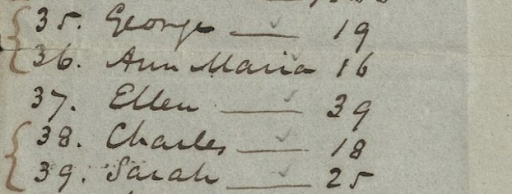
Born in 1807, Ellen first appears in Henry Watson’s records in 1843. Although Ellen was enslaved until her freedom in 1865, the bulk of what we know about her comes from letters written between 1843 and 1848.
The Peck Family
A letter from December 21, 1846, hints at the fact that Ellen was first enslaved not by the Watsons but by Sophia’s family, the Pecks, who were some of the first settlers in Greensboro, Alabama. Indeed, the letter explains that Mrs. Peck wants to sell Mr. Peck’s plantation after his death that same year, but that she still wants to retain ownership of a few enslaved people:
“The plantation was Mr. Peck’s we have concluded to break up. On tomorrow the land will be rented at auctions and the corn, (?), etc. sold, the negroes have already been divided.”
Role in the Watson Household
It is very likely that Ellen learned her cooking skills during her first few decades enslaved in the Peck household. This letter also suggests that Henry Watson inherited Ellen as part of Sophia’s dowry. Considering that the Watson and Peck families only lived a few blocks away from each other in downtown Greensboro, Ellen probably did a lot of back and forth between the two houses at the time. In March 1845, right after the Watsons purchased their Greensboro house, Henry writes that Mrs. Peck brought one of her servants with her to help lay down the carpet (Henry to his mother, March 23, 1845). Although there is no clear correlation, we can assume that the servant Henry mentioned might have been Ellen, who was one of the first enslaved domestic servants in the house.
Unlike many other enslaved women on the Watson plantation who had families of their own, Ellen stands out because she is listed as being without children. During slavery, when enslaved women’s role was first and foremost reproductive, being an older woman meant having roles besides breeding. However, surprisingly, from 1849 onwards, Ellen is marked as the maternal figure of an “assembled family” composed of Pleasant (24), Elizabeth (3½), Anthony (19), William White (18), Caroline (19), Lucy (18), and Henry (24). This peculiar familial structure ebbed and flowed depending on the new pairs that Henry Watson would put together. For example, Henry and Lucy Ann were paired as a new couple with reproductive duties in 1850, giving birth a year later to Treasure.
Ellen cooked for the Watson household. Henry describes her as someone “who could milk, make good bread and good coffee” (Henry to his mother, November 7, 1847). Ellen even made some bread in 1851 that Henry presented at the Alabama Agricultural Fair to win a prize (Henry to his mother, November 29, 1851).
Enslaved people providing domestic labor for their enslavers usually lived within the household or in close proximity to it. In Ellen’s case, because of her position as cook and the way the Greensboro estate was set up, she most likely lived in the two-story outbuilding that housed the kitchen and had servants’ rooms right above.
Such architectural structures were extremely common in Alabama: kitchens would be separated from the main house, but still attached. Henry Watson continued that tradition and wrote to his mother:
“The kitchens you know are all detached from the homes to avoid the noise, smell and filth of the negroes as well as the flies and smell of cooking which in this hot climate are not apecable. Ours is of brick, a story and a half high. Below is the room for cooking and the room for washing. Above is a store room and above a servant’s sleeping room.”
Letter from Henry to his mother, March 23, 1845.
It remains unclear where Ellen lived once she was not as frequently mentioned in the letters and once Henry later relied on other enslaved women such as Phillis to cook for the family.
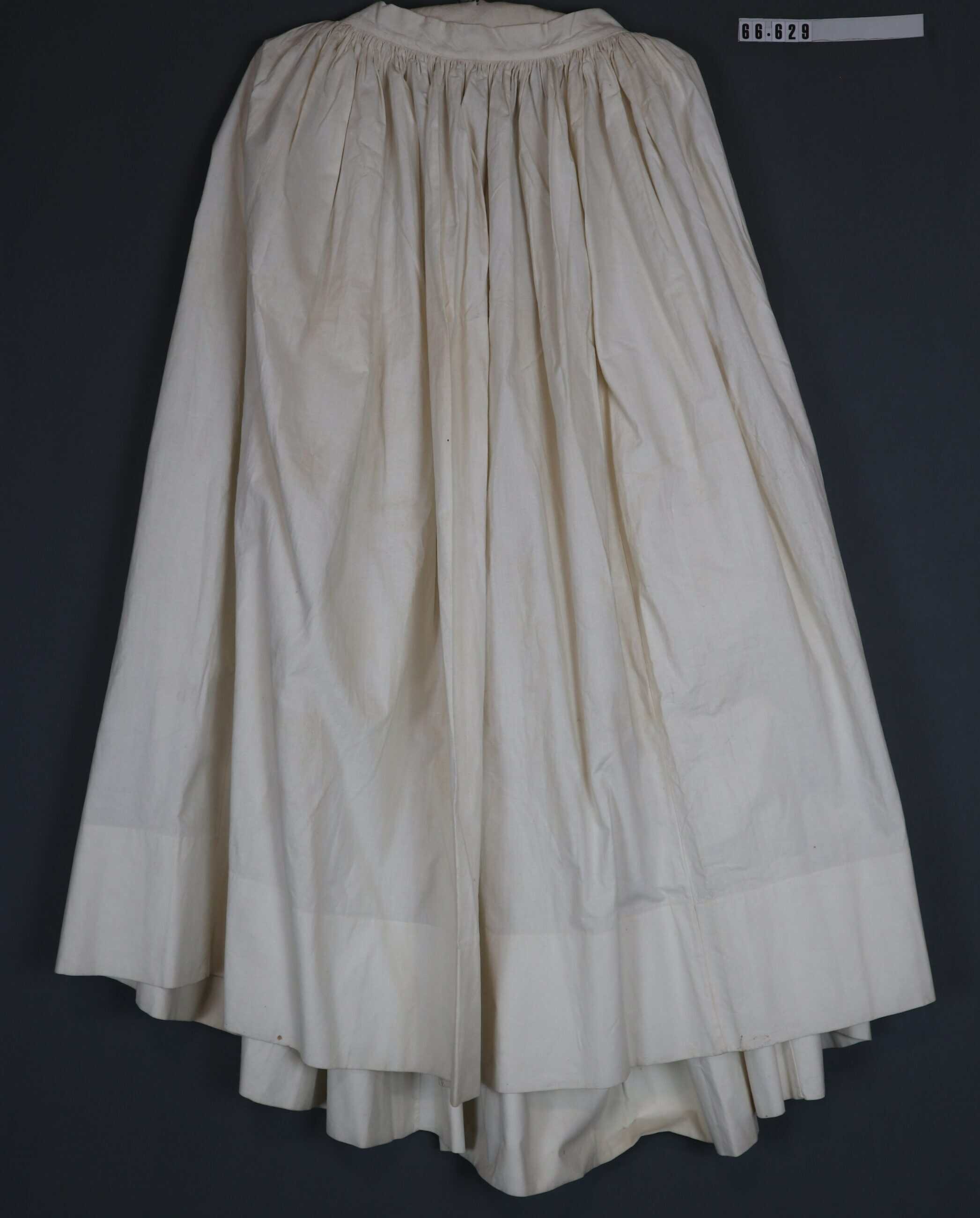
Besides cooking, Ellen was also in charge of other tasks like cutting out clothes and nursing sick people, both in the Watson household (Sophia to Henry, May 30, 1848) and on the plantation (Sophia to Henry, June 22, 1848). As Ellen was not trained to be a seamstress, the type of textile labor she was given is referred to as “coarse sewing,” or the making of household items that require more basic sewing skills. This includes towels, sheets, curtains, or undergarments such as underskirts.
The underskirt pictured at the top of this page, from c. 1840-1860, which is part of the Historic Northampton collection, is the type of item Ellen would have been sewing. It is made of heavy, plain cotton.
We also know that Phillis, another enslaved woman purchased by Henry Watson in 1850, became the family’s main cook in the 1860s, when Sereno Watson was in charge of the plantation. Thus, we don’t know what Ellen’s role in the household was once she was no longer the assigned cook.
Ellen’s Resistance
Ellen’s special status, as being enslaved first by Mrs. Eliza Peck and then by Henry Watson, may have created conflict within the Watson household as she continuously challenged Henry’s authority. In a letter from November 7, 1847, Henry Watson complains:
“Ellen continues to try my patience. It is very difficult to get a negro who understands good cooking. If they do tend to one, they have some bad habits and bad temper and are not fit to be about.”
While Henry Watson acknowledges her great skills at cooking, he also emphasizes her “bad temper,” suggesting that she would not follow every order and instruction she was given.
Ellen’s resistance to authority within the system of slavery is also evidenced by the fact that “she ha[d] been turned out of the church.” (Henry Watson to his mother, October 18, 1846) This outcome might have originated from two elements: first, she might have challenged some of the sermons of the Baptist church that the enslaved people in the Watson household were allowed to attend. Second, she seems to have enjoyed a certain spatial mobility despite her enslaver’s orders against it. Indeed, after this incident of Ellen being turned out, Henry Watson vetoed enslaved people going to church and set up a system of obtaining leaves.
In a letter from October 18, 1846, Henry also suspected Ellen of freeing his pigeons since she works on the Watson estate with other livestock, including cows:
“Our ‘doves’ dwindled down to three or four. I suspected Ellen of having taken them and took the key to the cote. Since then, they have increased to 18, but as we also fed them and they stay at home and increase rapidly at times.”
Whether or not Ellen actually freed those pigeons is unknown; however, the very fact that Henry suspects it to be one of Ellen’s schemes hints at not only their complicated relationship, but also how Ellen explored every possibility of unsettling the household.
We do know that Ellen lived to see freedom in 1865, but the record of her life is lost after that.