Sylvia Church
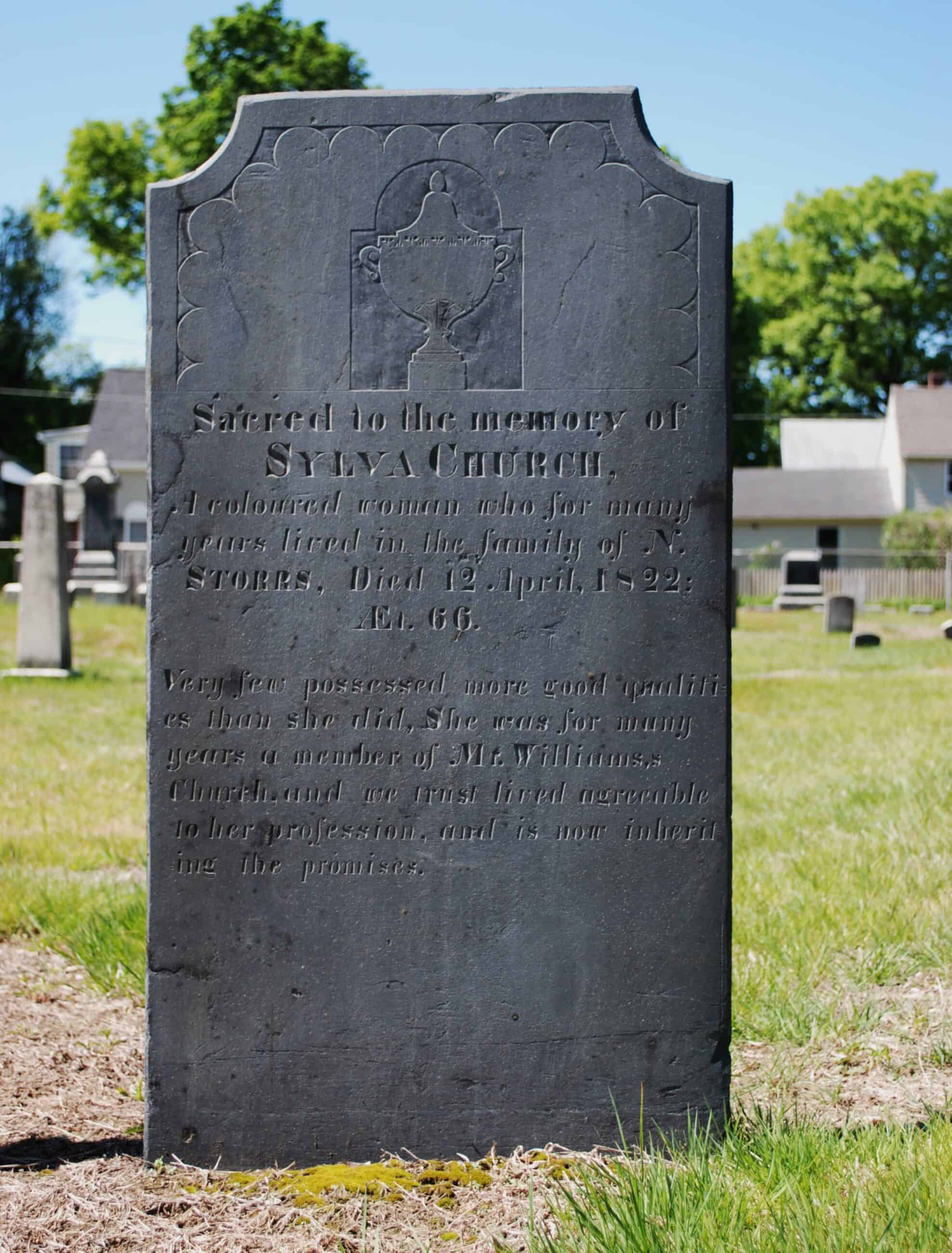
Sylvia Church was enslaved in Northampton to the Dwight family, but the dates are uncertain. After gaining freedom, at least by 1783, she remained in Northampton in the employment of the Dwight family. She died in 1822.
Sylvia Church was born around 1756. We do not know the exact date, where she was born, or where her family was from. We do know that by the time she was 20 years old, she was enslaved by the Dwight family in Northampton.
One account states that Sylvia Church was sold on Long Island when she was just nine years old. If she came to the Dwights at that point, she would have been put to work in a house with seven children (ages one to 13), with a new child added every two years over the next decade. The Dwights’ third child would have been almost exactly the same age as Church.
Timothy Dwight was a merchant and judge. He and his wife Mary had 13 children before he left Northampton for Mississippi on business and died there in 1777. He left behind the legacy of his political beliefs (he was a loyalist during the American Revolution, and the town did not let him forget it), his wife, his children, and Sylvia Church.
We have little information about what Church’s day-to-day life with the Dwights was like, but we can get a sense of the atmosphere of the house by looking at the woman who ruled it: Mary Dwight. Dwight was a strong-willed woman and the daughter of famous theologian Jonathan Edwards.
Some of the most vivid stories about her come from the recollections of the two Tappan brothers, who grew up near the Dwight house. Lewis Tappan remembered that she had a “piercing voice,” gave strict orders, and saw that they were obeyed. His brother John remembered that once, when he was crying in the night, Dwight marched over to his house, pulled him out of his crib, and presented him to his mother, asking, “What in the world is the matter with this child?” Both recalled her anger and her moods—which could change in a moment—but they did so from a safe distance, a luxury Sylvia Church would not have had.
“‘Lil’ as she was called . . . was pious, faithful, industrious and economical … She ruled the children of the house and indeed the whole street. She was in fact a strong- minded woman.”
Benjamin Dwight, The history of the descendants of John Dwight, of Dedham, Mass., p. 139.
The Tappans did not write just about Dwight; they also wrote about Sylvia Church. Lewis Tappan recalled that he and the other neighborhood children would be scolded regularly by Dwight, but that whenever she scared them, they could run to Church and she would throw an apron over them or let them sit in a closet, hiding them until they stopped being scared. John Tappan remembered Church by one of her nicknames, Lilly (she was also called Lil), and similarly recalled her playing a big role in the lives of all the children who lived near the Dwight house. John wrote that both Church and Dwight “fascinate[d] my young heart.”
It is hard to know how Sylvia Church would have retold Lewis’ story of kindness to the neighborhood children. Was she interested in subverting Dwight? Was it a conditioned response after years of forced childcare? Was it simply in her nature to comfort a scared child? Sylvia Church’s life is surrounded by this type of question because there is so little documentation of her time in Northampton. And sometimes what documentation there is provides more questions than answers, such as whether Church ever gave birth to a child of her own.
Her gravestone reads:

Sacred to the memory of
SYLVA CHURCH.
A coloured woman who for many
years lived in the family of N.
STORRS, Died 12 April, 1822:
Age 66.

Very few possessed more good qualiti-
es than she did, She was for many
years a member of Mr. Williams's
Church, and we trust lived agreeable
to her profession, and now inherit-
ing the promises.
In 1798, the records of Northampton’s First Church list a “dead birth [born to] a negro…named Sylvia.” At this point, there were at least two women of color named Sylvia living in Northampton. There was a 15-year-old and Sylvia Church, who would have been 42 (the same age as Mary Dwight when she gave birth to her last child). We do not know which Sylvia was the mother, and we will probably never know what that loss would have meant on a personal level to the woman who experienced it.
There is one date of huge import for Sylvia Church that so far remains absent from the record: when she gained her freedom. We know that she would have been freed when slavery was abolished in Massachusetts, in 1783, if she hadn’t been freed earlier. After she was free, she joined the church and lived with the family of Nathan Storrs, though in what capacity has not been established.
Sylvia Church died in 1822, and she is one of a few people of color born in the 1700s to be buried in Bridge Street Cemetery. She is buried next to another woman of color, Sarah Gray. Through the evidence highlighted here, we can catch glimpses of Church’s life, but all that is currently known about Sarah Gray is what is printed on her headstone: her race, age, and date of death. Church’s headstone provides one last hint at a life largely obscured in the historical record by the same societal forces that enslaved her. It reads, “Very few possessed more good qualities than she did.”
See here to learn more about the enslaved people who lived and labored in Northampton.