The New Haven – Northampton Canal
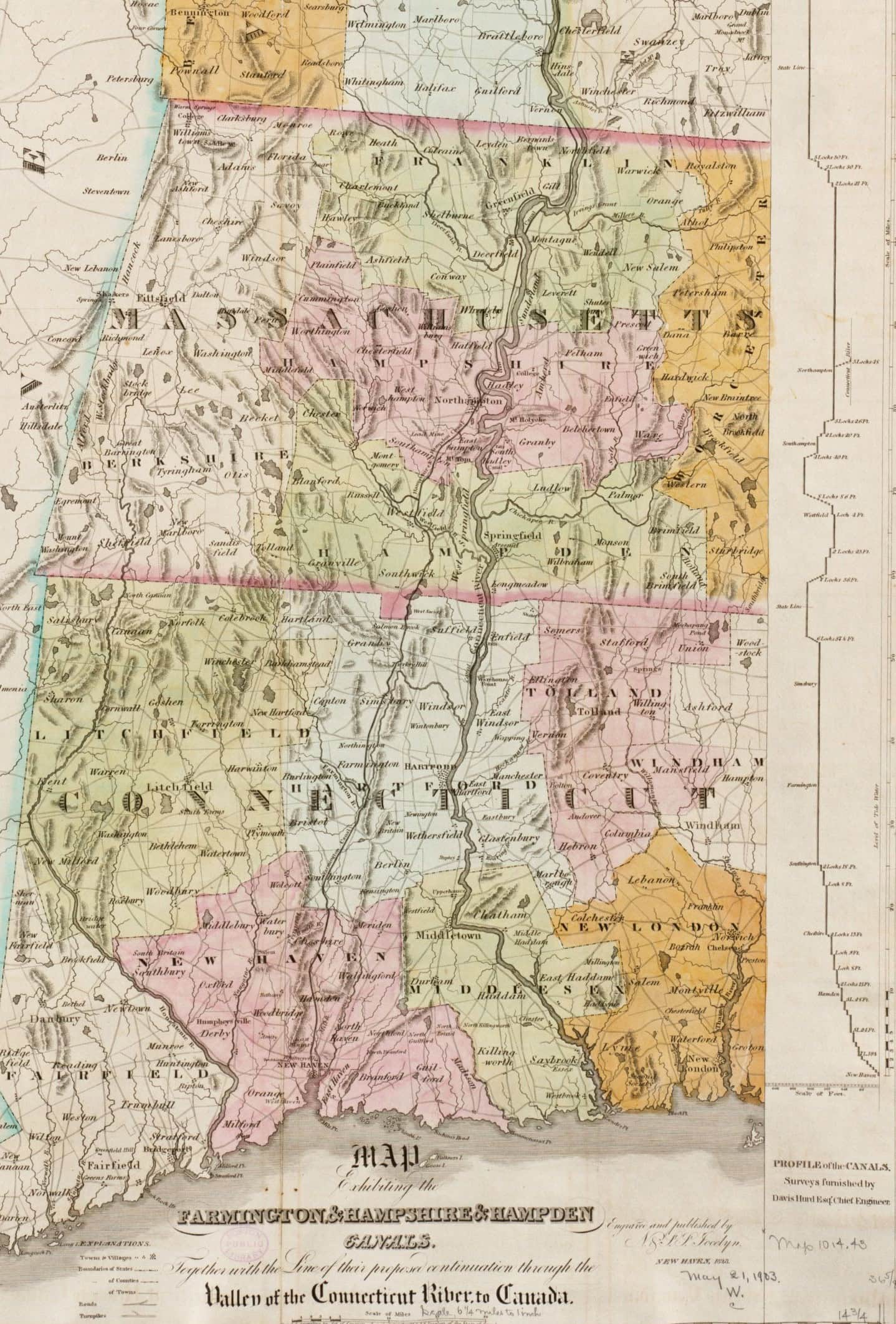
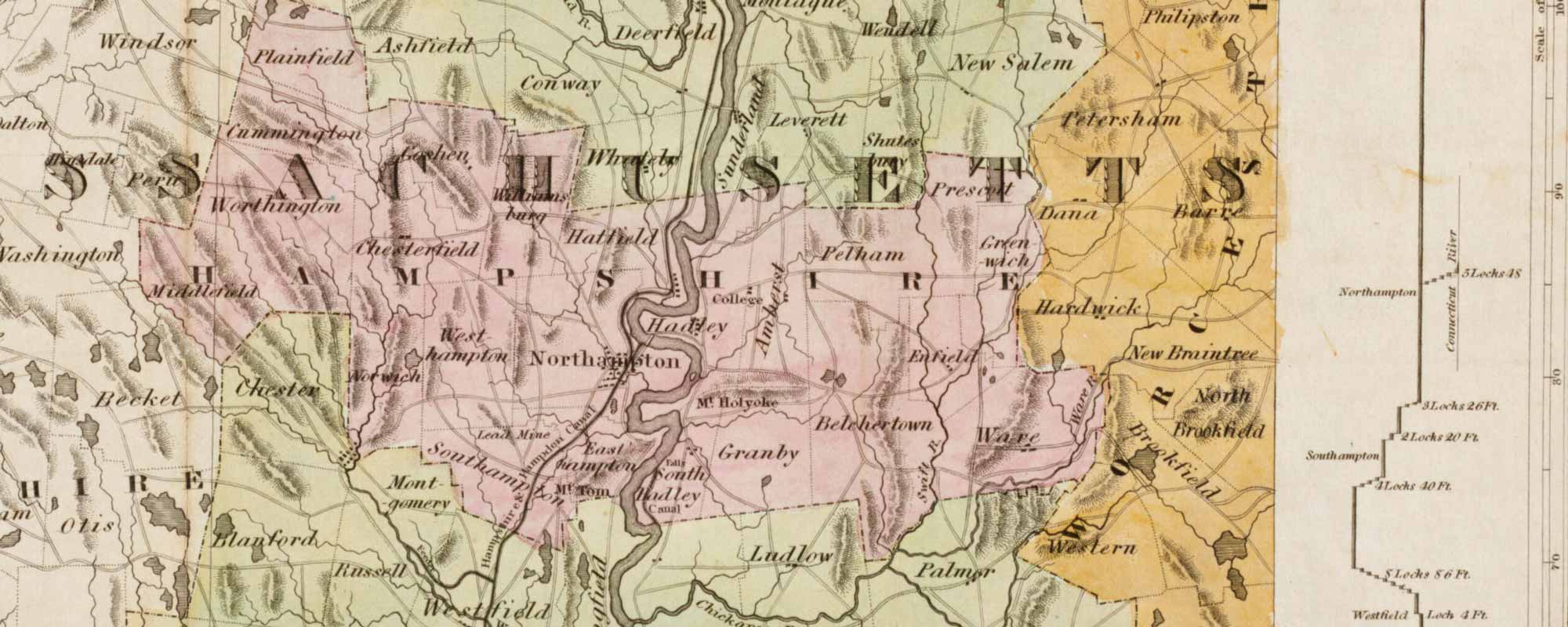
Detail of Connecticut and Massachusetts section of an 1828 map showing the canal. Map exhibiting the Farmington & Hampshire & Hampden canals: together with the line of their proposed continuation through the Valley of the Connecticut River to Canada. New Haven, Conn: N. & S.S. Jocelyn, 1828. Norman Leventhal Map Center, Boston Public Library call no.: G3722.C62 1828.J6.
Introduction
From 1835 to 1847, a canal operated from New Haven to Northampton entering downtown Northampton along South Street and State Street, then known as Canal Street. Remnants of the canal still remain in many locations along the canal route. For Carl Water, curiosity about canal stones near his Connecticut home led him on a 30-year journey to collect as many surviving historical sources about the canal as he could find. Building on the work of Charles Rufus Harte, Carl Walter visited every town the canal affected, compiled a digital archive of materials, and created fold-out canal maps. He probably has studied the canal for more years than the actual canal was in operation.
Rival Cities: Hartford & New Haven
In 1820, overland transportation was arduous and expensive. At that time Connecticut had two rival capital cities: Hartford and New Haven. Each had access to oceangoing transportation, but Hartford also had access to inland commerce on the Connecticut River. In the early 1820s, New Haven’s leaders decided to counter that advantage by financing and building a canal to Northampton on the Connecticut River north of Hartford. It was expected that this enormous project would divert inland commerce away from the river and direct it to New Haven. The Hampshire & Hampden Canal was the Massachusetts section of this project.
Northampton Agrees to the Canal
Northampton, as a river town with more than a century’s commercial experience on the Connecticut River, had less need for the canal than New Haven, but clearly welcomed additional business. Local proponents of the canal included Jonathan H. Lyman, Eliphalet Williams, Capt. Isaac Damon, and Judge Samuel Hinckley. The Hampshire and Hampden Canal Company contracted with Northampton resident Thomas Shepherd to build the canal in Hampshire County. Construction in Northampton began in 1826, and with the exception of an aqueduct and a flight of locks to the Connecticut River, was largely complete by the end of the following year.
The Canal was commenced in this town on Monday, and the work, we are told, will be prosecuted in favorable situations through the greater part of the winter.
Hampshire Gazette, November 29, 1826
40 YOKE OF OXEN, with SCRAPERS are wanted to work on the Canal in Northampton. Good wages given.
Punderson & Atwater. Hampshire Gazette, September 26, 1827
“Canal. – Messrs, Punderson & Atwater, of New-Haven, have agreed with the contractor, to construct the canal through this village from the south end of South-street to Slough Hill, a distance of about 2 1-2 miles – the work to be completed by the first of December next.”
Northampton Gaz. Connecticut Herald, December 19, 1826
Bankrupt Contractors & Lack of Water
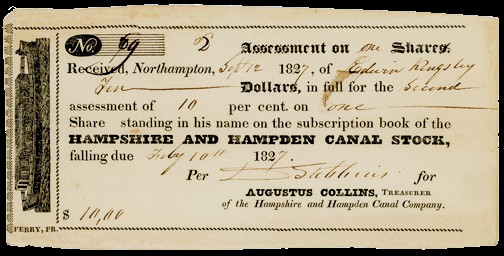
In 1829 bankruptcy of both of the canal company’s contractors left much of the canal unfinished north of Westfield. Construction would not resume until 1832 after promoters of the Farmington Canal arranged for New Haven to finance completion of the canal in Massachusetts. The project was finally completed in 1834, but an inadequate supply of water delayed operation of the canal north of Westfield for another year.
The Canal, – The water of Westfield river say the Hampshire Gazette, moves this way very slowly. The river is low, and much of the water that enters the canal runs through the sand on the plains. It will take some time to obviate this difficulty.
Connecticut Herald, October 21, 1834
Opening the Canal in Northampton
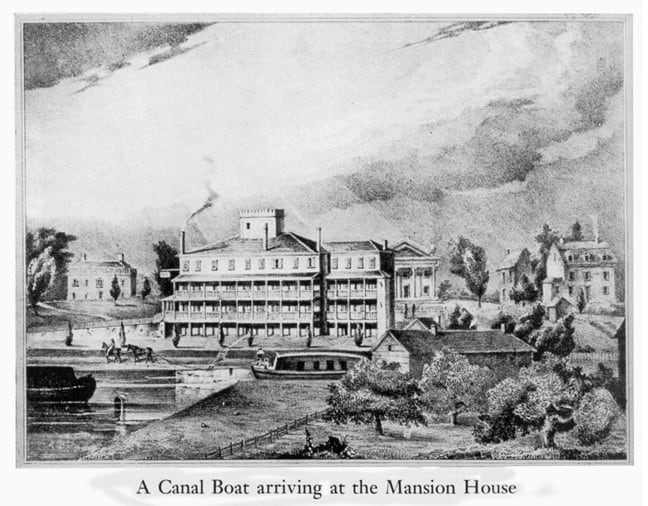
In July of 1835, after nine years of tolerating the presence of the unfinished work, Northampton celebrated the opening of the canal.
From the time of its commencement to its completion, nine years have elapsed, and during this period, it has met with many sad disasters in the turpitude of contractors and the natural difficulties incident to such enterprises ill-matured at the beginning. It has finally outlived all premeditated assaults and inevitable evils and happily its earliest friends have survived its completion. It only remains now for us of the present day, to use, to a good purpose, the generous expenditures made for our generation by those who have preceded us in this great work of internal navigation.
Northampton Courier, August 12, 1835
New Haven and Northampton Company. – The plan of organization for this company, to be substituted for those of the Farmington and Hampshire and Hampden Canals, will be found on the last page of this paper. – When properly understood, we think it cannot fail to meet the approbation of every one interested in the subject, as it probably presents the only resource by which the advantages of the original projectors of the Canal enterprise can now be realized. We understand that the business is now in a prosperous train, and that there is the utmost confidence of success.”
Connecticut Herald, November 10, 1835
Lack of Capital leads to Reorganization
At this time both of the undercapitalized canal companies failed. They were reorganized as the New Haven & Northampton Company in 1836.
Westfield Dam Failure
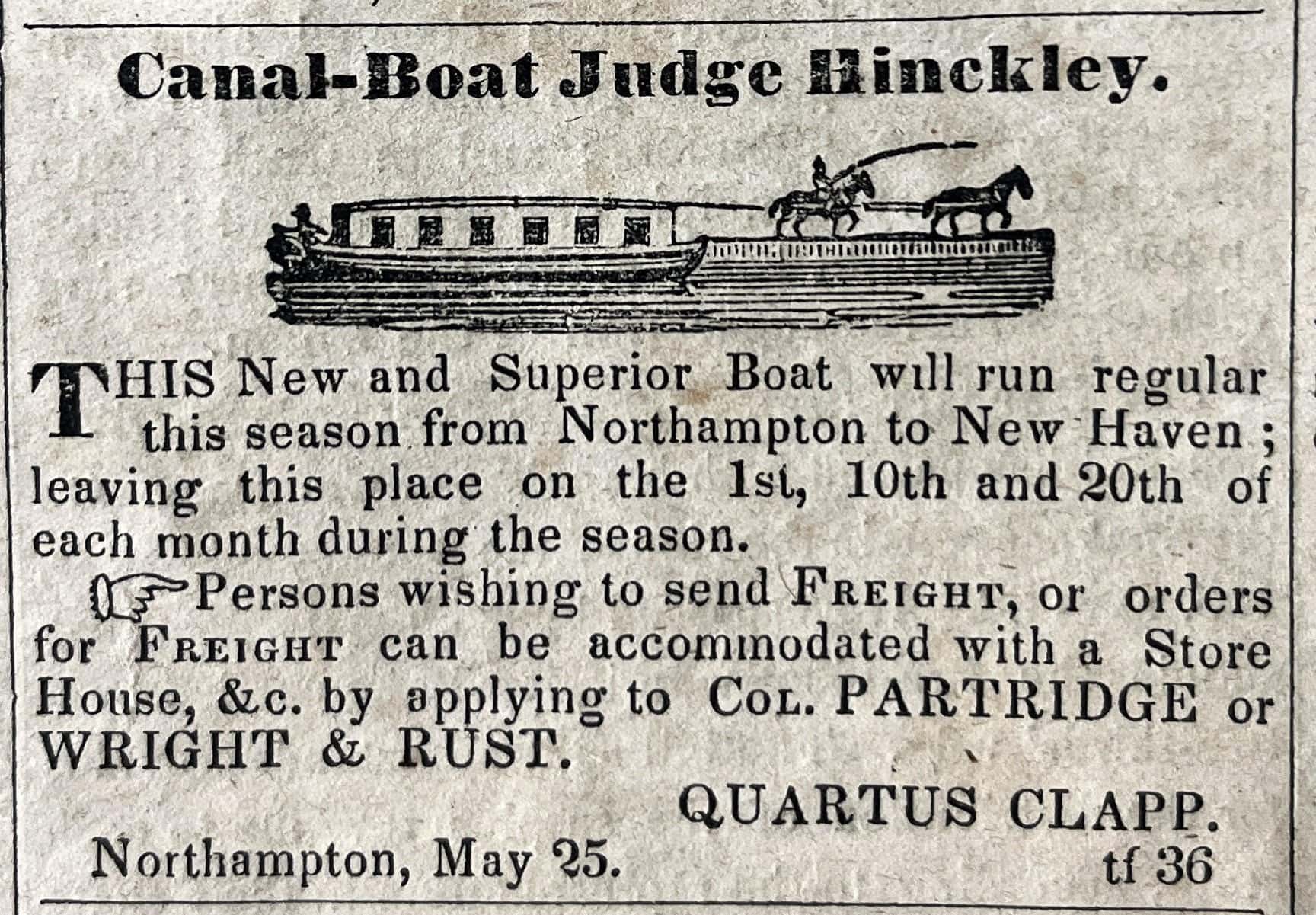
Trade with New Haven flourished until early 1837, when failure of the dam on the Westfield River forced closure of the canal north of Westfield. The northern part of the canal was not reopened until May of 1838, when Northampton’s canal boat, Judge Hinckley, was able to return home after an 18-month absence.
Canal-boat Judge Hinckley. New and Superior Boat will run regular this season from Northampton to New Haven: leaving this place on the 1st, 10th and 20th of each month during the season.…”
Hampshire Gazette, May 4, 1836
“This big ditch in Northampton”
This failure and recurrent breaches in the canal caused Northampton’s merchants to doubt the canal’s reliability and made reorienting Northampton’s commercial ties with the river more difficult.
“Some new disaster will take place”
The Canal in this town is a perfect nuisance. It ought to be indicted as such. The least a Corporation of this sort can do, after locating their works any where they please over private property, is the keep their concern in decent order and not forever be annoying and incommoding such people. From the Aqueduct to the River, the tow-path and banks, much of the way, are sliding into the Canal. By the time the Feeder is repaired and the Canal ready for navigation this side of Westfield, some new disaster will take place and the business of digging out this big ditch in Northampton will again interrupt navigation. The stone locks, abutments to the bridge, and the Canal banks are every where going to decay and tumbling into this unseemly mud-hole. Last week, the stone abutment of the bridge leading to Prospect street fell into the Canal, carrying with it the many timbers of half the bridge. …”
—Northampton Courier, May 10, 1837
“People will never send any thing by the Canal”
The Connecticut River Boats have driven a snug business this spring, in consequence of the ‘feeble and infirm health of the Canal.’ It is in very weak and wasting condition…. The truth is, there is a vast amount of freight to be brought to this vicinity, and as long as the Canal disappoints every expectation and freight gets along here so abominably bad, people will never send any thing by the Canal.”
The Daily Herald, June 9, 1837
Meeting Expectations and Doing a Considerable Business
During the late 1830s and early 1840s, canal operations became more reliable and traffic increased with freight boats and packet boats making scheduled trips from Northampton to New Haven. In 1843, a steamboat was hired to tow canal boats up the Connecticut River from the northern end of the canal.
The Canal. – The Northampton Courier says – the Canal extending from New Haven to this place, is now doing a good business. Goods are transported through to this and other towns with regularity and despatch, and boats are in readiness at the termination of the Canal, to take the freight to the towns north; since its construction there never has been so good a prospect of success as is presented at this time, under its present management.”
The Westfield New Letter, July 7, 1841
THE CANAL. – We think that our canal, the past season, has satisfied the just expectations of its friends and the community. It has been open the whole season of navigation, and with, perhaps, slight interruptions, has been navigable during the whole time. Freight has been transported with safety, and with a good degree of regularity and dispatch. No break of any moment has occurred, and it withstood the parching drought of the summer remarkable well. Considerable business has been drawn in from the river, which has not been done in any season before; and this business will undoubtedly be much augmented another year.”
Hampshire Gazette, November 30, 1841
Overall Financial Success Elusive
However, financial success for the canal was elusive. Revenues generally exceeded ordinary operating expenses, but were inadequate to cover the extraordinary expenses arising from weather-related damage and decay. Income was difficult to increase because this canal, unlike the Erie Canal, was not oriented along a major artery of commerce. There were never enough canal boats in operation to generate the revenue needed to sustain the canal, and tolls could not be raised because of competition from the river.
ENGINEER’S REPORT. [NH&NCO. for the year 1844] “…The experience of the last two years has satisfied us that the number of boats is wholly inadequate to do the business which legitimately belongs to the canal. It is true, that no very great quantity of freight has accumulated upon the banks of the canal, or in store, for the reason, that no person would leave their freight unless there was absolute certainty of its going forward. It is not sufficient to say to persons that the canal is in perfect order, so long as they find no means of transporting their freight upon it; and it is impossible to increase the business, so long as the present number of boats are barely sufficient to do the business which now offers….”
<citation missing>, January 15, 1845
Expensive Repairs Needed
A major storm in October 1843 caused 30 simultaneous breaches in the canal. The canal was operational within a month, but repairs were expensive and recurrent weather-related damage was inevitable. Consequently, the canal’s stockholders began to consider more viable modes of transport.
…We are glad to learn. from a gentleman who has explored the whole line since the late flood, that the most prompt measures have been instituted to repair the damages, a competent force being put upon every point where repairs are required. More than a thousand hands are now in active operation, with every facility to render their exertions effectual in completing the work in the shortest time possible.
Daily Herald, October 17, 1843
The Coming of the Railroad
In the 1840s, it became evident that railroads could operate year round and, compared with canals, were less expensive to build and more lucrative to operate. In late 1847, the New Haven & Northampton Company abandoned the canal and began its conversion to a railroad.
… We are frequently asked, ‘what is to be done with the canal?’… It certainly ought not to be left in its present condition, to breed musketos, if not miasma. The music of the bull-frogs is not adequate compensation for the evils apprehended. If the New Haven and Northampton company propose to construct a railroad along the line of it, we wish them god-speed … But if they contemplate making no public use of the ditch, they ought to make the fact known, that the proper measures may be taken to fill it up.”
Hampshire Gazette, June 6, 1848