Mineral Hills Greenway
Today, all the hills along Northampton’s western boundary—from Easthampton and Southampton north to Williamsburg—are part of the Mineral Hills Greenway.
The Mineral Hills earned their name from a series of unsuccessful lead mines that operated, mainly in Loudville, from the 1660s until the mid-1800s. Several hundred acres of protected conservation land and privately owned forested parcels make this one of the most extensive stretches of uninterrupted forest land in Northampton. Forested uplands, streams, and wetlands contribute to the public drinking water supplies of Northampton and Easthampton and create some of Northampton’s best habitat for moose.
For a more complete understanding of the human and natural history of this conservation area, read this paper written by Laurie Sanders.
Wildlife Camera Footage in Mineral Hills Greenway
A Week in the Life of Bears (Summer 2025)
A quick “dip” into bear behavior during the last week of June and first days of July 2025. This small stream in Northampton’s Mineral Hills Greenway was dammed by beavers during June, creating a small pond. By coincidence, from here, this unnamed tributary flows into Robert’s Meadow Brook, which is the primary water source for the City of Northampton’s popular swimming area, Musante Beach (Musante Beach was originally constructed in 1871 with the sole purpose of providing water for fire suppression and drinking water in the City’s downtown).
A Moose Kiss in May (2025)
While many animals completely ignore the presence of a wildlife camera, several species (bobcats, raccoons, bears, deer, and moose) are often curious and will frequently approach for a closer inspection. When this moose first passed this camera in early May, it very briefly glanced over. Two weeks later, it took a much, much, much closer look…and snuffle. Make sure your volume is on and enjoy!
Spring Comes to Mineral Hills (May 2025)
Many animals traveled along this 19th-century wood road during the spring. But going back in time to when a farm was here in the 19th century, the surrounding forest would have been cleared as pasture and almost all the animals you’re about to see were either rare or not here. Spring peepers and wood frogs, however, would have provided the acoustical backdrop then, as now.
Wildlife Highlights, Winter 2023-2024
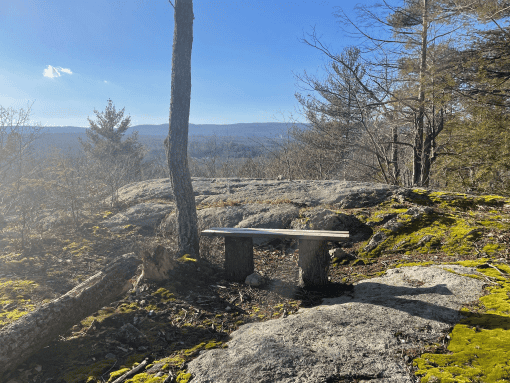
A century ago, the view beyond this rock would have extended much further, a mix of open field and young forest stretching up the adjacent slope. Today, rusty, broken strands of barbed wire and a few red cedar are among the clues of the land’s former use as pasture. Imagine what those farmers might say if they could watch this 3-minute clip. During those farmers’ lifetimes, most of the animals you’re about to see were extremely rare in Massachusetts–and in fact, the first coyotes wouldn’t appear in the state until the 1950s.
See our Youtube channel playlist “Wildlife in Wilder Places” for more wildlife content at Fitzgerald Lake Conservation Area.
ADDITIONAL RESOURCE
Kestrel Trust, “Mineral Hills Conservation Area.”