Ann Maria
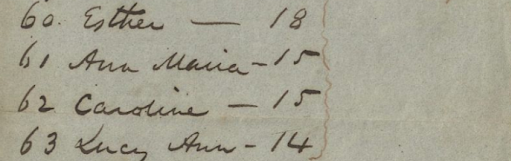
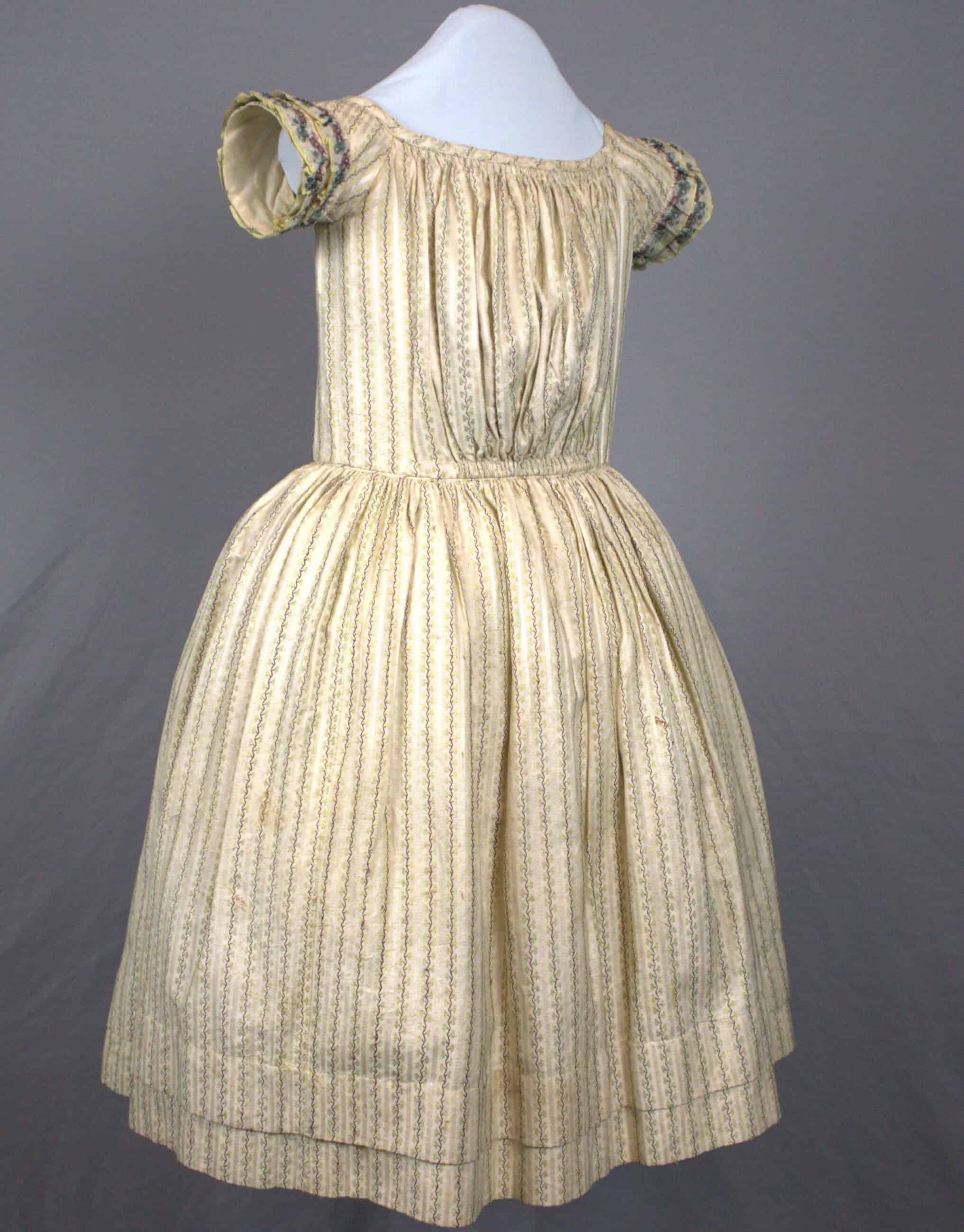
Ann Maria was an enslaved seamstress on the Watson family plantation. She likely made many garments in the Historic Northampton Collection.
Ann Maria was 16 when Henry Watson purchased her to marry her to George, a 19-year-old man he had purchased in the years prior. We do not know where she was born or who her parents were. In his early years as a plantation owner, Henry Watson intentionally purchased groups of young men and women to marry to each other in hopes they would have children and thus grow his fortune. In 1844 he purchased five men: William, Pleasant, Sam, Nelson, and Charles, along with five women: Tabitha, Patience, Esther, Caroline, Lucy Ann, and Ann Maria.
In 1847, at the age of 18, Ann Maria gave birth to her first child, a boy named Granville. She would continue to become pregnant and give birth to more children for the rest of her time enslaved to the Watsons. The reproductive labor of Ann Maria and other women like her was a key part of enslaved women’s duties on the plantation and in the household.
Reproductive Labor
Ann Maria’s labor was not limited to birthing new children for her enslaver Henry Watson. She also worked as a housemaid for him and his wife Sophia.
In June of 1850, she gave birth to a girl she named Maria Jane. Unfortunately, however, Maria Jane died six months later. The following year, in 1851, Ann Maria got pregnant again, limiting her ability to attend to the Watson family’s needs. They purchased an older woman named Phillis to work as a nurse for the family’s children and to pick up the household tasks Ann Maria was no longer able to perform due to her condition. Henry wrote to his mother in December of 1851:
We expect her [Phillis] to wait on the table when Ann gets so bulky that she will be unfit which from her growing condition I fear will be too soon.
In a letter the same month, Henry’s mother, Julia, asks if Ann Maria is still able to do her work. Finally, a month later, on January 2, 1852, Ann Maria gave birth to a daughter she named Lavinia.
Textile Labor
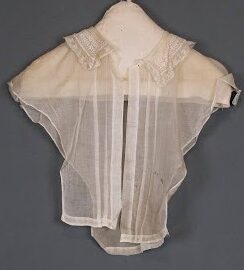
Ann Maria was back to work soon after Lavinia’s birth. This time, however, she was no longer mentioned as waiting on the table. Sophia wrote on April 12, 1852, to her mother-in-law, Julia, that Phillis is now engaged doing “all the course [coarse] sewing” and that “Ann will make a fine seamstress.” The designation of “seamstress” as opposed to coarse sewing implies that Ann Maria is especially skilled at sewing.
The two main kinds of sewing completed within the Watson household include the “course [coarse] sewing” of household textiles (draperies, sheets, towels, etc.) and the construction of slave clothes, as well as the “fine” sewing of making garments for the Watson family themselves to wear. Ann Maria’s role as “seamstress” puts her in a category with other young enslaved women who had likely been separated from their communities on the plantation in Newbern to be trained under the supervision of Sophia herself in the making of delicate gowns, petticoats, shirts, and all other clothing worn by the white elite Watson family members. This means Ann Maria was highly likely to have made at least some of the clothing in Historic Northampton’s collection of Watson family clothing.
Death
In 1855, at the age of 25, Ann Maria died. Despite her frequent appearances in the letters of the Watson family, her death is not mentioned once. The only record of her death is found in Henry Watson’s slave ledger, which reveals she was survived by her husband George and her two children, Granville, now 8, and Lavinia, now 3. George, Granville, and Lavinia would continue to live enslaved by the Watsons until the end of the Civil War in 1865. When the family was finally freed, George was 38, Granville was 19, and Lavinia was 13. Ann Maria would have been 36.