Rhoda Rhoades
Indian Doctors and Doctresses
During the 1800s, Native people were most notable when they appeared in an unexpected place, doing something unusual. One such example was documented in Deerfield in August of 1837, when a reporter for the Greenfield Gazette and Mercury newspaper announced the arrival of a group of 25 Abenaki Indians in town. These Native people were well-received and recognized by members of the Williams family as kin, because the eldest among them—a woman in her 80s known to her family as “Eunice of Williamsecook”—traced an ancestral connection to Eunice Williams (1696–1785), who had been taken captive and adopted by the Mohawk in 1704.1
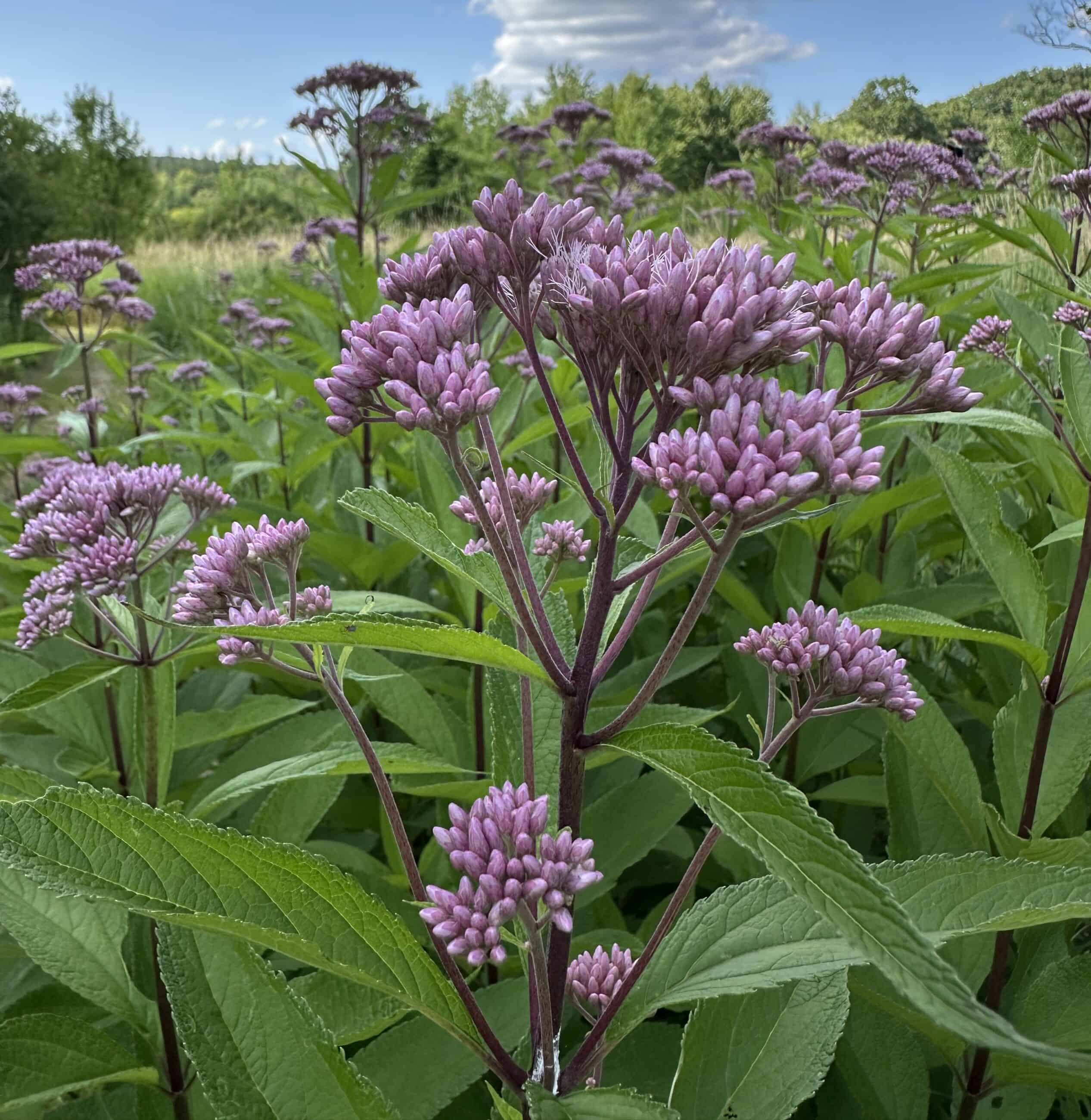
The family group included a well-known “Indian Doctor” named Louis Watso (c. 1778–1885), who generously shared medicinal information with Dr. Stephen West Williams of Deerfield. Watso relied heavily on Indigenous medicinal plants like wild ginger, “useful in the low stages of fevers, in nervous affections, palpitations, and similar complaints”.2 Dr. Williams embraced the usefulness of Native medicine, but he also complained that “hundreds of my fellow citizens” visited Indian Doctors who “pretended to be able to cure all diseases by their simple remedies and the people believe them.”3 Williams compiled an herbarium, now in the collections of Memorial Libraries, that contains 556 dried specimens, 411 of which are indigenous plants (Joe Pye weed, slippery elm, ginseng, cohosh, goldthread, Indian hemp, sassafras, etc.) found growing wild around Deerfield.4
The same Abenaki family that was so warmly welcomed in Deerfield found an entirely different reception when they visited Northampton in 1838. A reporter for the Northampton Courier disparaged them as having “adopted the vices of the whites without seeming to emulate any of their virtues”:
“The lofty bearing and noble demeanor of the primitive Indians are gone, and nothing is left but the abject and debased exterior of the red man…Their habitations are miserable tents, and their clothing the fragments of the cast-off wardrobes of white men…Altogether considered, they are merely a wretched remnant of a race of noble and proud Red men, who once tenanted this fair valley, and whose stealthy tread and uplifted tomohawk, carried death to hearts terrified by their appalling war-cry.” (Northampton Courier, June 6, 1838)
A reporter for the Hampshire Gazette newspaper similarly made it clear to his readers that he took great offense at the popularity of these Native people who had “attracted much attention.”5 The mere presence of these Native visitors appears to have been an unwanted reminder of the stubborn persistence of Native people who had simply refused to fade into the sunset.6
Rhoda & the Rhoades Family
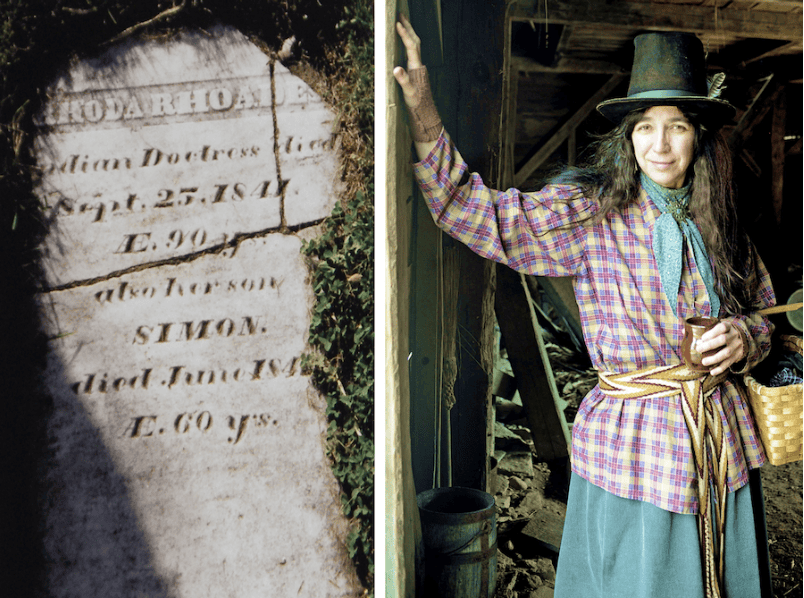
Folks in Northampton were far more welcoming to another Native medicinal practitioner who regularly passed through town—Rhoda Rhoades (c. 1751–1841), a Mohican Indian Doctress from Indian Hollow, in present-day Huntington. Rhoda and her brother, Zebulon Fuller, traveled a regular circuit by horse to Westfield, Springfield, and Northampton. She also doctored people at her home, using special diets and traditional medicines made with a wide variety of Indigenous plants.7 For example, in 1836, Brookfield printer Homer Merriam sought Rhoda’s services to cure his chronic dyspepsia. He lodged for a month at her home, praising her as having: “a good knowledge of roots and herbs and their medicinal properties, and a good degree of skill in the use of them.”8
Huntington Town Historian Myron Munson described Rhoda’s materia medica as follows:
“As an apothecary, she gave prominence, let us say, pre-eminence, to plants, flowers and roots, as remedies. She searched the meadows, swamps and woodlands for medicinal vegetation that was growing wild…But her pharmacopia was by no means limited to such…every kind of flower that I ever saw grew in her garden…And they grew most luxuriantly.” (Myron Munson, c. 1880)9
The Rhoades family managed a maple grove, as did many Native people, who considered these groves to be hereditary property.10 Maple sugar was used as the primary seasoning for roasted corn, game, or fish, and traveling bags were often filled with chunks of maple sugar, parched corn, jerked venison, and dried berries, collectively called pemmican.11
Rhoda always carried extra maple sugar in her saddlebags, giving it out to children when travelling. In 1871, an elderly man recalled visiting with Rhoda whenever she passed through Northampton:
“She was very kind to children, and her sugar box was emptied oftener by the lumps she gave us, than in any other manner…[she] dealt in ‘roots and yarbs,’ and understood what she was dealing in, much better than many of our modern doctors…she cured permanently many cases that were given up as hopeless by eminent physicians…” (anonymous, 1871)12
Rhoda was so well loved by her neighbors that when the rest of the Stockbridge Mohican Indians left western Massachusetts to relocate westward in the 1790s, she stayed behind.13 When she passed away in 1841, she was buried in Indian Hollow.
Notes
- Margaret M. Bruchac, “Abenaki Connections to 1704: The Sadoques Family and Deerfield, 2004,” in Captive Histories: Captivity Narratives, French Relations and Native Stories of the 1704 Deerfield Raid, edited by Evan Haefeli and Kevin Sweeney, 262-278 (Amherst, MA: University of Massachusetts Press 2006). ↩︎
- Stephen West Williams, “Report on the Indigenous Medical Botany of Massachusetts,” American Medical Association Transactions (Philadelphia, PA: American Medical Association, 1849), 863-927. ↩︎
- Librarian David Bosse discovered this undated complaint in the Stephen West Williams Papers, Box 15, Folder 1, Memorial Libraries, Deerfield, MA. ↩︎
- Karen B. Searcy, “The Steven West Williams Herbarium: An Early 19th Century Plant Collection From Deerfield, Massachusetts,” Rhodora 119 (978) (June 2017), 132-162. ↩︎
- Hampshire Gazette, June 6, 1838. ↩︎
- Jean O’Brien, “‘Vanishing’ Indians in Nineteenth-Century New England: Local Historians’ Erasure of Still-Present Indian Peoples,” in New Perspectives on Native North America: Cultures, Histories, and Representations, edited by Sergei A. Kan and Pauline Turner Strong, 414-432 (Lincoln and London: University of Nebraska Press 2006). ↩︎
- Margaret M. Bruchac, “In Search of the Indian Doctress,” Old Sturbridge Visitor 39 (1) (1999): 6-7. ↩︎
- Homer Merriam, “Annals of the Merriam Family, Gathered by Homer Merriam, Commenced in 1862.” Manuscript in the Merriam-Webster Collection at Beinecke Library, Yale University, New Haven, CT. ↩︎
- Myron Munson, unpublished notes, 1880s, from collection of Huntington Historical Society, Huntington, MA. ↩︎
- Samuel Hopkins, Historical Memoirs Relating to the Housatonic Indians (Boston, MA: Kneeland Press 1753), 38. ↩︎
- Mathews, A Dictionary of Americanisms on Historical Principles, Volume II, 1219. ↩︎
- Anonymous, “The Old Town of Norwich” [Indian Hollow, MA], Hampshire Gazette, Northampton, MA February 7, 1871. ↩︎
- For more information on the historic relocations of the Mohican, see Shirley W. Dunn, The Mohicans and Their Land, 1609-1730, Purple Mountain Press, 1994. ↩︎