Harriet Atwood Williams DeRose
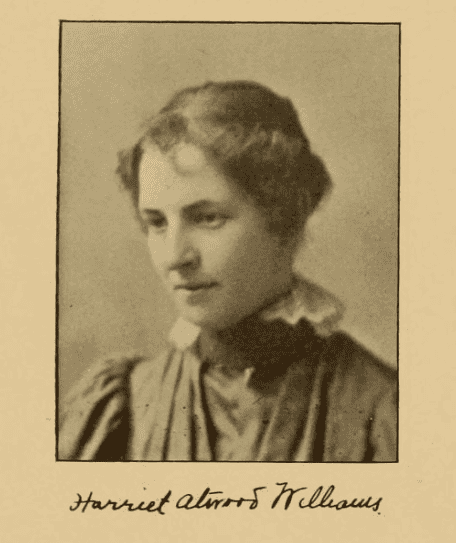
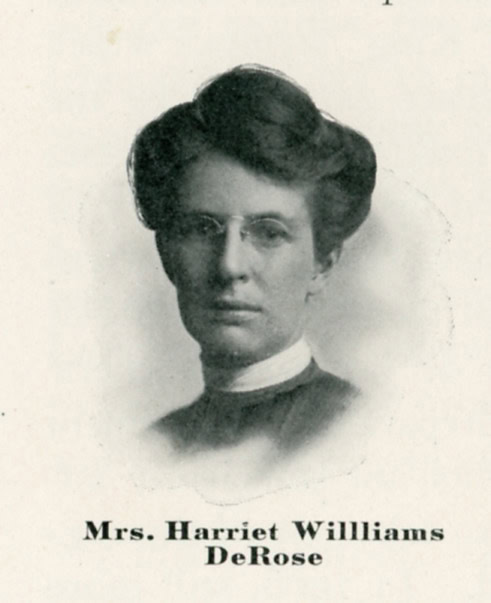
Harriet Williams DeRose (1877–1960) became one of the first female newspaper publishers in the United States when she bought the 174-year-old Daily Hampshire Gazette in 1929. She led the newspaper for 39 years.
The Early Years
Harriet Atwood Williams DeRose was born in 1877 to Charles Edwin and Martha Wheeler Williams in North Stonington, Connecticut, a small town near New London. After graduating high school in New London in 1894, DeRose enrolled at Smith College.
When DeRose graduated in 1898, she was one of 277 graduates receiving the liberal arts degree. Although the class size at Smith—and other women’s colleges—had dramatically increased since their beginnings, only 2.8 percent of American women received any kind of higher education at the time. This put DeRose in a select group of well-educated women who would go on to impact the country profoundly in the first half of the 20th century.
At some point during college, DeRose learned typing and shorthand (stenography) at the Walworth Institute in New York. Although these skills were primarily used in business offices, DeRose found them useful in her college courses.
Teacher and Business Assistant
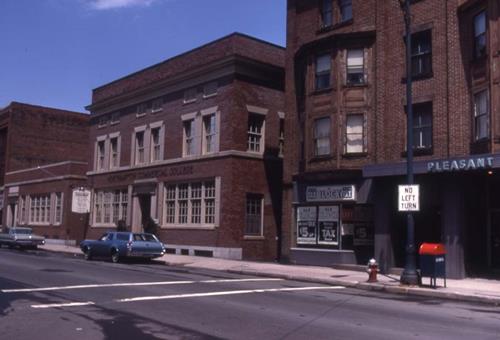
After graduation, DeRose was hired at the newly formed Northampton Commercial College (NCC), then located at the corner of Main and Pleasant Streets. As one of six faculty members, (four men and two women), she taught both shorthand and typing. She was also a business assistant, charged with maintaining the financial records for the college.
DeRose was at NCC for 20 years, during which time she married and raised her two children. It was very unusual for a married woman at the time to work outside the home after marriage unless required to do so by death or incapacity of her husband. However, DeRose never did follow a woman’s prescribed path through life.
There were several important innovations that impacted DeRose’s teaching at NCC, including the first QWERTY keyboard and introduction of a new shorthand method. When she became publisher of the Daily Hampshire Gazette, DeRose would remember the advantages conferred by innovation as well as the business-management skills she learned at NCC.
After working at NCC for 20 years, and with her children in their teens, DeRose left teaching in 1919 for a position as business manager at the Daily Hampshire Gazette. DeRose was in charge of payroll, advertising income, and expenses, among other financial duties, and reported to the publisher, Collins H. Gere.
Collins H. Gere was a quiet, well-respected publisher who saw his job to “improve schools, strive for better government and influence the right side.” By the late 1920s, Gere wished to retire, so he offered the opportunity of buying the Gazette first to the editor and then to the press manager, both of whom refused. Gere then looked to the extremely competent DeRose.
Grandsons Charles W. and Peter L. DeRose, publishers of the Gazette from 1970 to 2005, tell this family story: DeRose knew that being a woman in the man’s world of publishing might make her undesirable in some middle class circles, so she went to the major businesses in Northampton and said that she wanted to buy the Gazette but wanted assurances that they would continue to advertise in the newspaper after she became publisher. The merchants, who already knew DeRose from her years as business manager, promised to keep advertising and DeRose agreed to become the next publisher.
Gere mentored DeRose until his retirement in 1929, when in a seamless transfer, DeRose purchased the corporate stock in the Gazette and became one of the first female newspaper publishers in the United States.
Publisher of the Daily Hampshire Gazette
In 1972, a retrospective Gazette article speculated that, “It must have taken a great deal of courage and daring [to become publisher in 1929].”No written records exist to say why DeRose took on the challenge as publisher of a daily newspaper, but at least some of the reasons can be inferred from her history. DeRose was intelligent and very well educated for her time. She had been employed all of her adult life as a teacher and a business manager, so had leadership skills, financial expertise, and a strong work ethic. In addition, she had seen the benefits of technological innovations to both the employees and the bottom line. Furthermore, she had already spent years at the Gazette being mentored by Gere in the responsibilities of a publisher. She was ready to take on this new challenge.
As a publisher, DeRose was effectively the CEO of the Gazette, overseeing the production of each day’s newspaper six days a week, ensuring its financial stability, and setting the tone and general direction of the editorial content. In a small newspaper like the Gazette with about 45 employees, Mrs. De Rose worked daily with the editors to decide what local, statewide, and national events would be printed. She was also responsible for the financial stability of the newspaper, as well as for maintaining a balance among the news, sports, features, opinion, and advertising competing for limited space in the newspaper.
By all accounts, DeRose had an excellent working relationship with her employees. Every morning she had coffee with the women, mostly typesetters, at the Gazette. She sought to bring out the best in her employees, lending a helping hand or giving a second chance when warranted. Once, when an employee was very ill, DeRose drove him to Boston for medical treatment. As a result, “Mrs. D,” as she was affectionately nicknamed, was rated “the best” by her employees, many of whom spent their entire working lives at the Gazette.
The Physical Plant of the Gazette
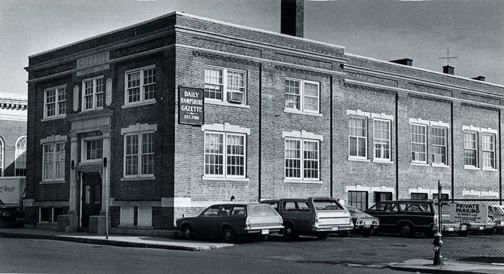
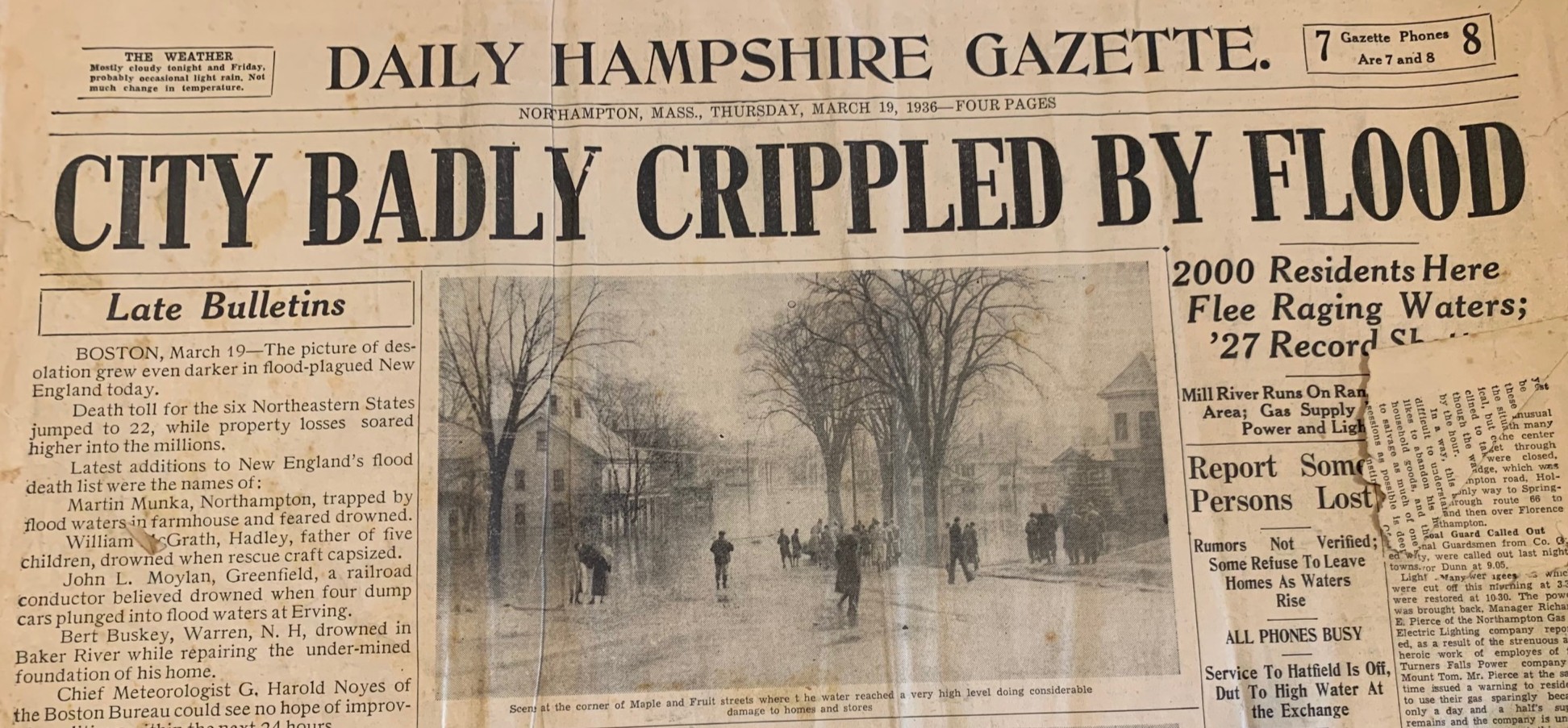
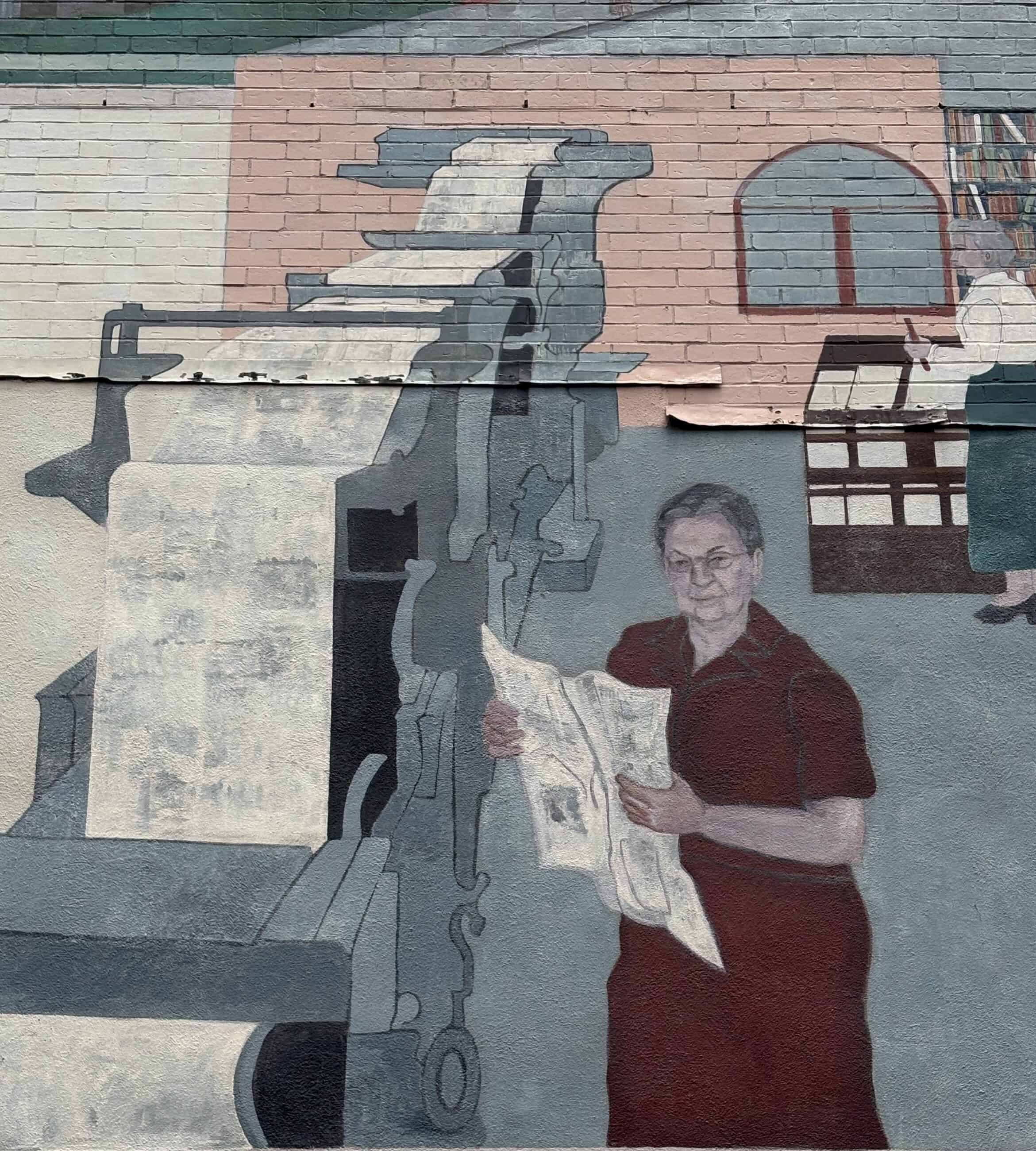
The Gazette offices were on the first floor of 16 Armory Street. DeRose’s office was on the second floor and the heavy printing presses were in the basement. This proved to be a near disaster on March 19, 1936, when the Connecticut River overran its banks and, according to the Gazette, “badly crippled” Northampton and surrounding towns. At least 2,000 residents fled the flood and many were killed. Since there was no gas to heat the linotype machines and the printing presses in the basement were flooded, abbreviated editions of the Gazette had to be published in Holyoke for at least three days until the water receded and the gas lines were restored. This was the only time that the Gazette was not published locally during DeRose’s tenure.
The Printing Presses
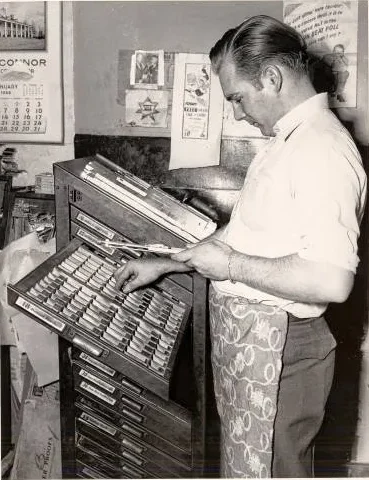
The process of printing a newspaper in the first half of the 20th century used hot-type or linotype presses. Typesetters would use a machine similar to a large typewriter to inject molten lead into letter-shaped molds. The text created using these molds was arranged on large plates, which were used to print the newspaper before it was cut and folded. Printing using hot lead was a difficult and sometimes dangerous job. Jim O’Connor, a retired press operator, said in a 2020 interview in The Amherst Bulletin, “We always got burned [by the hot lead type] at some point. I’ve still got some scars.”
DeRose knew the benefits of innovation from her years teaching, so in 1948, she approved the purchase of an expensive new printing press: the massive 45-ton Hoe Simplex, which had the advantage of color printing. With this printing press the Gazette became one of the first newspapers to print in color.
Years later, in 1966, the Gazette boasted that they had just begun using the new offset presses, the first of its kind in Western Massachusetts. The article went on to say, “The mechanical facilities [at theGazette] always have been among the best and most modern, a tribute particularly to Mrs. [Harriet] DeRose who ensured quality equipment was made available, often at great expense.”
Journalism and the Gazette
Journalism is the process of reporting on the news as well as exposing and interpreting the facts. The ideas of what is considered newsworthy of reporting and how much—or little—an editor should interpret that news has changed over the years. The first decades of the 20th century saw the rise of several pioneering female reporters, including Ida B. Wells-Barnett, a Black woman who overcame oppressive discrimination to crusade for racial justice and against lynching; and Ida Minerva Tarbell, who exposed the corruption of Standard Oil Company, the biggest monopoly of the time.
These courageous reporters, and many others, helped to change the system but in doing so, created a backlash that suppressed progressive reporting. As a result, many newspapers, including the Gazette under C. H. Gere, were politically conservative. For example, in 1928, The Gazette—and most other newspapers—strongly supported the candidacy of Herbert Hoover, whose policies were blamed for helping to create the Great Depression.
In contrast to the political conservatism of the time, DeRose took a nonpolitical stance in her editorials, which can be seen in the general election of 1936. President Franklin Delano Roosevelt, a Democrat, was running for a second term in office against Republican Al Landon. Eighty percent of daily newspapers in the U.S. endorsed Al Landon, including the neighboring Springfield Republican. In contrast, DeRose wrote an editorial on the day before the election titled “Go Vote,” in which she encouraged readers to cast a ballot for the candidate of their choice, not the newspaper’s choice. She wrote: “There would seem to be no excuse for not casting an intelligent ballot in the state and national elections here tomorrow.”
Similar editorials in other election years also continued to be nonpolitical, a position that did not go unnoticed. In 1954, DeRose was honored by the Northampton Elks Lodge for “accurate, complete and unbiased coverage, particularly in the controversial fields of politics and government.”
Many publishers in the 1930s and 1940s would suppress news stories that would be embarrassing to the local power brokers, but not DeRose. Her grandsons remember that their grandfather, Charles A. DeRose, whom they described as “a quiet, stern, post-Victorian era man,” once asked his wife to bury a story about an associate. She replied, “I would like to, but it’s against our policy, so I can’t.”
Challenges to Publishing the Gazette
When DeRose became publisher, daily newspapers such as the Gazette were at their peak with approximately one newspaper for every four people nationwide. The Great Depression gripped the country throughout the 1930s. With millions of people out of work, businesses were struggling, which in turn led to less advertising, an important revenue stream for newspapers.
The newspapers also faced competition for audiences and advertising revenue by the rise of radio. In the 1920s, the radio, once a luxury, had become a fixture in American households. There were over 700 radio stations, all of which had the same access to national and international news as the newspapers. As a result, many of the nation’s daily newspapers went out of business or consolidated during the Depression years.
In spite of these challenges, the Gazette managed to continue publishing in the 1930s and 1940s. Circulation was flat in the early Depression years as DeRose was learning the publishing business, but increased as DeRose instituted changes such as printing fewer pages for each edition to save on paper and printing costs, printing the radio schedules, and relying on less-expensive local news, such as weddings, instead of purchasing national news from organizations such as the Associated Press
In the 1950s, television began to negatively impact the daily newspapers. Home television ownership increased nearly 10-fold in the decade between 1950 and 1960. DeRose responded to the rise of television journalism by consolidating with sister publications in Greenfield and Amherst to focus on hyperlocalism. Historian Richard C. Garvey wrote in The Northampton Book (1954), “The Gazette’s increased local coverage had area residents avidly scanning the columns to see their own names in print.”
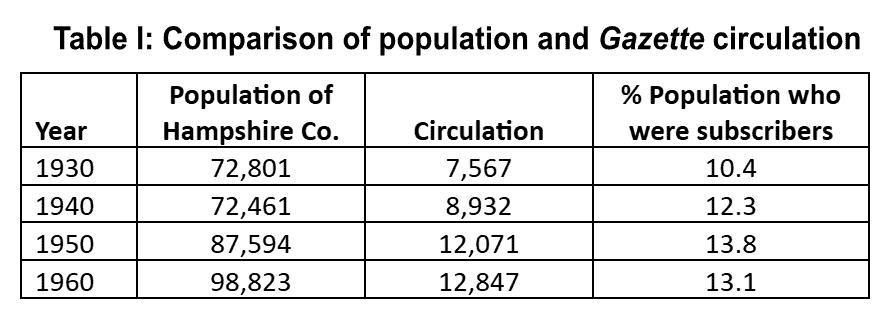
How effective was DeRose’s approach to publishing in the face of competition from radio and television. Figure 1 shows that readership in Hampshire County increased from 1930 to 1950, so it is clear that the Gazette continued to thrive under DeRose’s leadership.
Grandson Charles W. DeRose recalled local businessman Al August telling him, “Your grandmother had a Midas touch. Everything that she got involved in seems to succeed.”
A Family of Publishers
Harriet Atwood Williams married Charles Anthony DeRose in 1904 at the Edwards Church in Northampton. Shortly after their marriage, the couple moved to the large white house at 289 Elm Street, where they lived for the rest of their lives along with DeRose’s brother, Dr. Nathan Williams, and his family.
The DeRoses had two children: daughter Louisa born in 1906 and son Charles Nathan born in 1907. Charles Nathan spent most of his adult life at the Gazette, beginning in the advertising and circulation departments. In 1956, with his mother’s health failing, he became editor and took over as publisher upon her death in 1960. He continued his mother’s policies of integrity and non-political editorials as well as her penchant for innovation.
When Charles Nathan died of a heart attack in 1970, his sons Charles W. and Peter L. took over as publishers of the Gazette, making them the third generation of DeRose publishers. In the 1960s, Charles W. had worked in advertising both at The Burlington (VT) Free Press and at the Gazette. Peter was interested in engineering, much like his grandfather, and enjoyed working on the presses and other machinery at the Gazette. As publishers, the brothers saw the work of putting out a newspaper as “a balancing act between news gathering with Constitutional rights versus dependence on readers and advertisers.” Under their leadership, the Gazette continued to thrive until the rise of the internet and the 24-hour news cycle made it very difficult to publish an independent newspaper. In 2005, Charles and Peter DeRose sold the Gazette to the Newspapers of New England, ending three generations of DeRose publishers.
The Legacy of DeRose
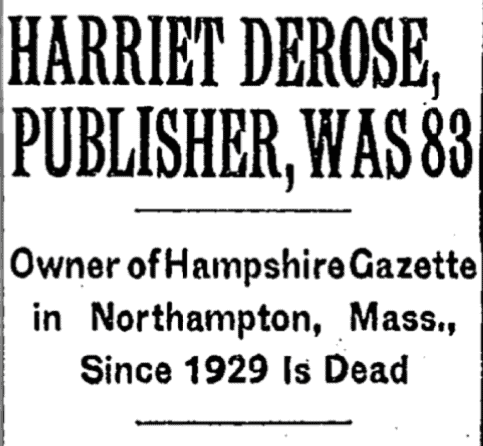
DeRose died in her beloved home on September 23,1960, at age 83, survived by her son, three grandchildren, and three great-grandchildren. She is buried in her hometown of North Stonington, Connecticut.
DeRose’s obituary in the Gazette described her as “owner, publisher, president and treasurer [of the Gazette] who combined love of family and dedication to work.” Today, no one would think it unusual for a woman to graduate from college and go on to have a demanding career while raising a family. But at the turn of the 20th century, it was rare for a woman to earn a college degree and even more rare for her to have a 60-year career in education, business, and newspaper publishing. Her 50th Smith College Reunion Book reported in 1948: “Harriet Williams DeRose, publisher of the Hampshire Gazette, is our only example in this business.” Yet she did not see herself as a trailblazer. During the 30 years she was publisher, she refused to have her name on the masthead of the paper, listing Gere as publisher in the national directory of newspapers.
DeRose lived during a period of great changes in the United States. She saw the rise of the women’s suffrage movement and voted for the first time in 1920 when she was 43. Shortly after she bought the Gazette, the Great Depression descended on America, resulting in a loss of jobs for a quarter of the workforce including at the daily newspapers. Through 30 years of challenges to the daily newspapers, DeRose worked hard to engage the readership, support the advertisers, and provide effective leadership to her employees.
As a result, The Gazette readership remained steady under her leadership in spite of many challenges. Furthermore, she and her husband were a loving couple who supported a close-knit extended family, three of whom carried on her work as publishers of the Gazette. DeRose began a legacy in newspaper publishing that spanned 76 years and three generations.
ADDITIONAL RESOURCES
“DeRose, 83, Publisher in ‘Hamp,’ Dies,” The Springfield Union, September 24, 1960, p. 5.
“Harriet DeRose Publisher Dies,” September 25, 1960, The New York Times, p. 26.
“Harriet (Williams) DeRose,” by Peter L. DeRose and Daniel Carvalho III. Published by Republican Heritage Book Series (2018).
“History of the Gazette being printed in Northampton,” The Amherst Bulletin, August 4, 2020.
Oral-history interview of Charlie and Peter L. DeRose, Conducted by Elizabeth Sharpe and Alice Sessions, October 26, 2022. Historic Northampton, Northampton, MA.