Constructing a Reproduction of the Sarah Strong Chest
Introduction
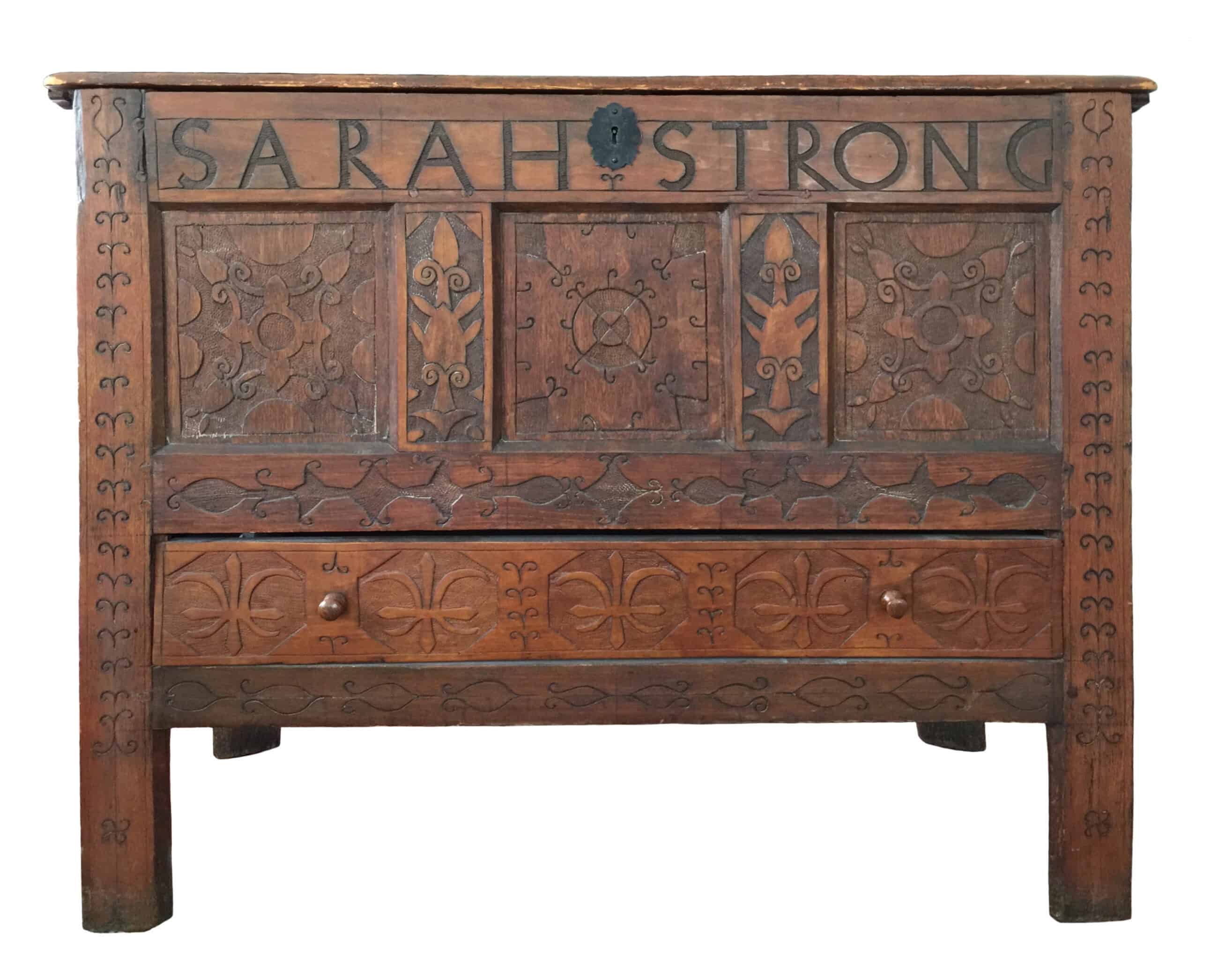
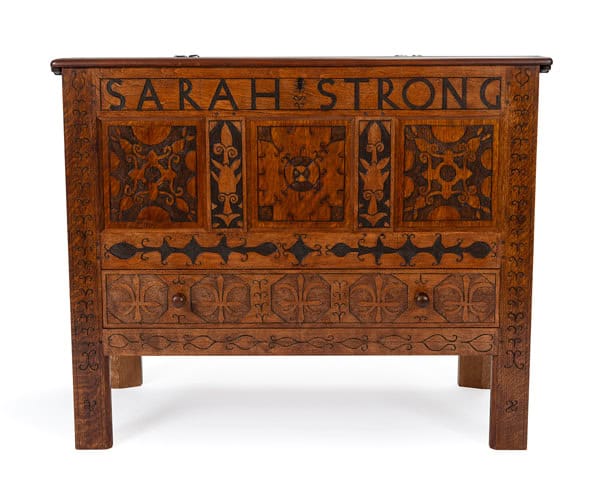
For master furniture maker Sharon Mehrman, making a reproduction of Historic Northampton’s Sarah Strong chest was a labor of love and forensics.
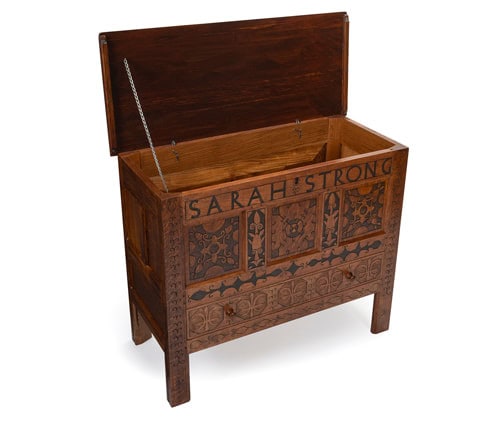
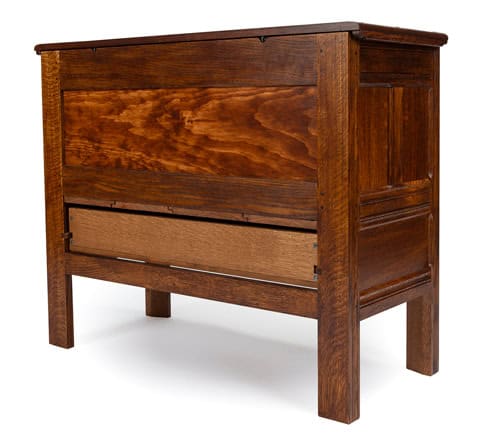
Sharon Mehrman’s reproduction of Historic Northampton’s Sarah Strong chest was at 85 percent the size of the original. It was made for the hands-on learning section of the 2019 exhibit, Making it on Main Street. The reduced size of the replica made it easier to move around and more accessible to be handled by more people, especially children. The original chest, made sometime between 1680 and 1740, was displayed in an exhibit case. Visitors could touch and explore the reproduction chest to see the marks left by the tools used in marking and making the chest, and to learn about the chest’s construction.
Who was Sarah Strong?
The Strong family’s roots go back to the English settlement of Northampton in 1654, when John Strong was one of the first leaders. From the carved name on the chest, we know that the chest belonged to Sarah Strong. There were several Sarah Strongs who descended from John. One possible candidate lived on Main Street, where her father had a thriving business tanning hides to make leather. Sarah Strong was given this chest by her parents to outfit her for marriage. These chests, often called Hadley chests, held the most valuable household items—linen sheets, towels, napkins, blankets, and perhaps some silver. Textiles were expensive because they were so time-consuming to make.
Women had few rights once married, so having Sarah’s name carved on the chest was meaningful. In the patriarchal system of the 17th and 18th centuries, a husband legally owned all his wife’s possessions, though it was culturally accepted that a woman owned movable property (such as a chest and linens) that she brought into the marriage. Sarah’s name protected her goods and ensured an inheritance for generations of women.
Women’s Property
In an interview with the Daily Hampshire Gazette, Mehrman said that making the reproduction chest was both fascinating and challenging, and she learned a lot along the way. She began by doing an in-depth study of the chest; there are only about 135 extant chests of this type in museum and private collections. Of those, only seven bear a woman’s full name. Six of those chests have carved letters, and one has painted letters.
More frequently, these chests were monogrammed with two or sometimes three initials. Sarah Strong’s full name is a bold statement of ownership at the time when women did not legally own property. “The original chest is one of those pieces of furniture that is really special,” Mehrman said. “Making the reproduction married the two loves I have of history and woodworking, and I was really intrigued and excited about the insights into the original I gained by making the chest.”
Woodworking Techniques
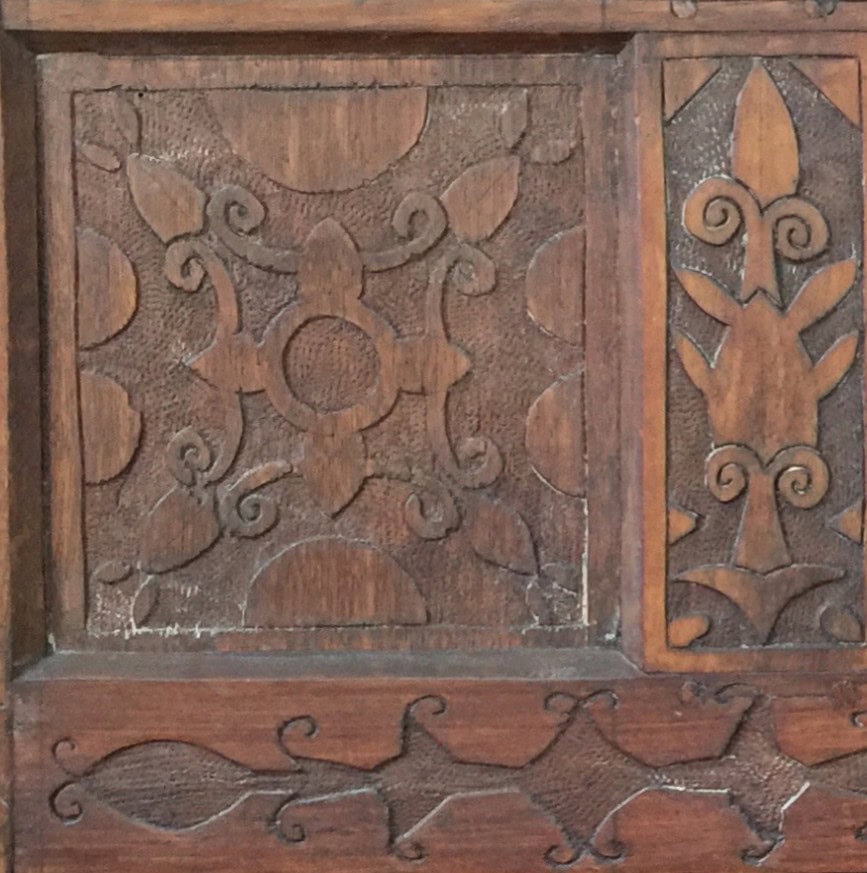
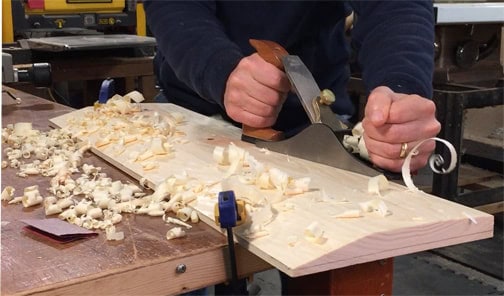
Some early American woodworking techniques were very different from modern ones, especially for measuring and layout, she said. Mehrman used hand tools similar to those of the original artisans. She saw plenty of tool marks on the original from planes, chisels, scratch awls, and dividers, all of which help tell the story of how it was made. Her observation of the varying quality of the original carved imagery on the front of the chest suggests that the Strong chest was made by several people with different levels of carving skill and experience.
The hierarchical structure of historic woodworking shops included the master (owner of the business and presumably the most skilled woodworker), journeymen (those who successfully completed their apprenticeships and continued to build experience and skills), and apprentices (beginners who learned the trade for up to seven years). By contrast, Mehrman worked alone. “It took me a lot longer than it probably took them. They weren’t fussy, they were making them fast,” she said. “Even so, the chest was executed to a very high level of skill,” she added.
Wood Species
At every step, she said, she learned something new. “I wanted to reproduce the chest as closely as I could. The challenge was that every time I gained a new insight, I had to look deeper.” An example was her interpretation of the mixture of wood species on the front of the chest. The chest, like all Hadley chests, is made using frame and panel construction with beveled edges along the edges of the stiles and rails on the front of the chest. The mortise and tenon joinery on the front is different from the sides and back of the chest. Each tenoned piece on the front of the chest has one shoulder that is angled at 45 degrees to accommodate the corresponding beveled edges with mortises. Mehrman discovered that the angled shoulders are difficult to cut out of oak, as the saw is worked against the grain.
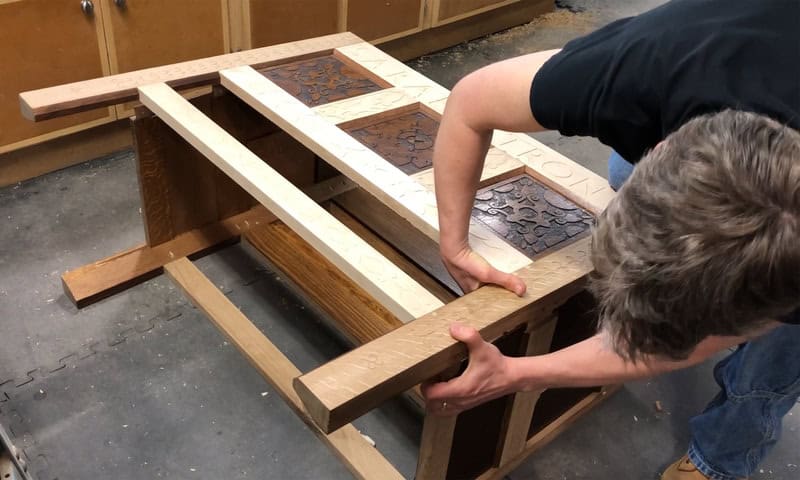
“I started to make the front out of oak. When I discovered how difficult it was, I realized the original maker probably made an intentional choice to use a less dense wood to ease cutting the angled joinery.” While she can’t say exactly what wood was used on the front without scientific testing, she said it might be birch. Birch, beech, maple, and oak were, and still are, woods that are readily found in our local forests. Mehrman used oak and pine for the rest of the chest, which were used in the original and are found in most Hadley-type chests.
Mehrman said it is clear from the ray fleck grain pattern on the oak that it was quartered from logs. Though there were sawmills here, she believes that the wood was more likely riven. Riving wood means to split logs into quarters with a wedge and large mallet, then to split boards out of the quartered sections with a froe and froe club.
Learning Social Culture through Woodworking
The experience of studying and making the chest was an honor and a privilege for Mehrman, she said. “As a maker in Northampton, I feel a real connection to this exhibition – I am living the theme “making it on Main Street,” she said. Mehrman has lived in Northampton since 1998. “There is so much to learn in work like this—not just about material culture but about social culture too,” she said.
Mehrman was quick to say how much the project meant to her. “For me this was bringing together my work and my love of museums and places that tell our history, especially local history,” she said.
This article was adapted from an article by Rachel Simpson for the Daily Hampshire Gazette in the Gazette sponsored supplement, “Making it on Main Street: 400 Years of History,” June 20, 2019).
Video series: Making a circa 1700 Chest
In addition to making the reproduction chest, Mehrman also videotaped and photographed the process.
I think people will get a sense of not only my insights from making it but also about the process of hand-crafting furniture.”