Enslaved Black People
On Terms and Naming
The people listed here were enslaved in Northampton at some time during their lives, or were enslaved elsewhere and had significant interactions in Northampton, such as going to court, seeking medical care, or living here after taking their freedom.
- Manumission
- This term is used to describe a situation where an enslaver voluntarily frees an enslaved person. We only have one confirmed instance of manumission in this project, but we do not know the circumstances of how some people obtained their freedom so there may have been more.
- Names
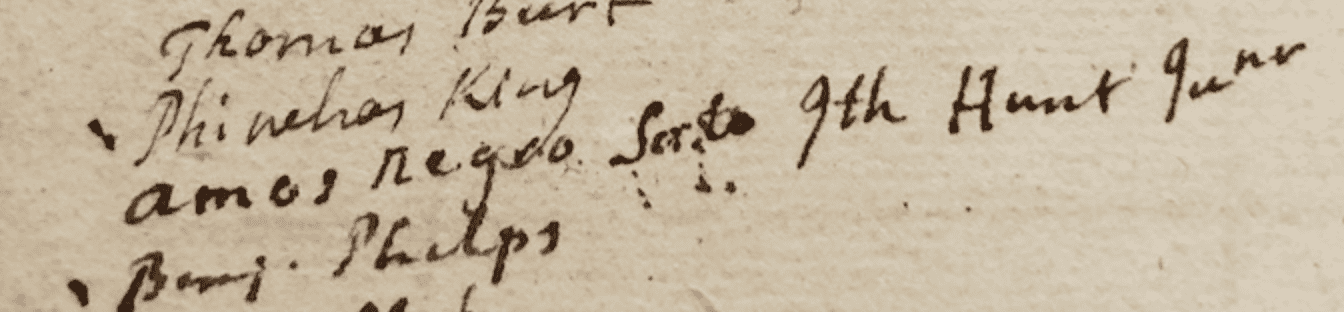
- Many of the people on this page are listed with only their first name. We have attempted to use the most accurate name we can find for each person, but it is not always possible to know if what we are using is the full name. It was very common for the white people writing the documents we have been using for our research to refer to enslaved people by their first name alone, or use the word “negro” in place of a last name. This method of erasure can both obscure the identity of the person who is being written about, and make it harder to know whether that person would have used a surname themselves. We know that some of the people who were written almost exclusively without a last name actually had one, such as Amos Hull Sr., who was often described as “Amos Negro.”
- Servant
- The term “servant” was a common indicator for enslaved status in Northampton records. It’s usage changed over time. In the 1600s we found references to Native people referred to as “servants” who were employed as domestic workers. However, this changed in the 1700s. The easiest place to see how is in church records. Many people would be listed with their first name followed by “servant of” and then the first and last name of a white resident of Northampton. Every time we were able to find what we believed to be another reference to the subject of the church record, it was an enslaved person, not an employee. As such, we were able to conclude that it was common to refer to enslaved people as “servants” in official records, and that a listing as a “servant” could be evidence of enslavement.
Brief Biographies of Enslaved Black People
Bess
A Black woman named Bess died in Northampton on October 13, 1767 (First Church of Christ Records, section 2, p. 22). She may have been the same Bess who was enslaved by Colonel John Stoddard. who was referred to as Elizabeth and Bes (see the profile for Elizabeth). However, since Elizabeth was a common name, it is entirely possible that there were two Black women named Bess living in Northampton at the same time. The fact that no enslaver is listed in her death record (a common practice) could indicate that, at least at the time of her death, Bess was free.
Joab Binney
Though Joab Binney is one of the most well-documented people who was enslaved in Northampton, little is known of his early life. He was probably born sometime between 1710 and 1730. Dr. Stephen West, a minister who profiled Binney’s wife Rose, wrote that Binney was born in Africa, on the same territory as Rose. (West did not name the area.) At some point after he was enslaved and taken from his home, he came to Northampton. Here, he was enslaved by Jonathan Hunt III. It is also possible that he was previously enslaved by a female member of the Strong family. It is probable that he was the only enslaved person in Hunt’s household at this time, though Hunt would later enslave a second man, Amos Hull.
Rose Binney
Rose Binney was born in the early to mid 1730s. She may have been born in West Africa, enslaved there, and taken to America. This was the version of events presented by Electa Jones, in Stockbridge, Past and Present, her 19th-century history of Stockbridge, Massachusetts. Jones wrote that “When a child,” Binney was captured “as she was getting water from a spring.” In Northampton, Binney was enslaved by the minister Jonathan Edwards, and began a relationship with Joab Binney, who was enslaved by Jonathan Hunt III. In 1750, Edwards was removed from his position as minister of Northampton. Later that year, or perhaps the following year, Edwards and his household, including enslaved Rose Binney, moved to Stockbridge, Massachusetts.


Boston
A Black enslaved man named Boston lived on Bridge Street within two hundred yards of Historic Northampton. He was referred to as “One certain Negro man called Boston, of about ninteen years of age” in the 1715 bill of sale which still survives at Forbes Library town archives. Joseph Parsons Jr. of Northampton purchased Boston from a ship owner named Ephraim Breed on June 21st, 1715. He was likely born around 1696. We do not know how long he lived or when he died. This is currently the only known record of Boston’s life.
Cato
In his history of Northampton, James Russell Trumbull recorded that on October 5, 1765, several men from Roxbury, CT, took possession of a lead mine about six miles from Northampton. (These men were Charles Scott, Ethan Allen of Vermont, Benjamin Stiles, Abram Bronson, Israel Bronson, John Frederick Stendall, and Thomas Row.) Trumbull states that these men brought with them three enslaved men (Cato, Cesar, and Tom) to work in the mine. We have no further information on Cato (History of Northampton Massachusetts, vol. 1, p. 364).
Cesar
Cesar was one of the enslaved men that James Russell Trumbull mentioned in his history of Northampton when, on October 5, 1765, several men from Roxbury, CT, took possession of a lead mine about six miles from Northampton. (These men were Charles Scott, Ethan Allen of Vermont, Benjamin Stiles, Abram Bronson, Israel Bronson, John Frederick Stendall, and Thomas Row.) Trumbull states that these men brought with them three enslaved men (Cesar, Cato, and Tom) to work in the mine. We have no further information on Cesar (History of Northampton Massachusetts, vol. 1, p. 364).
Sylvia Church
Sylvia Church was born around 1756, though the exact date and location are unknown. She may have been sold on Long Island when she was nine. She was enslaved by the Dwight family of Northampton, but the exact dates of her enslavement are unclear. She continued to work for the family after slavery was abolished in Massachusetts. Two neighborhood boys, the Tappan brothers, remembered that Sylvia Church had a close relationship with the neighborhood children. In 1798, the records of Northampton’s First Church of Christ list a “dead birth [born to] a negro…named Sylvia.” There were at least two Black women named Sylvia living in Northampton then, so it is unknown whether Church was the mother of this stillborn child. Sylvia Church joined the church later in life. After the death of Mary Edwards Dwight, she moved in with the family of Nathan Storrs, the husband of Timothy and Mary Dwight’s daughter, Sarah. Sylvia Church died in 1822, and she is one of a few Black and Native people born in the 1700s to be buried in Bridge Street Cemetery.
Read more about Sylvia Church under Explore–People.
Coffee
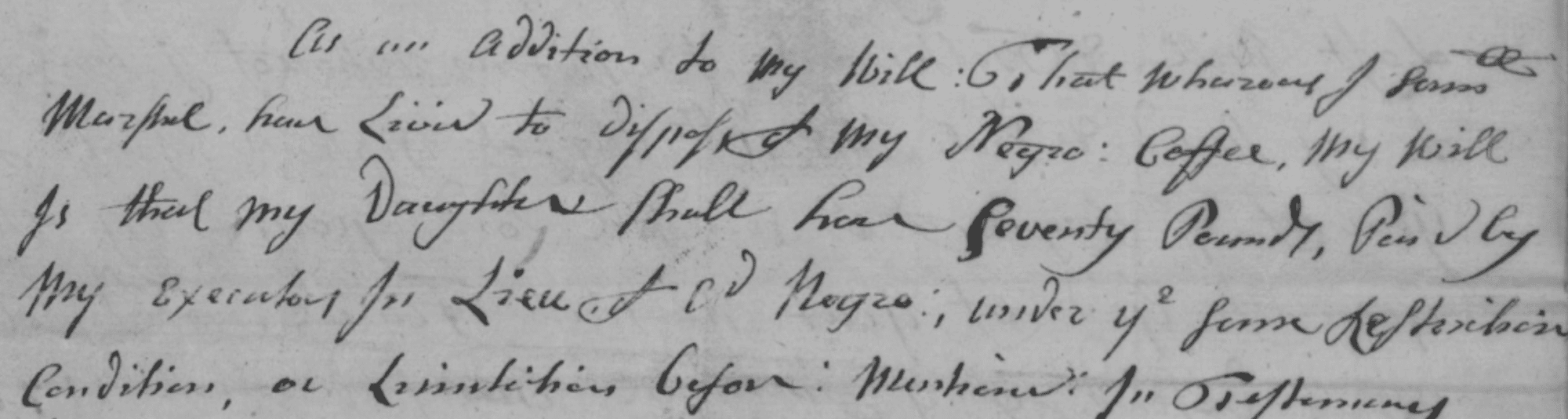
Coffee was listed as a “servant” in the 1725 will of Samuel Marshall, but was in fact enslaved by him and other members of the Marshall family. Marshall left Coffee to his daughters, with instructions that they should sell Coffee and divide the profits between them (Probate Record for Samuel Marshall). This economic arrangement indicates that he was enslaved, not indentured or an employed domestic worker.
Dinah
Dinah is part of one of the most descriptive records referring to an enslaved person in Northampton. She appears in the will and probate records of Joseph and Mercy Bartlett. However, there is little record of her outside of those documents, so much of what can be gleaned of her life is through inference. Dinah was enslaved by Joseph and Mercy Bartlett. She was baptized on June 4, 1738 (First Church of Christ Records). She was given her freedom in Joseph Bartlett’s will of 1755, which referred to her as a “Negro woman.” After she gained her freedom at Joseph Bartlett’s death, she was employed by Mercy Bartlett, who survived her husband and later left Dinah property in her own will.
Dinah
Since we cannot confirm that the Dinah whom Sylvester Judd noted as “There seems to be a Dinah also at Moses Kingsley’s–not a slave” (Judd manuscript, Northampton vol. 1, p. 65), we have created a separate entry for her. This may refer to the same Dinah who Joseph and Mercy Bartlett enslaved, but since we currently do not have proof of that, and Dinah was a very common name, we are including a separate entry in recognition of the fact that she might be a different person. This Dinah was also recorded in the 1764 census, though without her name (History of Northampton Massachusetts, vol. 2, p. 328).
Dorothy
Dorothy was referred to as a “servant” to Benjamin Stebbins when she was baptized on June 4, 1738 (First Church of Christ Records). It is possible that she is the Dorothy who was married to Jonah on March 12, 1739 (Northampton, Massachusetts Marriages, 1656–1800 ), which would make her the mother of at least two sons with him. Their first son, named Felix was baptized in 1739, and presumably died shortly thereafter, since their next son, born in 1740, was also named Felix. Dorothy was a less common name than Elizabeth or Dinah, so while these records could refer to two separate women named Dorothy, we have grouped them together as we believe they more likely refer to the same person.
Elizabeth
Elizabeth was enslaved by Colonel John Stoddard. She was a member of the church in Northampton and was baptized on December 21, 1735. This baptism does not give us an idea of her age, since it may have been an adult baptism. Her baptismal record listed her as “Negro servant to Col. Stoddard” (First Church of Christ Records, page 2 of section 2, and page 8 of section 2). Elizabeth is most probably the person referred to in the 1744 town tax records, which state that “Col. Stoddard” enslaved one person (Northampton Town Papers Whiting Street Fund, Tax Assessors 1703–1884, 1706–1791 Tax Valuations).

Felix
Felix was a child listed as the son of “Jonah Negro” in his baptismal record. He was baptized on June 17, 1739, most probably by Jonathan Edwards (First Church of Christ Records). The paternity listed on the baptismal record makes it probable that he was the son of Jonah, who is profiled here, and Jonah’s wife Dorothy, also profiled here. This record does not mention Felix’s enslaved status, but both of his parents were enslaved, so it is probable that he was born into slavery. It also seems that he died in infancy, since his younger brother, baptized in 1740, was also named Felix. At the time, it was common practice for a family who lost a child to give the same name to their next child of the same sex.
Felix
Felix was listed as the son of “Jonah Negro” in his baptismal record. He was baptized on October 26, 1740, most probably by Jonathan Edwards (First Church of Christ Records). The paternity listed on the baptismal record makes it probable that he was the son of Jonah, who is profiled here, and Jonah’s wife Dorothy, also profiled here. This record does not mention Felix’s enslaved status, but both of his parents were enslaved, so it is probable that he was born into slavery. Felix was the younger brother of the Felix listed above, probably given the same name because of his older brother’s death.
Hannah
The only records we currently have of Hannah are legal records, and they do not contain any vital information. We do not know how old Hannah was, where she was born, or the names of her family members. We do know that she was enslaved by Timothy Baker, and of childbearing age in 1692 (this could put her birth year anywhere from the mid 1640s to the late 1670s). In the early 1690s, she was charged twice with fornication with another enslaved person named Mingo. The second case would have been regarded as more serious, because this time Hannah became pregnant.

Amos Hull, Sr.
Amos Hull, Sr., was listed as “Amos Negro” in First Church of Christ records, but family records confirm them to be the same person. We do not know much about Hull’s early life. If he was similarly aged to his wife Bathsheba, he would probably have been born in the early 1720s, but we do not know what his age was in relation to hers. We do know that in Northampton he appears to have been involved in the church to a significant extent. He was listed as being “In full communion” with the First Church – indicating full membership (First Church of Christ Records). We have also seen a record of Jonathan Edwards giving him catechism along with white children and quizzing him about the number of the kings of Judah.
Bathsheba Hull
Bathsheba Hull was referred to as “Bathsheba Negro” in the listing that recorded her as a member of Northampton’s church (First Church of Christ Records). We currently do not have a record of her early life, but she may have been born in the 1720s. Hull may have been the “Bathsheba Negro” who testified in Jonathan Edwards’ investigation of the “bad book” episode. In 1744, Edwards accused several white young men and boys of reading lewd material, possibly a midwifery text. Bathsheba testified that she had seen Noah Baker, Timothy Warner, and Elkanah Burt reading a book they jokingly referred to as “the bible” and then read it aloud to her and Naomi Warner.
Ishmael
Ishmael was baptized on August 1, 1736, and referred to as a “servant” to Nathaniel Edwards in his baptismal record. Ishmael was a member of the church in Northampton (First Church of Christ Records, section 2, p. 2). It is possible that he is the same person as the entry for Ishmael on the page for free people of color, but we have no evidence to suggest it currently.
Jack
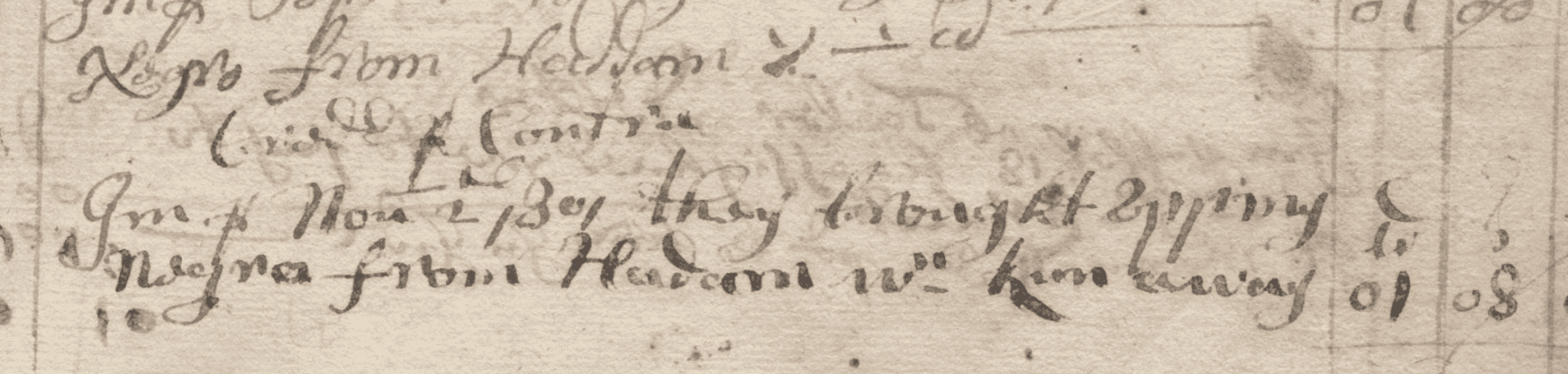
We know little about the life of Jack before he was enslaved by Samuel Wolcott in Wethersfield, CT. We do not know how old he was at that point, or where he was born. There is a notation in Samuel Wollcott’s account book on September 4, 1678, that states “bringing up my Negro from Haddam” and another on November 2, 1680, that states “they brought up my Negro from Haddam” (account book of Samuel Wolcott). This could suggest that Jack may have lived or spent time in Haddam, CT, before or during his time enslaved by Wolcott.
Jack
We know nothing about Jack, save that he was listed as a “negro servant” and that he died in 1757 (Register of the Deaths in Northampton: From the First Settlement of the Town in 1653 to August 1824, p. 33).
Jason
Jason became a member of the First Church of Christ during Jonathan Edwards’ ministry (1728-1750), but the exact date is not recorded. He was listed as “servant to Major Pomeroy,” implying that he was enslaved by Ebenezer Pomeroy, who was a major during this period (First Church of Christ records, p. 57).
Jesse
Jesse was baptized on August 31, 1735, and listed as “servt to Maj. Pomeroy.” This is referring to Ebenezer Pomeroy, who would have been a major at this time (First Church of Christ records, section 2, p. 2).
Joab
It is possible that this record refers to Joab Binney, but we do not have enough evidence to be confident in making that claim. Joab was baptized on January 18, 1741. This record listed him as the “negro servant” to Mrs. Strong (First Church of Christ records, section 2, p. 3), and he was also a member of the church (First Church of Christ records, section 2, p. 8). Joab Binney was employed as a tanner in Stockbridge, and one branch of the Northampton Strongs were also tanners, so there is a tangential connection to Joab Binney. However, it is unclear to which Strong this record refers.
Jonah
Jonah was baptized on January 26, 1735. The baptismal record lists him as “Jonah Negro,” a “negro servant to Maj. Pomeroy.” This is referring to Ebenezer Pomeroy, more commonly known by his rank as Colonel, but who would have been a Major at this time (First Church of Christ records). Jonah was married to Dorothy and father to Felix and Felix.


Josie
Josie was baptized August 31, 1735. The baptismal record listed her as a “servant” to Major Ebenezer Pomeroy. It is also noted in another entry that she was a member of the church in Northampton (First Church of Christ records). There is indication that Josie had an ailment of some sort. Sylvester Judd included the accounts of Dr. Crouch in one of his volumes.
Leah
Leah was enslaved by Jonathan Edwards and his wife Sarah Pierrepont Edwards. Edwards referred to her as “my servant maid” in her baptismal record of April 11, 1736, and as “my servant” in the record of her church membership (First Church of Christ records, section 2, p. 8).
Mingo
Mingo was a man who was enslaved by Samuel Parsons. Mingo may have been a nickname for Domingo (a Spanish name could also indicate that he or a member of his family had previously been enslaved in a Spanish colony, but that is conjecture). In the early 1690s, he was charged twice with fornication with another enslaved person named Hannah. The second case would have been regarded as more serious, because this time Hannah became pregnant.

Moidore
Moidore (also known as Midah, Moydor, and Midor) was enslaved by Caleb Strong. In The Northampton Book, Edwin C. Rozwenc wrote that he was an “accomplished fiddler who was taken along on picnics and parties.” James Russell Trumbull recorded a similar account of Moidore as a fiddler and said that he also worked in Strong’s tannery. Judd wrote about Moidore, calling him Midah, “a likely negro who worked many years for Lt. Caleb Strong in his tannery, was the fidler [sic]…He settled in Worcester [?] + acquired property.”
Nanne
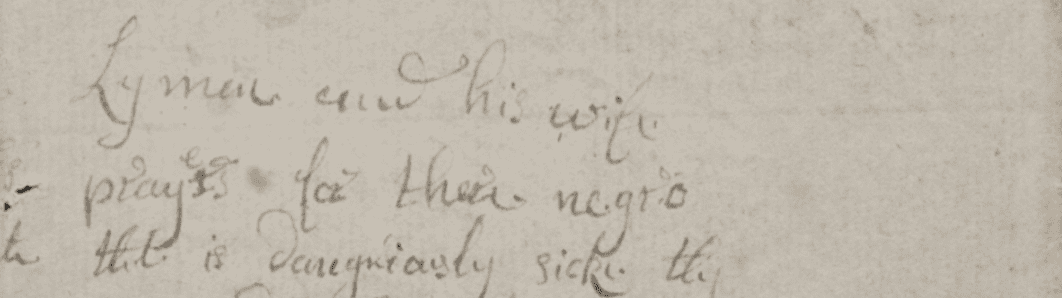
Nanne was enslaved by Benjamin Lyman. She was listed as “Negro girl” in Lyman’s 1723 probate record, and that record placed her value at £40 (Hampshire Council of Governments records, vol. 4; Judd manuscript, Northampton I, p. 219). Nanne is probably a nickname, and further research into how the nickname was used at the time suggests that her full name may have been Anne. Nanne may be the person who is referred to in a 1732 prayer request given to Jonathan Edwards. Edwards only saved half of the piece of paper, so the request is very incomplete, but it is from a member of the Lyman family praying for the recovery of a Black person from a serious illness (“‘For Their Spiritual Good’: The Northampton, Massachusetts Prayer Bids of the 1730s and 1740s”). However, since there is so little identifying information, we cannot be sure that this is Nanne.
Peter
Peter was enslaved by Joseph and Mercy Bartlett. He was given his freedom in Joseph Bartlett’s will of 1754. After he gained his freedom at Joseph Bartlett’s death in 1755, he was employed by Mercy Bartlett, who survived her husband and later left Peter property in her own will. Peter and Dinah, the other enslaved person freed in Joseph Bartlett’s will, were two out of only three people mentioned in Mercy Bartlett’s will. The third was Mary Kingsley, presumably a friend, to whom Mercy left the balance of the estate. The only other entity who inherited anything was the church, to which Mercy left one silver cup.
Peter
Peter was an enslaved person residing in Northampton who was hired by Joseph Hawley III, though probably not enslaved by him. This would have entailed Hawley’s using the labor of Peter, but mostly or entirely paying Peter’s wages to the person who enslaved Peter (whose name is not listed). At the time when Hawley hired him, Peter was a child, but we do not know when he was hired. Hawley lived from 1723 to 1788, so that is currently the window of time in which we know Peter lived (Judd manuscript, misc. MA and Long Island, vol. 8, p. 293).
Phillis
Phillis was born in 1765 and was enslaved in Hadley by the Phelps family. Phillis’ mother was named Peg. Peg was sold away from Phillis and her sister Rose in 1772 to Captain Fay in Bennington, VT, so that she could marry Pomp, who was also being sold to Capt. Fay (Entangled Lives by Marla Miller, p. 58).
Pompy
We know little about Pompy except that he was enslaved by Samuel Clark and left to Clark’s son in his 1745 will.


Abijah Prince
Abijah Prince was born around 1706 and enslaved by Reverend Benjamin Doolittle of Northfield, MA, from around the age of 12. Prince eventually gained his freedom, then lived in Northampton for two years. After he left Northampton, he married a woman named Lucy Terry, had children, and lived most of his life throughout the Connecticut River Valley area and southern Vermont. Abijah Prince appears in records under several notations: Abijah, Abijah a Free Negro, Abijah Negro, and Abijah Freeman. There has been extensive research done on Prince by Gretchen Holbrook Gerzina.
Simon
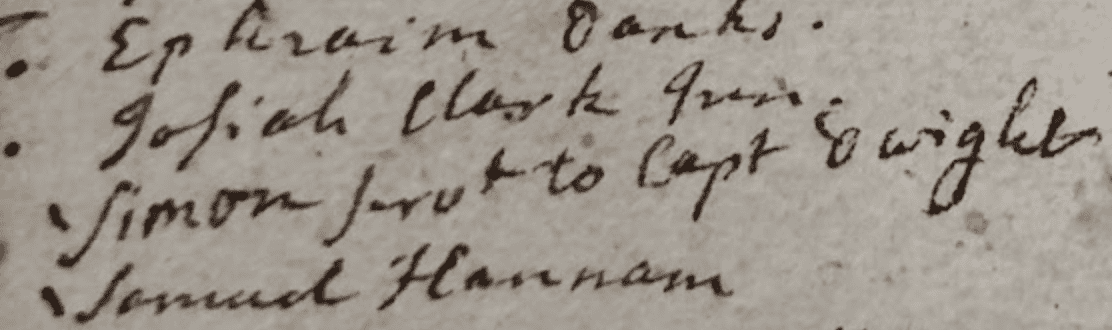
Simon was baptized on February 22, 1736, and probably enslaved by Captain Timothy Dwight, as his baptismal record referred to him as a “servant to Captain Dwight.” He was a member of the church in Northampton (First Church of Christ records section 2, p. 2 and 8). There is less to indicate his race here than for some of the others, but the fact that the record does not list his last name and refers to him as a servant suggests that he may have been a person of color.
Tom
Tom was an enslaved man brought to Northampton to work in a mine in 1765. In his history of Northampton, James Russell Trumbull recorded that on October 5, 1765, several men from Roxbury, Connecticut, took possession of a lead mine about six miles from Northampton. (These men were Charles Scott, Ethan Allen of Vermont, Benjamin Stiles, Abram Bronson, Israel Bronson, John Frederick Stendall, and Thomas Row.) Trumbull states that these men brought with them three enslaved men—Tom, Cato, and Cesar—to work in the mine. Currently, we have no further information on Tom (History of Northampton Massachusetts, vol. 1, p. 364).
Tony
Tony was born around 1722 and was enslaved by Ezra Clapp in Westfield, MA. Tony eventually gained his freedom, but at some point preceding 1781, Clapp attempted to re-enslave Tony. We know this because in 1781, Tony sued Clapp for unlawful imprisonment. The case was tried in the courthouse in Northampton. Tony won, and Clapp was ordered to pay him £2. Tony’s situation illustrates the fact that, despite the ratification of the anti-slavery Massachusetts Constitution in 1780, slavery did not end. (“Uncovering the Stories of Black Families in Springfield and Hampden County, Massachusetts, 1650–1865” in the Historical Journal of Western Massachusetts, Westfield State University, vol. 40, 2012, p. 68).
Venus
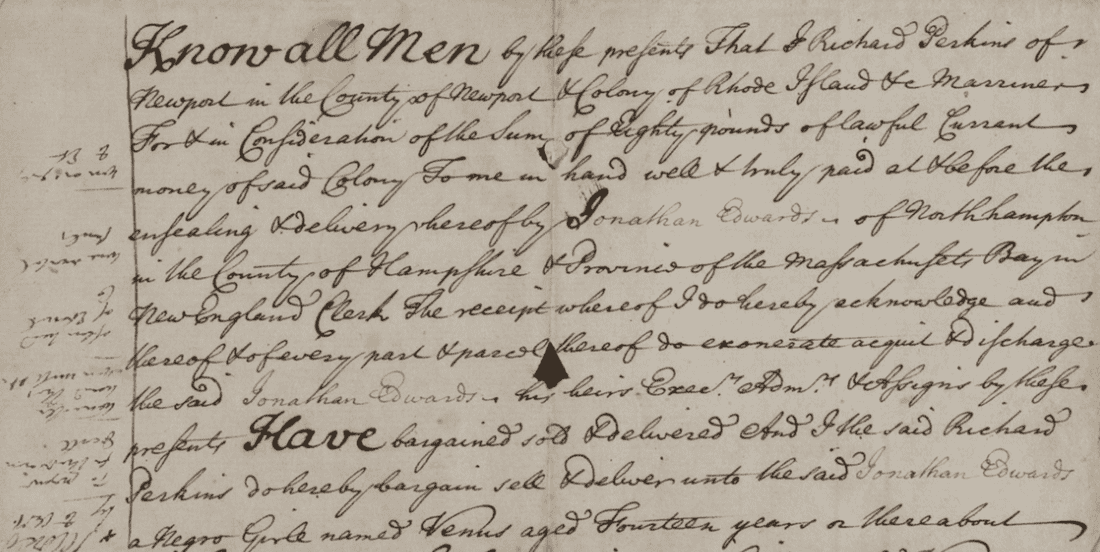
Venus was probably born in West Africa between the years of 1716 and 1718. She was enslaved by Jonathan Edwards at 14 years old, on June 7, 1731. Edwards paid £80 to Richard Perkins in Newport, Rhode Island, to enslave Venus. Kenneth Minkema’s paper “Jonathan Edwards’s Defense of Slavery” has good details on the lives of Perkins and witnesses to the sale, who were traders of enslaved persons, as well as privateers. The only reason that we know about this sale is that Edwards used the receipt for Venus as scrap paper and kept it in order to save the notes that he had written on the back of it. Since no one has yet found documentation of Venus after the sale, historians have posited that she and Leah (See the entry for Leah) may have been the same person, and that perhaps Edwards changed her name to Leah, or that she chose Leah on her entry into the church. It is also possible that Edwards sold her or that she passed away.
People Listed Without Their Names
Methods of record-keeping that dehumanized enslaved people while they were alive continue to obscure their identities even hundreds of years later. Sometimes this is an artifact of an extremely patriarchal society: tax and census records frequently only listed the name of the head of household. However, the erasure of Black, Native, and enslaved people was more extreme. Since they were listed as property in tax records, their existence was recorded as a tally mark, with no indication as to gender or age. We have been able to match some of the unnamed records with individuals, but we have not yet been able to uncover the names of the people in the records below.
Male child (name not listed)
A Black child was listed as “a negro boy” in the inventory of the estate of Ebenezer Strong in 1729, but no name was written. This inventory recorded him as having the value of £80 (Probate record of Ebenezer Strong, Hampshire County Probate Records).
Man (name not listed)
The 1764 Northampton census listed one man as enslaved by Joseph Hunt, but did not list that person’s name. Census records in this period only listed the name of the head of household and denoted all other members of the household by race, and, in some cases, gender and age (History of Northampton Massachusetts, vol. 2, p. 328). This may be the same person who was also listed in 1759 Northampton tax records, but no gender is known for the person in that entry. Tax records at this period were a handwritten form, with boxes that could be checked or filled in with numerals to denote different types of property. Therefore, none of these records preserves the name of the enslaved person it is referring to (Northampton Town Papers Whiting Street Fund, Tax Assessors 1703–1884, 1706–1791 Tax Valuations).
Person (name not listed)
A person was listed in 1752 Northampton tax records as being enslaved by Preserved Bartlett, but the records did not list the person’s name. Tax records at this period were a handwritten form, with boxes that could be checked or filled in with numerals to denote different types of property. Therefore, none of these records preserves the name of the enslaved person it is referring to (Northampton Town Papers Whiting Street Fund, Tax Assessors 1703–1884, 1706–1791 Tax Valuations).

Person (name not listed)
A person was listed in an undated Northampton tax record as being enslaved by Robert Breck, but the tax record did not list the person’s name. Tax records at this period were a handwritten form, with boxes that could be checked or filled in with numerals to denote different types of property. Therefore, none of these records preserves the name of the enslaved person it is referring to (Northampton Town Papers Whiting Street Fund, Tax Assessors 1703–1884, 1706–1791 Tax Valuations).
Person (name not listed)
The 1764 Northampton census listed one person as enslaved by Jonathan Clapp, a miller and tavern owner, but did not list that person’s name. Census records in this period only listed the name of the head of household and denoted all other members of the household by race, and in some cases by age (History of Northampton Massachusetts, vol. 2, p. 328).
Person (name not listed)
The 1764 Northampton census listed one person as enslaved by Joseph Clapp, but did not list that person’s name. Census records in this period only listed the name of the head of household and denoted all other members of the household by race, and in some cases gender and age (History of Northampton Massachusetts, vol. 2, p. 328).
Person (name not listed)
A person was listed in 1770 Northampton tax records as being enslaved by Gideon Clark, but the tax record did not list the person’s name. Tax records at this period were a handwritten form, with boxes that could be checked or filled in with numerals to denote different types of property. Therefore, none of these records preserves the name of the enslaved person it is referring to (Northampton Town Papers Whiting Street Fund, Tax Assessors 1703–1884, 1706–1791 Tax Valuations).
Person (name not listed)
A Black person was listed as “negro servant” enslaved by John Lancton or Langton. We do not know the person’s name, but Lancton’s 1728 probate record stated their value at 60 pounds (Probate Record of John Lancton).
Person (name not listed)
In 1732, a member of the Lyman family gave a prayer request to Jonathan Edwards. (Prayer requests were slips of paper that asked the general congregation to pray for a specific person either because of a happy or sad event.) Edwards only saved half of the piece of paper, so the request is very incomplete, but it is from a member of the Lyman family praying for the recovery of a Black person from a serious illness (“’For Their Spiritual Good’: The Northampton, Massachusetts, Prayer Bids of the 1730s and 1740s”). Since there is so little identifying information, we cannot be sure who the person is, but so far the only named enslaved person whom we have been able to associate with the Lyman family during this period is Nanne.
Person (name not listed)
A person was listed in the 1756 Northampton tax records as being enslaved by Samuel Mather, a doctor, but the tax record did not list the person’s name. Tax records at this period were a handwritten form, with boxes that could be checked or filled in with numerals to denote different types of property. Therefore, none of these records preserves the name of the enslaved person it is referring to (Northampton Town Papers Whiting Street Fund, Tax Assessors 1703–1884, 1706–1791 Tax Valuations).
Person (name not listed)
A person was listed in the 1752 Northampton tax records as being enslaved by Major Jonathan Stoddard, but it did not list the person’s name. Tax records at this period were a handwritten form, with boxes that could be checked or filled in with numerals to denote different types of property. Therefore, none of these records preserves the name of the enslaved person it is referring to (Northampton Town Papers Whiting Street Fund, Tax Assessors 1703–1884, 1706–1791 Tax Valuations).
Person (name not listed)
In 1782, a group stormed the Northampton prison to effect the release of Samuel Ely, an activist who believed that the Massachusetts constitution was not fair to poor farmers. In the process of freeing Ely, the group also freed several other prisoners. Among them was a self-emancipated person whose name we do not know (History of Northampton Massachusetts, vol. 2, p. 459).
Woman (name not listed)
The 1764 Northampton census listed one woman as enslaved by Joseph Hunt, but did not list that person’s name. Census records in this period only listed the name of the head of household and denoted all other members of the household by race, and, in some cases, gender and age (History of Northampton Massachusetts, vol. 2, p. 328).