Mary Bliss Parsons
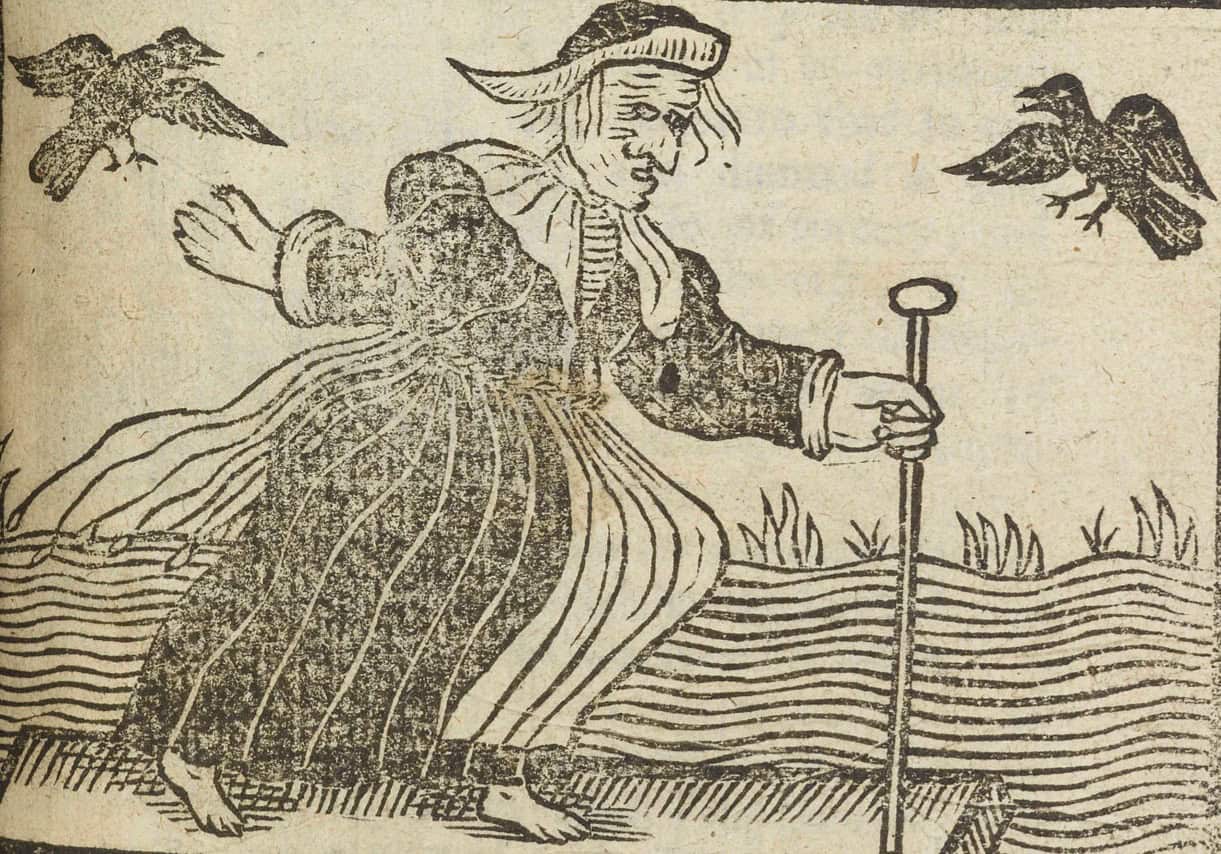
Sometimes it can seem like 17th-century witchcraft trials were a choice between being found innocent and living, and or being found guilty and dying. But many accused walked a winding third path, haunted by suspicion for decades. Mary Bliss Parsons (1628–1712) of Springfield, and later Northampton, was one such woman.
The Other Mary Parsons
In the early 1650s, a Mary Parsons died, accused of witchcraft. This was not Mary Bliss Parsons, but rather Mary Lewis Parsons. Both lived in Springfield, Massachusetts, and they shared a name and a troubled reputation. However, they were not related, and as far as can be seen in the records, were not even socially acquainted. Mary Lewis Parsons’ baby died, and she was accused of using magic to kill it. Though the witchcraft charges were dismissed, she was convicted of murder. Some remembered that at the same time Mary Lewis Parsons was accused of witchcraft, Mary Bliss Parsons began to behave strangely.
Springfield neighbors’ recollections of these “fits” were sometimes less than exact, but one person remembered that she cried out about “witches.” Mary Bliss Parsons and her husband, Joseph, moved to Northampton shortly after the trial, so any suspicions that lingered in Springfield fell by the wayside.
Mary Bliss Parsons in Northampton
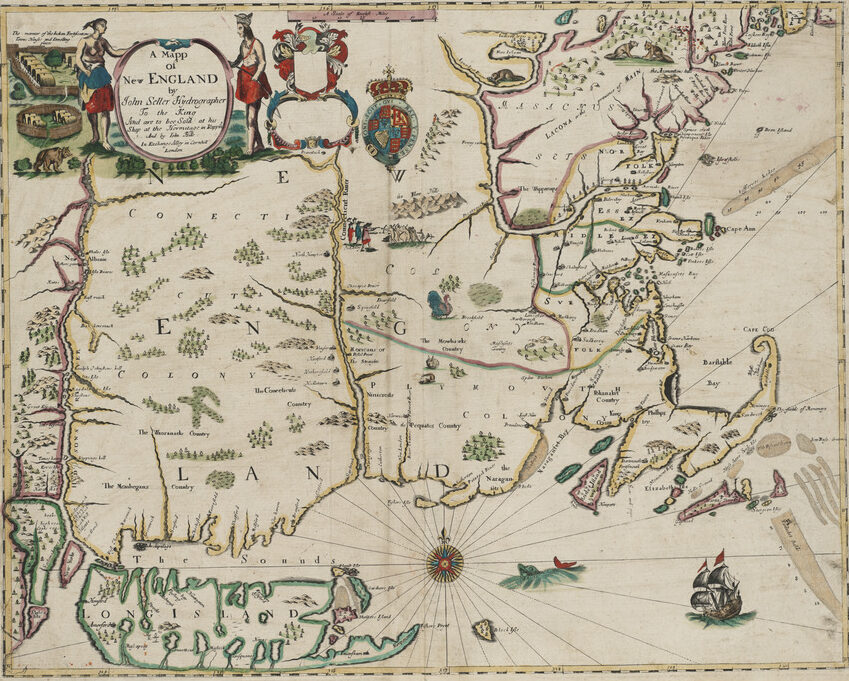
Mary and Joseph Parsons were some of Northampton’s earliest English residents, arriving in town in 1654 and moving onto a plot of land on Market and Bridge Streets where Historic Northampton stands today. The Indigenous population of the area, the Nonotuck, had made agreements with the English about land use, and intended to retain rights to fish, gather, plant, and set up wigwams in traditional places. Instead, English colonists such as the Parsons forced them out.
In this period, Northampton was a tight-knit, patriarchal, and profitable farming community. The Puritan church enforced proper behavior through public punishments. For true believers (who made up a large percentage of first-generation English immigrants to New England), life in Massachusetts was not just about their personal concerns; they were also on the battlefield between God and the devil.
Though they were Calvinists—and believed that God had decided whether any human would be saved before they drew their first breath—being saved in the afterlife would not protect them from being tormented or even killed by the devil’s agents on earth. Among these agents were witches. They believed witches were humans who made a pact with the devil, and received supernatural abilities in return. These abilities included: connections with imps or magical animal assistants; speaking through the mouths of animals; causing crops to fail; and causing pain, harm, or death to animals or other humans without being physically present themselves.
Once in Northampton, Joseph Parsons continued a fur trade with Indigenous people in the Connecticut River Valley, and it made his family one of the richest in Northampton. The couple moved into a small house on a four-acre lot that extended east from present-day Market Street. When they came to Northampton, the Parsons had three young children. (They would eventually have 13.) Their fourth, named Ebenezer, was the first English child born in Northampton.
Sarah Bridgman’s Rumors
In the year after their arrival in Northampton, one of the Parsons’ neighbors, Sarah Bridgman (who lived on present-day Hawley St.), began to spread rumors that Mary Bliss Parsons was a witch. The inciting incidents for these rumors revolved around two of Sarah Bridgman’s children who had suffered serious misfortunes. Her older son had been hit from behind while walking in the marshes near Northampton. He saw no assailant, but fell to the ground and injured his knee. The injury tormented him for some time, and as he was recovering, he saw a ghostly figure of Mary Bliss Parsons pressing on his wound.
More tragically, Bridgman lost her youngest baby very soon after he was born in 1656. She would later recall that he had been born healthy, then one day she heard a knocking at her door, looked out, and saw women in white passing. She later said that as soon as she saw the women she knew “there is wickedness in this place” and that her child would die. No one else heard the knocking or saw the women. When the infant died that year, he became the first English person to die in Northampton.
From a modern perspective, it is tempting to think of people who accuse their neighbors of practicing magic as liars. How could they have witnessed a magical event if magic does not exist? However, accusers and accused alike lived in a world where magic was considered to be real, and sometimes this can blur the definition of truth and lie. We know that Mary Bliss Parsons did not project her spectral form into Sarah Bridgman’s house. We don’t know whether Sarah Bridgman sincerely believed that Mary did.
The Parsons’ Slander Case
In 1656, the Parsons struck back at Bridgman’s accusations by filing a suit against Bridgman for slander. A lawsuit in the 17th century looked quite different from a lawsuit today. Most people in 1600s Massachusetts would not have had a lawyer, and frequently these trials were conducted without a jury unless the accused requested one or it was a capital case.
The case quickly became as much about Parsons as it was about Bridgman. In August, the case was presented in Springfield; in October, it was brought before the Magistrate’s Court in Cambridge. The Bridgmans sought to prove that Parsons actually was a witch, which would mean that Sarah Bridgman could not have slandered her by calling her one. The Bridgmans called witnesses to other magical occurrences, such as William Hannum, who stated that his cow had died after an argument with Parsons. William Branch remembered that Joseph Parsons said that whenever he lost his keys Mary could always find them, and that one time Branch had seen Mary walk into water but her clothes had remained dry.
John Mathews told a much more damning story. He remembered hearing a fight between Joseph and Mary while he was at their house making barrels. According to him, Joseph said that Mary was “led by an evil spirit.” Furthermore, Mathews remembered that Mary had confided in him that “spirits appeared to her like poppets [small human figures or dolls] as she was washing her clothes at the brook” and that sometimes while she was in one of her fits she would find herself out in the middle of a field in her underclothes with no idea how she got there.
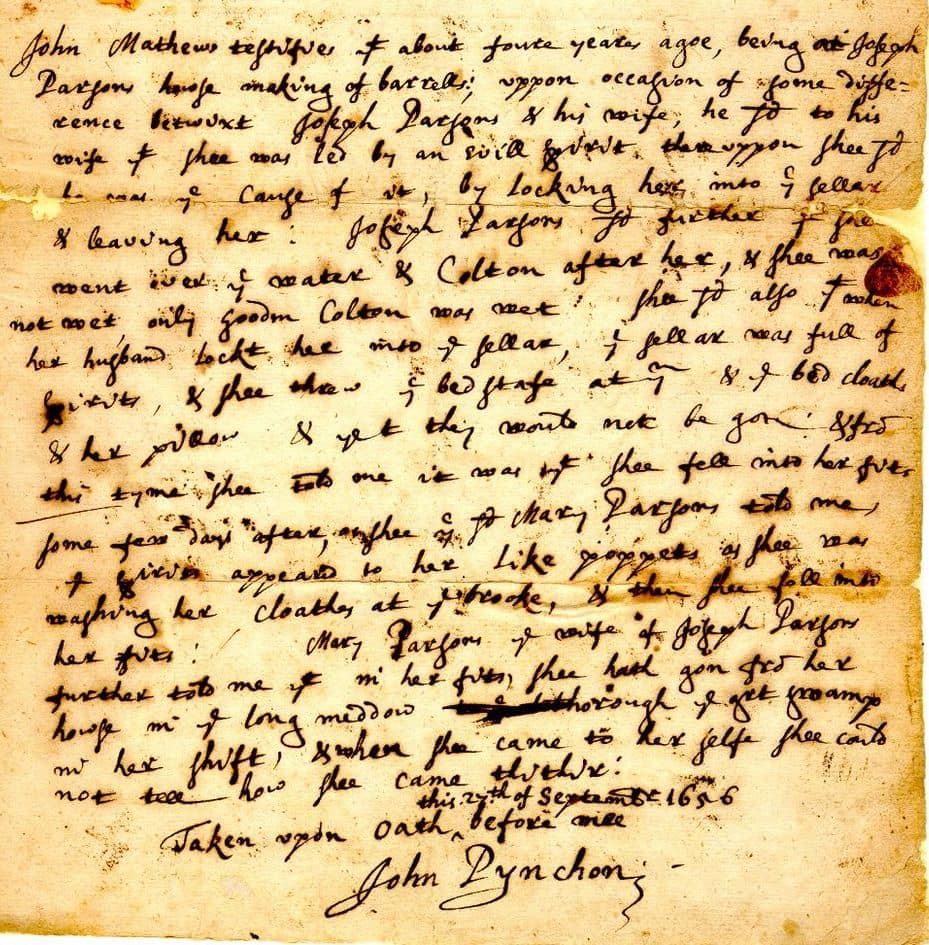
Note: Click on image to enlarge.
Transcription of the Testimony of John Mathews
“John Mathews testified yt about foure years agoe, being at Joseph Parsons house making of barrells; uppon occasion of some difference betwixt Joseph Parsons & his wife, he sd to his wife yt shee was led by an evill spirit thereuppon shee sd he was ye cause of it, by locking her into ye sellar & leaving her : Joseph Parsons, sd further yt shee went over ye water & Colton after her, & shee was not wet only Goodm Colton was wet : shee sd also ytt when her husband lockt her into ye sellar, ye sellar was full of spirits, & shee threw ye bed stafe at ym & ye bed cloathes & her pillow & yet they would not be gon ; & from this tyme shee told one it was yt shee fell into her fits some few days after, shee ye sd Mary Parsons told me, ye spirits appeard to her like poppets as shee was washing her cloathes at ye brooke, & then shee fell into her fits : Mary Parsons ye wife of Joseph Parsons further told me yt in her fits, shee hath gon from her house in ye long meddow thorough ye grt swamp in her shift, & when shee came to her self shee could not tell how shee came thither: Taken upon oath this 27th of September 1656 before mee”
Transcript courtesy of Mary Parsons’ Archive, University of Massachusetts Lowell
Looking back at these descriptions, one might conjecture about the nature of Parsons’ “fits,” but really we do not know much. They could have been the result of a physical disease, a mental-health condition, or simply a heightened emotional state seen through the lens of a highly patriarchal society. Joseph’s treatment of Mary remains an ambiguous factor. Mathews testified that when Joseph had accused Mary of involvement with a spirit, she had fired back that it was his fault for locking her in the cellar. Mathew stated that Parsons described being surrounded by “spirits” in the cellar, and that she had thrown her pillows and bedclothes at them, implying that her confinement was regular enough that she had a bed in the locked cellar. This casts a different light on William Branch’s and Thomas Stebbins’ memories of Joseph saying that wherever he put his keys, his wife could find them, as both mentioned that a consequence of finding the keys was that she would “gett [sic] out.”
It is possible that locking Mary first into the house and then into the cellar was a safety measure, if her condition was one where she would regularly walk out and could not find her way home. However, she may have been confined to her house at least some of the time because her husband wanted to restrict her movements or who she was meeting.
In their slander prosecution, the Parsons focused much more on a case against Sarah Bridgman than on defending Mary’s behavior. Joseph Parsons called two witnesses to testify that James Bridgman, Sarah’s husband, had pressured them into supporting Bridgman’s claim. Parsons also called witnesses to cast doubt on the supposedly supernatural events. One witness testified that he heard William Hannum say that his cow had obviously died of natural causes, not witchcraft, and another witness had examined the cow in question at Hannum’s request, and had told him that the death was natural.
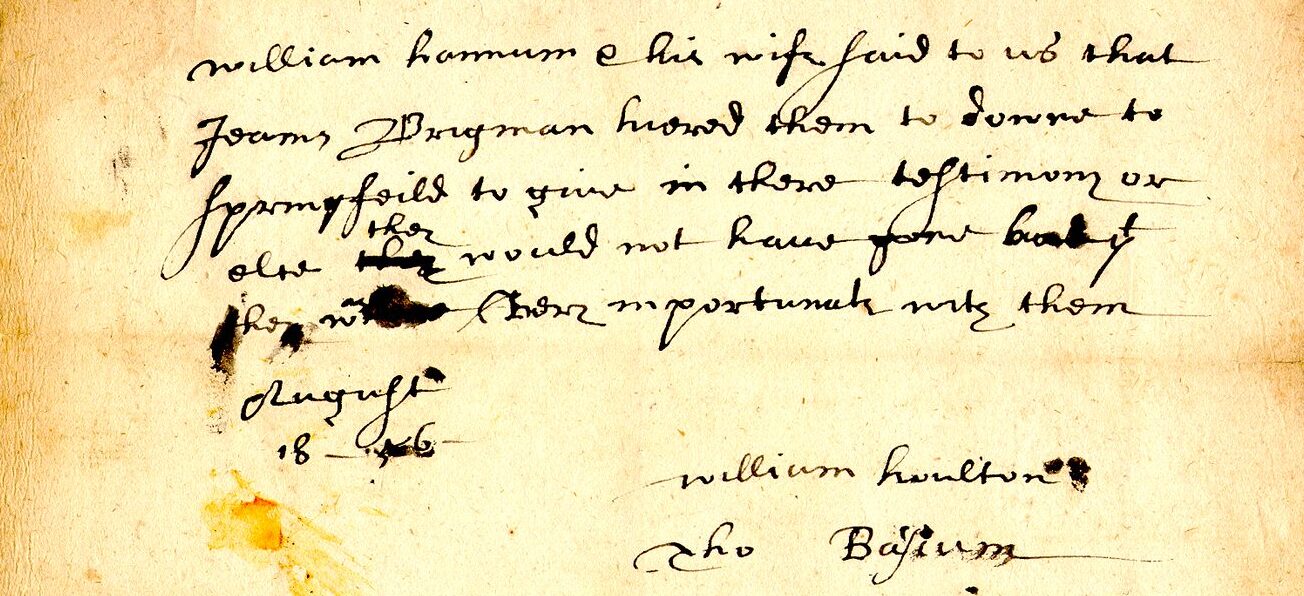
“William hannum & his wife said to us that Joams Bridgman hiared them to downe to Springfeild to give in there testimony or else they would not have gone but yt he was very importunate with them
August
18 [16]56
William Houlton
Tho Bascum”
Transcript courtesy of Mary Parsons’ Archive, University of Massachusetts Lowell
In the matter of Sarah Bridgman’s children, Joseph Parsons was also able to find witnesses who remembered a different version of events. Two of Bridgman’s neighbors testified that her baby was sickly from the time he was born. In the matter of her son’s wounded knee, one of the neighbors went further, stating that when asked to produce the son to verify his witchcraft story, she had not let him speak.
In the end, the Magistrate’s Court in Cambridge ruled against Sarah Bridgman in 1656. She was ordered to apologize publicly or pay a fine. She chose to pay.
Though the slander case had involved multiple witnesses connecting Mary Bliss Parsons with witchcraft, at this point she had never been officially accused. For many women suspected of witchcraft, that did not matter. Rumors could dog their footsteps whether or not the government intervened. In 1668, Sarah Bridgman died. However, it was her daughter Mary’s death that would bring Mary Bliss Parsons under suspicion again. When Mary Bridgman Bartlett died in 1674, she was only 22 years old, and some thought that she died suddenly and of unexplained causes. That same year, 20 years after the slander trial, Mary Bridgman Bartlett’s husband, Samuel Bartlett, and her father, James Bridgman, accused Mary Bliss Parsons of witchcraft.
The Hampshire County Court convened to hear evidence about the accusation, but they did not ask for Mary Bliss Parsons to be present. Parsons went anyway. She stated that she went “having [an] intimation that…she should be called in question…desiring to clear herself of such an execrable crime.” Once there, she heard Samuel Bartlett give a statement “to show the grounds of his fears and suspicion,” and James Bridgman’s statement “entreating that diligent inquisition may be made concerning the death…of his daughter.”
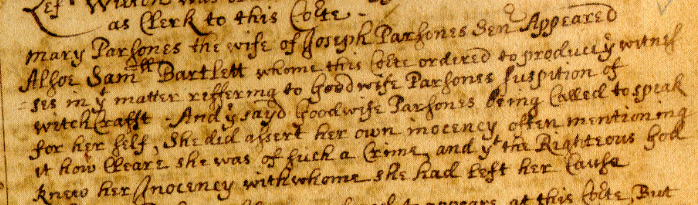
“Mary Parsones the wife of Joseph Parsones Senor Appeared alsoe Samll Bartlett whome this Corte ordered to produce ye witnes=ses in yt matter refferring to Goodwife Parsones suspicion of witchcraft. And ye sayd Goodwife Parsones being called to speak for her self, she did assert her own inocency, often mentioning it how cleare she was of such a Crime, and yt the Righteous God knew her Inocency with whome she had left her cause…”
Transcript courtesy of the Mary Parsons’ Archive, University of Massachusetts Lowell.
After a second hearing, the Hampshire County Court decided that it did not have proper jurisdiction to decide Mary Bliss Parsons’ case, so they passed their evidence along to the magistrates in Boston.
In the meantime, the Hampshire County magistrates mandated that several “soberdized [sic], chaste women” search Mary Bliss Parsons’ body to find “whether any marks of witchcraft may appear.” The mark of witchcraft, or witch’s mark, could be any of several types of skin growths believed to be places where the devil had placed his mark on a witch. We do not know the results of Mary Bliss Parsons’ examination. One court record mentions that there was a report made, but that report has never been located.
Proof of Witchcraft
Any witchcraft case involving a death was serious. It was easier to downplay a witchcraft charge if the defendant was accused of minor injuries and mischief. In 17th-century England, “witchcraft” and “murder by witchcraft” could even be two separate crimes, and the latter was much more likely to result in the death penalty.
Despite the fact that she was accused of taking a life, one advantage Mary Bliss Parsons had was that witchcraft was reasonably hard to prove and by the 1670s, many officials were dubious of the effectiveness of witchcraft prosecutions. After a peak in the mid-1600s, prosecutions against suspected witches were actually trending downward at this point. Belief in magic was widespread, but believing in magic and proving that a specific person used magic were two different things.
Sarah Bridgman’s story about her son seeing Mary Bliss Parsons’ ghostly figure torment him was the evidence that pointed most directly to Parsons being involved in supernatural occurrences. However, testimony where someone saw an apparition, also known as spectral evidence, had dubious legal standing. Since it was believed to be possible for the devil or another witch to project a spectral image of an innocent person, this type of testimony sometimes was not even allowed in court. Eighteen years later, much of the evidence in the Salem witchcraft crisis would rest on accusations based on spectral evidence. In that case, the credence given to this type of evidence was one of the factors that made it easier than normal to get a conviction, and the lack of proof for the same evidence ultimately allowed authorities to retroactively declare many of the accused and executed innocent.
The best proof for a witchcraft trial was a confession and two first-hand witnesses to the same supernatural event, neither of which was present in the case against Parsons. Mary Bliss Parsons was unwavering in declaring her own innocence, and juries often did not convict on witchcraft cases precisely because convincing evidence could be so hard to find. There are unfortunately few surviving records of the witchcraft trial in Boston, but we do know that ultimately Parsons was acquitted.
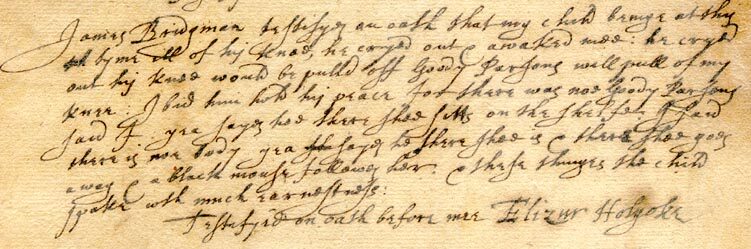
“Testifyed on oath before me Elizur Holoyke James Bridgman testifed on oath that my child benige at this tyme ill of his knee, he cryed out & awaked mee : he cryd
out his knee would be pulled off Goody Parsons will pull of my knee : I bid him hold his peace for there was noe Goody Parsons said I. yea says hee there shee sitts on the shelfe, I said there is noe body yea sayed he there shee is & there shee goes away & a black mouse followes her : & these thigns the child spake with much earnestness…”
Transcript courtesy of the Mary Parsons’ Archive, University of Massachusetts Lowell.
After the Trial
Even after her acquittal, Parsons was not out of the woods. Being found innocent often did nothing to stop suspicions within the accused’s community. Like Parsons, they could be accused again years, or even decades, later. If a perceived witch was seen as having escaped judgment, they could also face harsh reprisals. Mary Webster of Hadley was found innocent by the very same court that was trying Mary Bliss Parsons, and locals in her community still attempted an extra-judicial hanging when she was back in Hadley.
A few years after the Parsons witchcraft trial, in 1678, Northampton experienced another potentially supernatural death. This time, it wasn’t so much the manner of death that was odd, as it was the condition of the body. Even after he had been dead for some time, witnesses described John Stebbins’ body as warm and said it was covered in strange and unexplainable marks. The investigation into this suspicious death was headed by Samuel Bartlett, who had already accused Parsons of witchcraft. Though Mary and Joseph Parsons moved to Springfield soon after Stebbins’ death, it is not clear if their decision was motivated by renewed witchcraft suspicions.
Though there were no further accusations, we know that the suspicions endured to some extent. In Springfield in 1702, Betty, a woman of color referred to as “Betty Negro,” was sentenced to 10 lashes across her back for striking a teenager, Peletiah Glover, and telling him that his grandmother was a witch who had caused the deaths of multiple people. Peletiah’s grandmother? Mary Bliss Parsons. Even 28 years after the witchcraft trial, and 46 after the initial accusation, these suspicions were still common knowledge. One of the presiding judges in this case was Joseph Parsons II, Mary Bliss Parsons’ son and Peletiah’s uncle. He had a stake in the case not just as a family member of the injured party, but also as someone whose personal reputation would be affected by continued witchcraft rumors surrounding his family. There are very few details about this case, so we do not know to what extent it is indicative of a larger awareness of the accusations against Mary Bliss Parsons. However, it is apparent that the rumors were deemed dangerous. Though the case did involve an assault, the judgment treated that as a secondary concern. The focus was on what Betty said about Parsons. It is also worth considering whether imposing a harsher punishment for slander would have been acceptable to the magistrates because the accused was a person who was marginalized by their society.
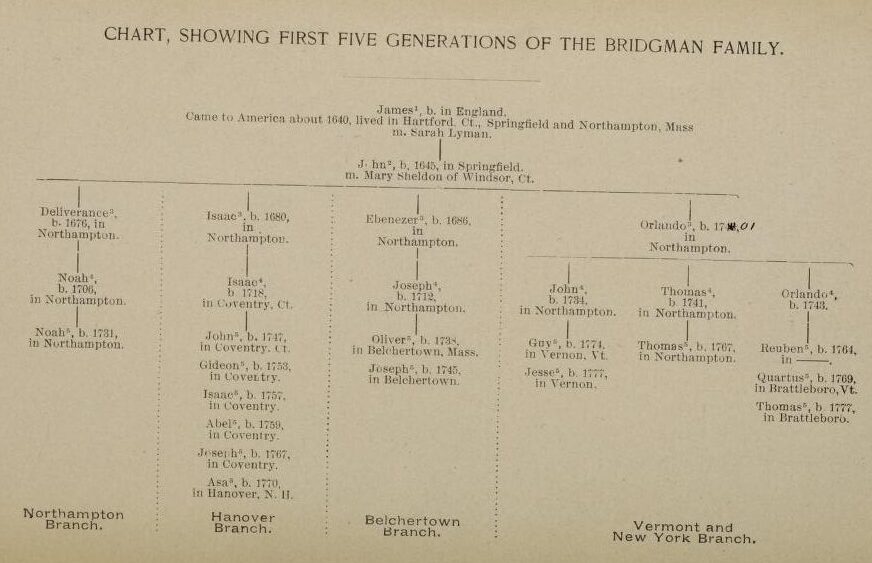
A few years later, this story had a sentimental epilogue. Mary Parsons (Mary Bliss Parsons’ granddaughter) married Ebenezer Bridgman (Sarah Bridgman’s grandson) in 1709. It is a bit too storybook to say that this alone ended the feud, but the fact that the two families were able to unite in this way indicates that tensions had cooled. Sarah Bridgman was long dead, but Mary Bliss Parsons was still alive, and may have been close to the couple, since they named their children after her parents.
A happy ending does not a happy story make. Even a guilty verdict would not have brought Sarah Bridgman’s child back to life, and it might not even have eased the pain and trauma that may have played into her allegation. Moving out of Northampton would not erase the decades of suspicion around Mary Bliss Parsons. If the real demons that plagued her were an undiagnosed medical condition or a controlling husband, then those demons were with her in Springfield too. These two women are at the center of this story, but ultimately we know little about their internal struggles, even though those struggles were what propelled them into a clash with each other.
ADDITIONAL RESOURCES
Becker, Kathy-Ann. Silencing the Women: The Witch Trials of Mary Bliss Parsons. Booklocker.com, 2013. (historical fiction)
Demos, John. Entertaining Satan: Witchcraft and the Culture of Early New England. Oxford University Press, 1983.
Parsons, Henry. Parsons Family: Descendants of Cornet Joseph Parsons, Springfield, 1636–Northampton, 1655. Frank Alben Genealogical Company, 1912.