Joseph Hawley III
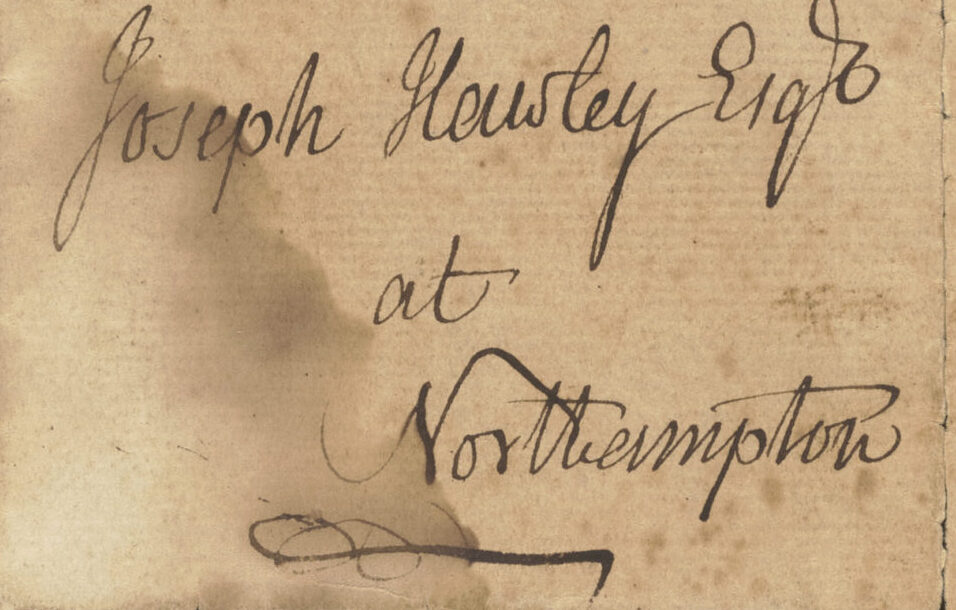
Joseph Hawley III was a prominent lawyer, judge, town officeholder, military officer, and legislator. He was a leader of the American revolutionary movement in Massachusetts and a champion of individual rights. Because he was a major in the Hampshire County militia, in local records he was referred to as Major Hawley.
Early Life and Family
Joseph Hawley III was born into a leading Northampton family, at their homestead on Pudding Lane, which was later renamed Hawley Street. He was minister Solomon Stoddard’s grandson and pastor Jonathan Edward’s first cousin. In 1752, he married local woman Mercy Lyman (1729–1806). They had no children of their own and adopted Mercy Hawley’s nephew, Joseph Clarke.

Hawley’s father, Joseph Hawley II (1682–1735), was a local businessman and town leader who was so swept up in the evangelical fervor of the Great Awakening that he ended his own life in 1735. This was perhaps one of the factors that motivated his son to advocate strongly for the dismissal of his cousin, Jonathan Edwards, as Northampton’s minister.
Hawley graduated from Yale in 1742. During King George’s War (1744–1748), he served as chaplain with a Massachusetts regiment that seized the French fortress of Louisbourg in 1745. After his military service, he studied law in Suffield, Connecticut, and began practicing in Northampton in 1749.
Political Leadership
He was an early leader of the revolutionary movement and among the first to recognize that war would be necessary to achieve independence. Locally, he was chairman of the Northampton Committee of Correspondence, in which members shared news about the Patriot cause and coordinated resistance against British control. At the provincial level, Hawley was initially selected as one of the Massachusetts delegates to the first Continental Congress in 1774. He declined because of a fear that his episodes of severe depression might return and compromise his ability to perform. In his place went future president John Adams. Hawley’s periods of deep melancholy continued to severely restrict his ability to participate in politics. After 1777, he mostly withdrew from public life with the exception of involvement in the controversies related to the Massachusetts Constitution in 1780. He led the fight for universal manhood suffrage and bitterly opposed the requirement that officeholders take an oath of belief in Christianity; he proclaimed it as an affront to the “inalienable Right of Conscience.”

Demeanor as a Common Man
Joseph Hawley III was remembered for his commitment to democratic ideals, for his modest demeanor, and for eschewing public honors. In 1876, the Hampshire Gazette published Benjamin Tappan’s recollection of meeting Hawley at his Northampton home. Tappan settled in Northampton from Boston in 1768, and this incident probably took place shortly after.
“Having ascertained where Major Hawley lived, he [Benjamin Tappan] proceeded into Hawley Street (then called ‘Pudding Lane’) and approached the house to which he had been directed. He was confounded at the sight. Major Hawley was esteemed a great man even in Boston, and he supposed his residence would be like those of gentlemen in Boston. Instead of this, he perceived an old, homely house, the front door of which was fastened by a wooden latch, to which a string or leather strap was attached, and hung out on the outside. He doubted whether this was Major Hawley’s house, but ventured to knock, and received the common salutation, ‘walk in.’ He entered the room, where he found a man in a plain and checked shirt, who asked him to take a chair. He was now more puzzled than before: this, he thought, could not be Major Hawley, and he inquired, ‘Does Major Hawley live here?’ ‘My name is Hawley, sir,’ was the reply.”
Hawley died March 10, 1788, and is buried in Bridge Street Cemetery. Hawley, Massachusetts, is named for him.
Additional Resources
Historic Northampton has documents and objects associated with Joseph Hawley and his family. Browse the catalog or contact us to schedule a research visit.
Clune, Mary Catherine. “Joseph Hawley’s Criticism of the Constitution of Massachusetts.” Smith College Studies in History 3, no. 1 (October 1917).
Dinnie, Sam. “The Burden of Proof: Sex, Power, and Patriarchy in the Eighteenth-Century Connecticut River Valley.” The New England Quarterly 98, no. 1 (2025): 70–108.
“Joseph Hawley Papers, 1653–1804,” Manuscripts and Archives Division, The New York Public Library.
Trumbull, James Russell. History of Northampton, Massachusetts, Vol. 2. Press of Gazette Printing Co., 1898.