Bathsheba Hull
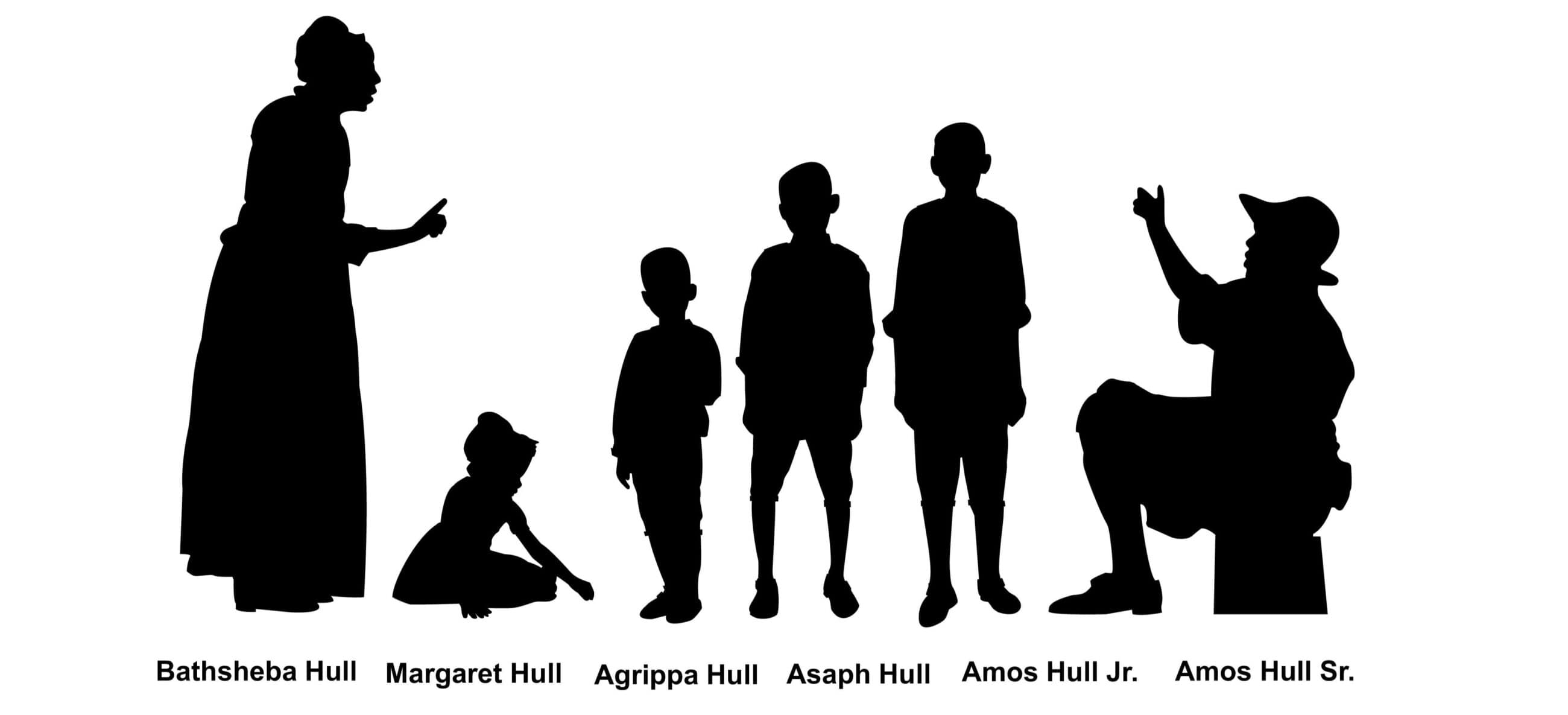
Bathsheba Hull was the first Black woman to own land in Northampton, who after freeing herself from the enslavement of Ebenezer Pomeroy, went on to have four children including Revolutionary War veteran Agrippa Hull.
Bathsheba’s Timeline
c. 1720 — Born, place unknown
Unk. date — Enslaved to Ebenezer Pomeroy
1744 — Testifies in “Bad Book Affair”
1748-49 — Freed by Ebenezer Pomeroy who pays 50 pounds surety bond
By 1754 — Marries Amos Hull
1761 — Amos Hull dies. The next year Asaph indentured in CT
1765 — Bathsheba excommunicated
1765 — Bathsheba purchases house; property ownership challenged
1766 — Bathsheba evicted and loses custody of male children
1766 — Philemon Lee is warned out of town but returns; Asaph dies
1767 — Marries Philemon Lee; Lee removed and told not to return
1767 — Philemon Lee jailed and told not to return; he returns and is jailed again.
1768 — Philemon Lee released. Bathsheba’s property taken. She and Margaret are warned out of Springfield.
1770s — Bathsheba and Philemon Lee move to Stockbridge. Lee buys then sells land.
c. 1793 — Bathsheba dies
Black Women in the 18th-Century
For most enslaved and even free Black women in 18th-century New England, sources can be sparse. It’s the responsibility of historians to put together the pieces to imagine the full depths of their lives from traces and glimpses that the archive provides. An entire life must sometimes be imagined from a single reference to a person in a will, a tax record, or a census. For Bathsheba Hull, however, this is not the case.
Bathsheba is one of the few Black women of this early period who, though experiencing enslavement, was able to make herself known to historians not just in one moment of her life, but throughout. Bathsheba’s story unearths the depth and complexity of enslavement as well as freedom-making in the town of Northampton during the 18th century.
The Bad Books Case
Our first encounter with Bathsheba in the archive comes in 1744 in a court case known as the “Bad Books Case.” We believe her to have been either in her late teens or early twenties during this time, putting her birth somewhere in the 1720s. Famed minister of Northampton, Jonathan Edwards had accused several young white men and boys of sharing literature containing sexual content. Scholars believe the books to have included Aristotle’s Master-piece, a 1684 anonymously written manual on sex and midwifery, as well as the more modern 1736 Thomas Dawkes’ The Midwife Rightly Instructed. In mid-18th-century New England, these kinds of texts would have been considered not only lewd but dangerous. Instead of addressing these young men privately, Jonathan Edwards decided to bring out a young Bathsheba to testify against these men. Jonathan Edward’s choice to force Bathsheba to speak put her in real danger as the young men she was accusing came from privileged and powerful Northampton families. She herself was enslaved by Ebenezer Pomeroy, an influential and active businessman in Northampton. Pomeroy would have been familiar with the families these young men came from and Bathsheba could be punished not only by the families of the accused but by the very family that enslaved her.
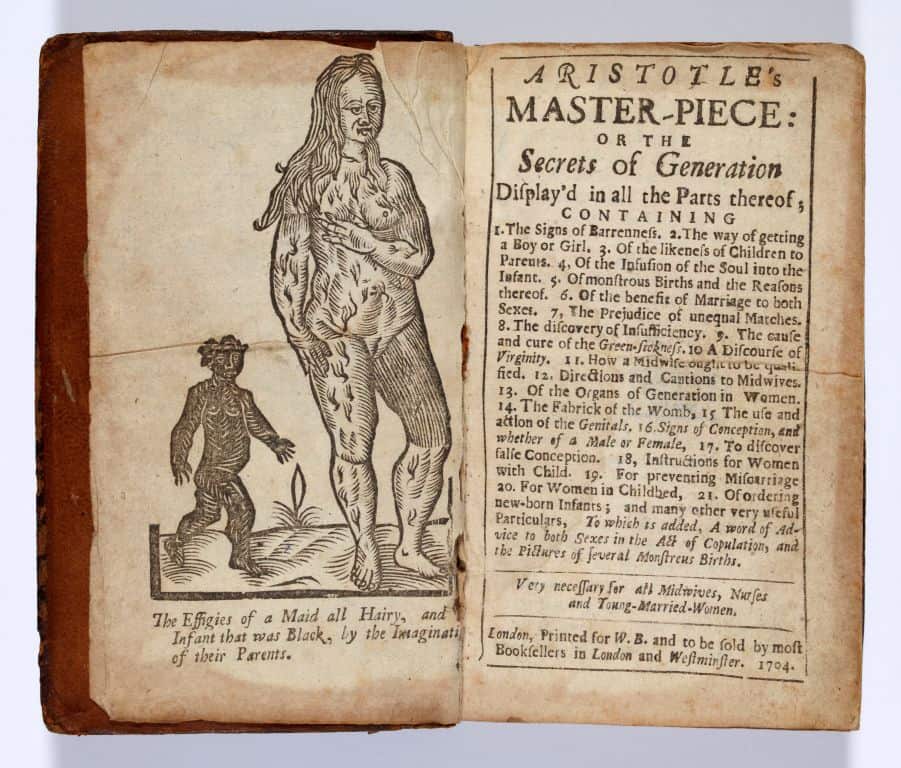
Despite fear of backlash, Bathsheba testified that she had seen Noah Baker, Timothy Warner, and Elkanah Burt reading the inappropriate texts. When asked what they were reading, Bathsheba testified that they jokingly called it “the bible” before reciting passages aloud to Bathsheba and a young white woman of a similar age, Naomi Warner. Edwards’ notes indicate that she said that the boys were “Ready to kiss them, and catch hold of the girls an [sic] shook ‘em,” suggesting that Noah Baker, Timothy Warner, and Elkanah Burt assaulted Bathsheba and Naomi Warner. Bathsheba’s testimony did not end there. She went on to report of a similar experience in which Oliver Warner approached her and Joanna Clark, another young white woman, to harass them, taunting ”When does the moon change girls? I believe you can tell.” Joanna Clark corroborated Bathsheba’s testimony. Though Bathsheba’s involvement ended after her testimony, the incident escalated and eventually contributed to Jonathan Edwards’s termination as pastor of Northampton.
This was a highly significant moment in the history of Northampton. Not only was this the scandal of the 1740s decade in Northampton but at the center of it all was the testimony of a young enslaved Black woman. Bathsheba’s testimony nor her racial identity would not have gone unnoticed. Though Black people were not forbidden from the early New England courthouse, their presence, let alone their public testimony, was rare. Many of the enslaved and free Black population were active members of the church, but few if any spoke publicly in front of the community, let alone against the white sons of the town’s elite. What we today would see as her bravery could have been perceived at the time as foolishness or obstinance. Bathsheba was risking her own safety by publicly testifying against white young men who were deeply connected to Bathsheba’s own enslaver. Her testimony would not be soon forgotten.
Finding Freedom
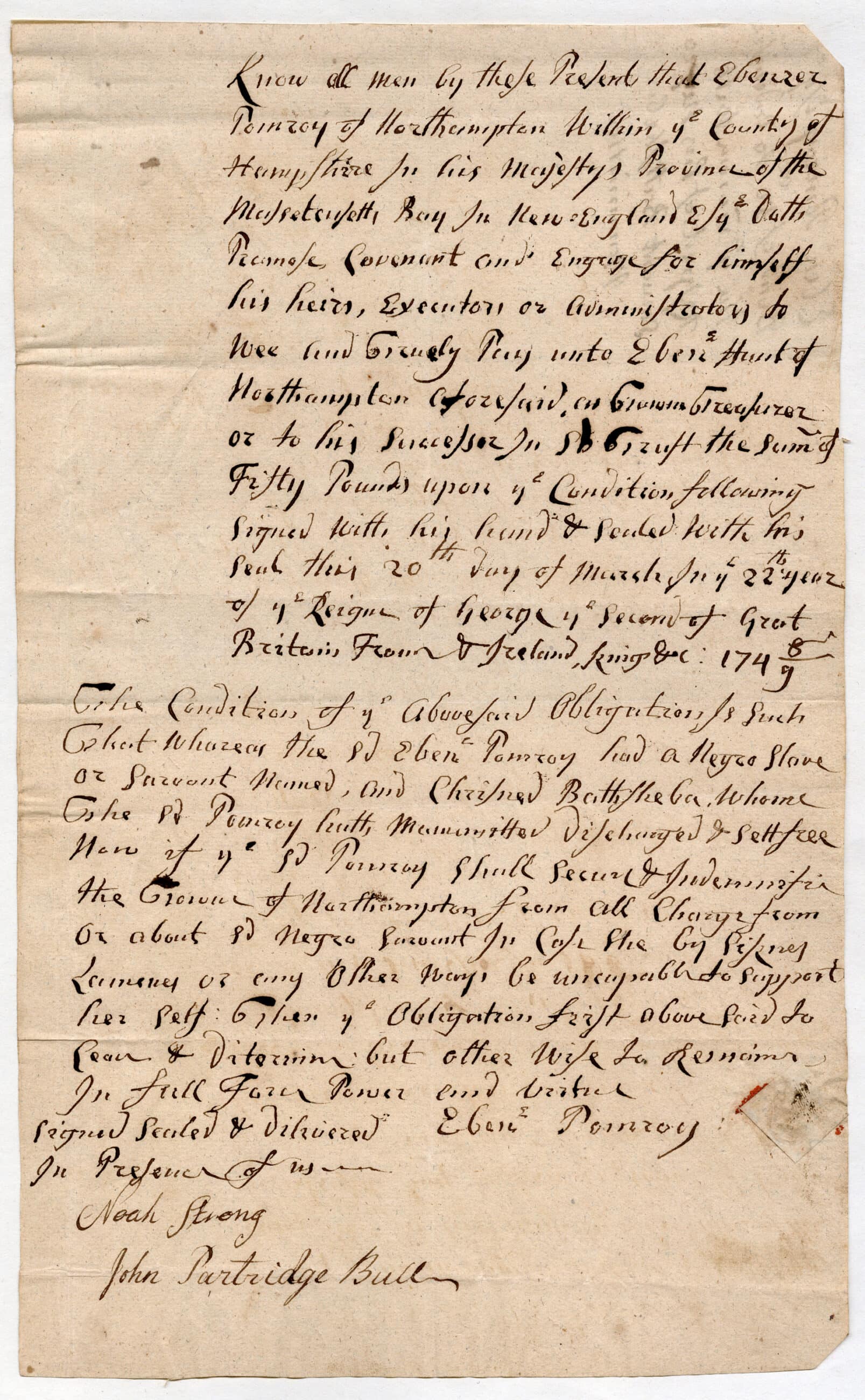
Five years later in 1749, Bathsheba was set free by said enslaver, Ebenezer Pomeroy. Ebenezer Pomeroy wanted to be rid of her, going so far as to write up a surety bond with the town of Northampton, paying 50 pounds “in case She by siknes lamenes or any other way be uncapable to support her self.” That money did not go to Bathsheba and instead went to the town so that Pomeroy could prove he was no longer responsible for her. But why would an enslaver like Ebenezer Pomeroy free Bathsheba, let alone pay 50 pounds to do it? It was not motivated by a moral change of heart or political ideals against slavery. Ebenezer Pomeroy continued to enslave four other people: Josie, Jonah, Jason, and Jesse. If he had truly wanted to be rid of Bathsheba so desperately, why had he not sold her instead? Enslaved women, especially ones of Bathsheba’s age (early to mid 20s) would have been extremely financially valuable. Enslaved women of that age were at their most valuable because they were in their reproductive prime. Pomeroy could have received more than 50 pounds by selling her to someone else in town, but he chose not to.
Perhaps, no one was willing to purchase Bathsheba. Given the stakes of the Bad Books case just five years prior, everyone would have remembered Bathsheba’s willingness to testify publicly about the intimate details of white men who were supposed to be above her. Though we cannot be sure why exactly Ebenezer Pomeroy chose to free Bathsheba, we know her personality was that of a bold and freedom-seeking woman, resisting the gendered expectations and conditions of enslavement in mid-18th-century Northampton.
With her newly gained freedom, Bathsheba immediately began building a life for herself. Within the first five years of freedom, she married Amos Hull, another free Black man once enslaved in Northampton. He was an active member of the church, whose records list him as formerly enslaved by Jonathan Hunt III. We do not know how he attained his freedom. Once Bathsheba and Amos were married, they lived on land close to present-day West Street. He bought supplies from Ebenezer Hunt, his enslaver’s uncle, to begin a small farm. Like many cash-poor New Englanders during this time, he paid for his goods with his own labor, by mowing, threshing, fanning, and reaping. While supporting themselves with their own labor, Bathsheba and Amos had five children. The first born was Amos Jr., in 1754, next Asaph was born in 1755. A baby girl named Margaret was born in 1757, though she did not survive. Agrippa was born in 1759, and finally another girl, also named Margaret, was born in 1761. All of Bathsheba’s children were born free, but not all died that way.
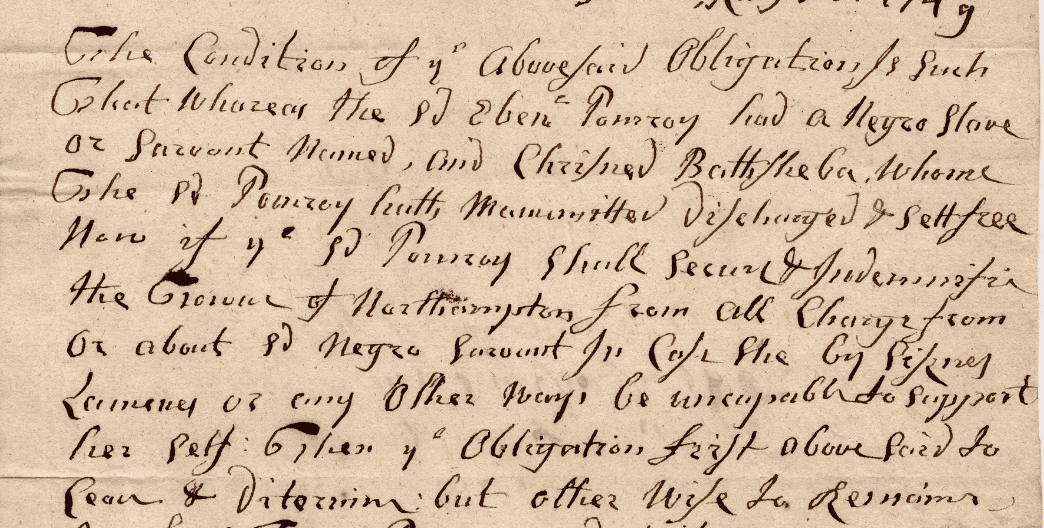
Transcription: “The Condition of ye Above said Obligation Is such That Whereas the sd Ebene Pomroy had a Negro Slave or Servant Named, and chrisned Bathsheba, whom The sd Pomroy hath, Manumitted Discharged & sett free Now if ye sd Pomroy shall secure & Indemnifie the town of Northampton from all Charge from or about sd Negro servant in case She by siknes lamenes or any other way be uncapable to support her self : then ye Obligation first Above said to lean and ditermine but other wise to remain [In full force power and virtue].”
Buying Land
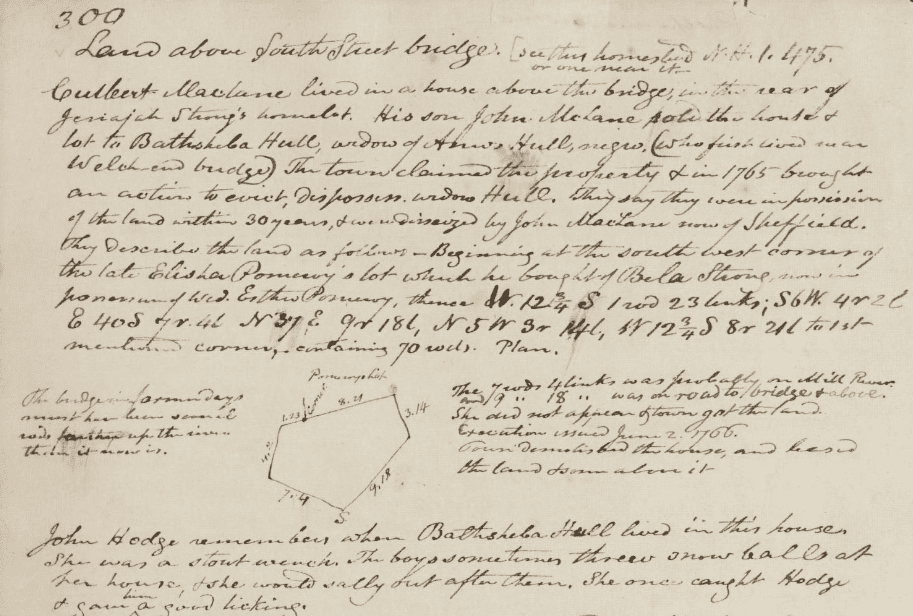
Tragedy struck the Hull family in 1761 when Amos Hull Sr. died of unknown causes. His death left Bathsheba widowed and vulnerable with four children all under the age of 10. Luckily Bathsheba had been working independently taking in laundry from families in the Northampton community such as Ebenezer Hunt. She had saved enough money to purchase her own plot of land and a house from a man named John McLane, “on the Island near South Street bridge, formed by the Mill Trench” as recorded by James Trumbull, a 19th-century historian of Northampton. Her land would have been one of the least desirable plots in town, as the waste water of the Mill Trench would have consistently eroded and flooded her land, making it difficult to plant a garden to feed her family. However undesirable the land was to the rest of Northampton, it was affordable enough for Bathsheba so she bought it and made a home there for herself and her five children.
As far as we know, Bathsheba was the first Black female landowner in Northampton. Land ownership was already rare for Black people in New England, even more so for Black women. Land ownership implied permanence in a community, not only for Bathsheba but for her four children as well. By buying land in Northampton, she was making a political statement declaring that there would always be a free Black presence in Northampton capable of building wealth for future generations. This was extremely threatening to the white elite that ruled Northampton.

Four years later in 1765, Bathsheba had been living on the island with her children and supporting them independently. She defended her home from harassment by local rowdy youth who would pelt it with snowballs.
She had begun a relationship with a local man Philomen Lee, a cordwainer (shoemaker) from Simsbury, CT, described as “fair-skinned mulatto.” Lee was warned out of Northampton, multiple times and in one of his court cases revealed his intention to purchase land in Northampton and establish residency. If he had successfully purchased land and the two were married, they would have been able to consolidate their wealth and become the largest Black landowners in Northampton at the time. The town of Northampton would not let this occur.
On March 17th, 1765, the First Church of Northampton excommunicated Bathsheba on charges of stealing. First Church records state that Bathsheba had been admonished about it, but that she remained “impertinent.” We do not know if these charges were true and if they were the conditions of her theft. Though working hard to support her family, as a free Black woman and a widow she would have already been living on the fringes of society. In 1765, the same year as her excommunication from the church, the town of Northampton filed a lawsuit against Bathsheba challenging her property rights to the land she bought from John McLane. They accused her of illegally purchasing the land because John McLane had been allegedly squatting. Trumbull wrote that John McLane had inherited the land from his father, Cuthbert McLane, and that there was never an issue with the town when these two white men occupied the land. The town of Northampton only took issue with the land’s owners when the owners were Black.
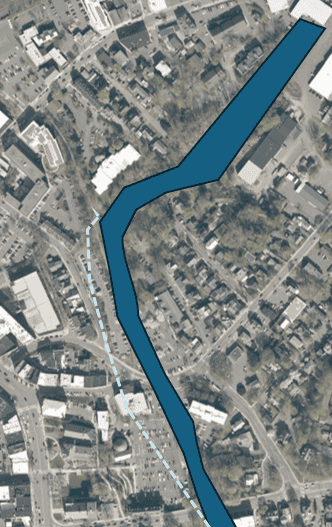
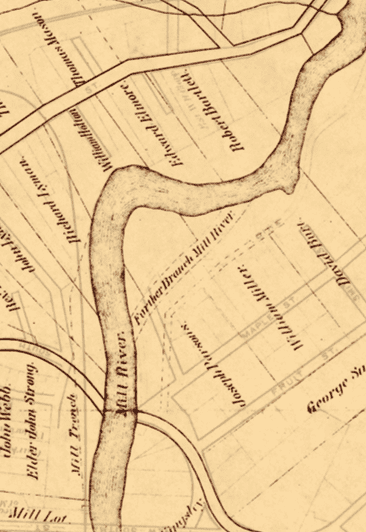
Maps showing the location of Bathsheba’s 3-acre island property. Click on images to enlarge.
On June 18, 1766, Philomen Lee was officially warned out of the town of Northampton but he refused to leave. In April of 1767, Philomen Lee and Bathsheba married. Ten days later Philomen was captured by the town and forcibly removed to Simsbury, Connecticut. The same year the court sided in favor of the town, making Bathsheba’s continued residence on the island illegal. Despite facing the loss of her home and husband, Bathsheba remained in Northampton.
Less than a month after his forced removal, Philomen returned to Bathsheba in May of 1767. On August 18th of that year, Philomen was captured again, this time jailed in Springfield. By September 1, he had returned to Northampton again. He was yet again captured and sent to jail. This time legal proceedings were brought against him by the town of Northampton. During the court case, Philomen expressed his desire to purchase land in Northampton and establish residency. Later records from 1772-1773 indicate that Philomen had the means to purchase land, and yet the town of Northampton refused to allow it.
The same year as Philomen’s repeated arrests, the town agreed to offer to purchase Bathsheba’s land rather than seizing it. If she refused to sell or “would not accept a reasonable price for it,” the town was authorized to “demolish and abate [her house] in such a manner as to render it uninhabitable.” By the spring of 1768, her husband Philomen Lee had been released from jail and the town made a motion to remove Bathsheba’s belongings from her house and move them to “the lower end of Pleasant St.” She had officially lost her home in Northampton.
Children of Bathsheba and Amos Hull
Amos Hull Jr. (1754)
Asaph (1755)
Margaret (1757, died)
Agrippa (1759)
Margaret (1761)
The Limits of “Freedom”
When Bathsheba lost her land, she didn’t just lose her home she lost her family as well. The Northampton Overseers for the Poor took custody of her two oldest children, Amos Jr. and Asaph Hull. Despite their young age, her two oldest sons were deemed capable of productive labor and were thus forcibly entered into contracts of service for white people. Amos Jr. was 14 and sent to Hadley. We do not know if Bathsheba ever saw him again. Asaph was sent to Fairfield, CT, indentured as a servant to the Pomeroy family, the very family that had once enslaved his mother. He died there at the age of 10 in service to a white family despite being born free. Bathsheba likely never saw him again. Her youngest son Agrippa Hull went to Stockbridge to stay with family friends, Rose and Joab Binney. Rose had once been enslaved to Jonathan Edwards, the minister who led the Bad Books case that made Bathsheba famous. Now she and her husband Joab who had been enslaved to the same man as Amos Hull Sr. took in Agrippa. Margaret was the only child to stay with her mother Bathsheba.
With Philomen Lee still jailed in Springfield and nowhere to stay, Bathsheba took Margaret to Springfield. On May 17th, Philomen Lee was released from jail. Later that month, Bathsheba and Margaret appeared before the court again, this time as homeless. Springfield ruled them as transient. They were ultimately warned out of Springfield.
From there, we do not know exactly where Bathsheba and Margaret went. Perhaps she went immediately to Stockbridge to reconnect with Agrippa and the Binneys. Eventually they did settle there. Philomen Lee appears in the tax list for Stockbridge in 1771, but we do not know if Bathsheba was with him at the time, or where the family was between 1768-1771. Philomen Lee purchased land in Stockbridge in 1772, suggesting that he, Bathsheba, and Margaret began to build a life for themselves in Stockbridge. Agrippa could have stayed with them too, or continued to live with the Binneys. In 1773, Philomen Lee sold his land, and we do not know what became of him after this. He may have left and separated from Bathsheba, or possibly he passed away. Either way, by 1791, Bathsheba was in need of care.
Final Years
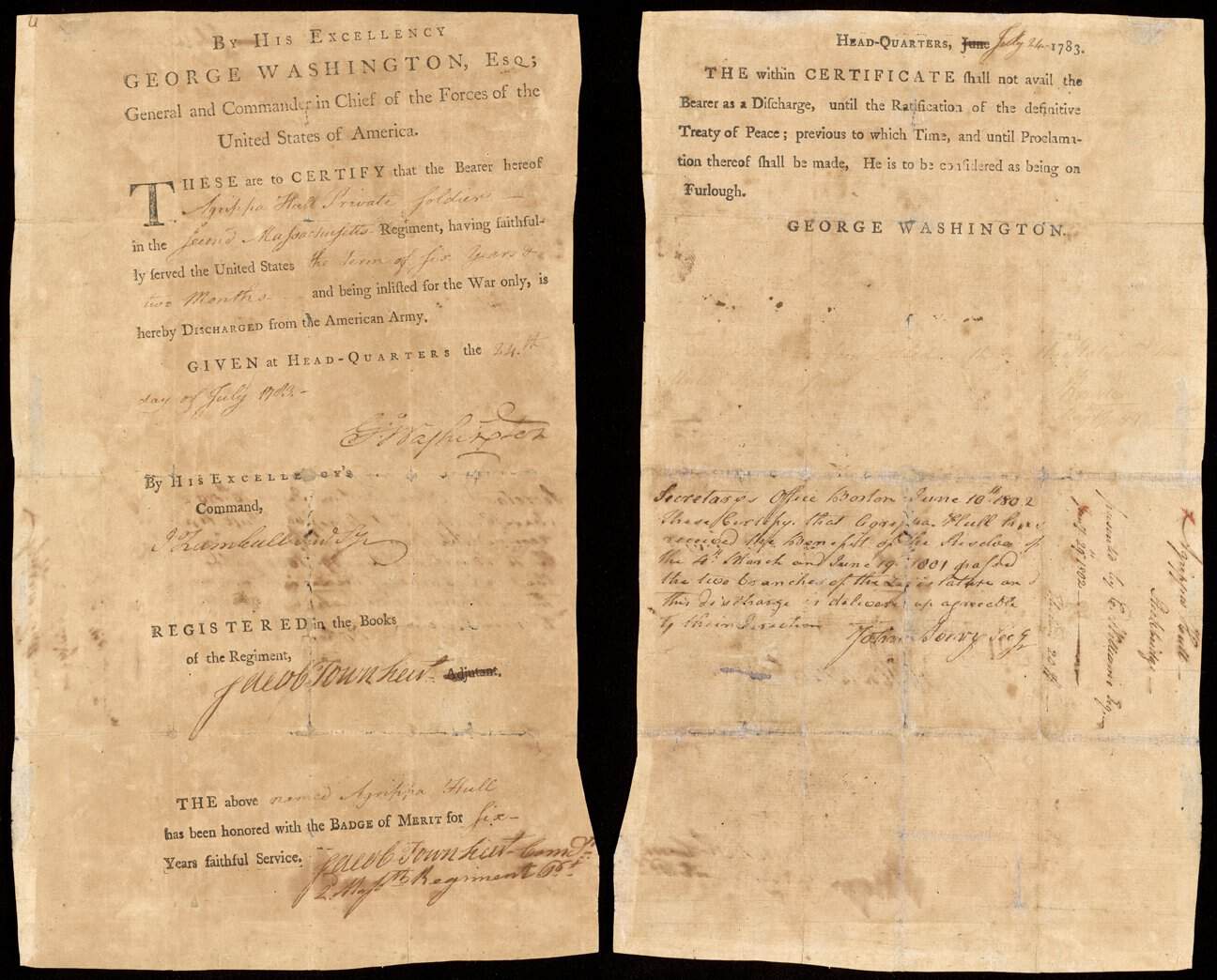
During the time between the 1770s-1790s, despite not knowing much about Bathsheba’s whereabouts, we know much more about her son Agrippa. In May of 1775, he enlisted in the U.S. Army and fought in the American Revolution as a private. He rose through the ranks, eventually working as assistant for General Tadeusz Kosciuszko. With his earnings he returned to Stockbridge and bought a piece of land for £9. He got a job working for Theordore Sedgewick, the lawyer responsible for representing Elizabeth “Mumbet” Freeman in the case that declared slavery unconstitutional in Massachusetts. With Sedgewick’s help, he married a self-emancipated woman, Jane Darby, and the couple had five children, only three of whom survived to adulthood: Charlotte, James, and Aseph. During his lifetime, Agrippa became the largest Black landowner in Stockbridge. Throughout his many successes, he continued to support his mother Bathsheba as she grew older.
By October of 1791, Agrippa, now 32, had been the sole caretaker for his mother for many years. His sister Margaret, living nearby, had married a man named Cesar Freeman ,and the couple refused to contribute to the care or welfare of Bathsheba. Agrippa took his brother in law, Cesar Freeman to court in a case summary stating:
The said Ceasar [sic] is able to contribute to the Support and comfortable subsistance [sic] of the said Bersheba [sic], but doth refuse to contribute anything thereto – And that in consequence thereof the sd Agrippa hath alone for many years past Supported & maintained his sd Mother to his great injury: wherefore the said Agrippa prays this Court that the sd Ceasar [sic] may be oblidged [sic] to do justice.
Though this was clearly a moment of tension for the family, it shows that unlike many other enslaved and formerly enslaved people in Northampton during her lifetime, Bathsheba was cared for by her family and loved ones at the end of her life. She would have been in her early- to mid-70s. Putting aside the fact that many individuals in the 18th century did not live to such ages, especially those who experienced enslavement, the few who did frequently spent their final years still providing service for their enslavers or employers. We know that at the end of Bathsheba’s life she was permitted to rest and be cared for by her son Agrippa, in his house, on land that he owned.
Conclusion
Throughout Bathsheba’s extraordinary life we see fragments of a woman who through her own words and actions forces the archives to take note of her existence. In an age when most enslaved women surface from the depths of the archive once or twice, to have an individual such as Bathsheba make herself so fully visible, even with gaps of knowledge, is very special. Her story reveals the complexities not only of enslavement, but in the building of a free life for Black women in 18th-century New England. Her quest to own her own land and establish residency in the community of Northampton, and the town’s pushback also help us contextualize the growth of free Black communities in rural New England towns like Northampton.
ADDITIONAL RESOURCES
McCarthy, Cliff. “Amos and Agrippa Hull.” Documenting Black Lives Project. Accessed May 23, 2026. Documenting Black Lives Project.
First Church Records. Hampshire Room for Local History, Forbes Library.
Trumbull, John. History of Northampton, Massachusetts, from Its Settlement in 1654. Vol. 2. Northampton, MA: 1898.
Judd Manuscript Collection. Hampshire Room for Local History, Forbes Library.
“Surety Bond Signed by Ebenezer Pomeroy, March 20, 1748/9.” Northampton Town Papers. Forbes Library.