Shays’ Rebellion
Introduction
Shays’ Rebellion was an armed uprising in Western Massachusetts and Worcester in 1786-1787 by debt-ridden citizens.
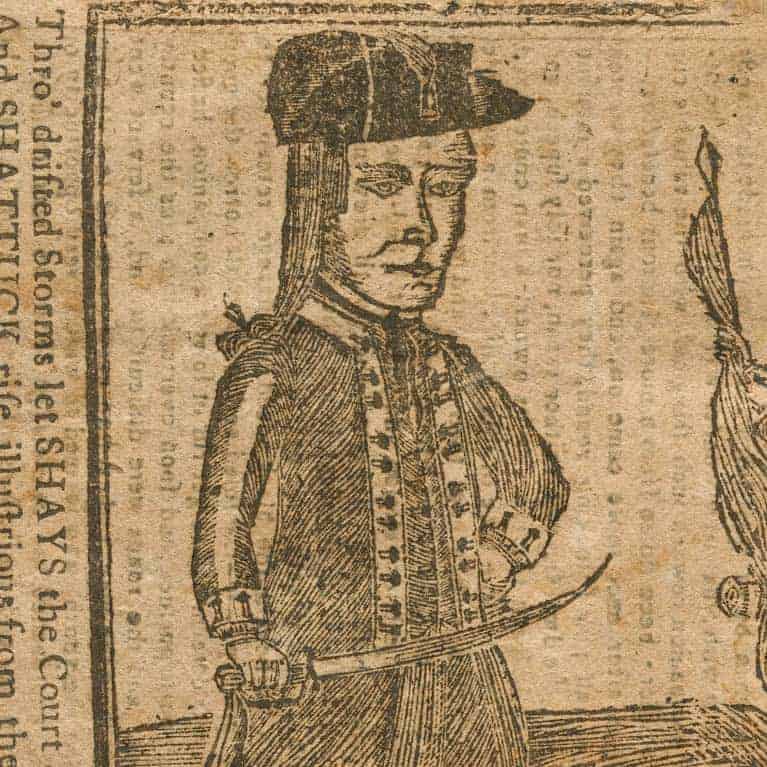
For two hundred years, Shays’ Rebellion has been interpreted as a failed uprising of disaffected farmers who wanted to overthrow the government. However, in Bullen’s reading of the historical record, it was a successful nonviolent anti-austerity campaign that won relief from flagrantly unjust taxes and economic policies.
Farmers Petition for Reform
After the Revolution, Boston elites passed economic policies that would have provided wealthy investors and speculators—including many legislators themselves—with windfall profits on their war bonds and other investments by raising taxes on regular people. These taxes would have forced many farmers off their land or imprisoned them for debt.
Starting in the spring of 1786, farmers petitioned for reforms. When the legislature adjourned in July without addressing the crisis, fifty towns sent delegates to the Hatfield Convention in late August, where they drafted a joint petition demanding reforms.
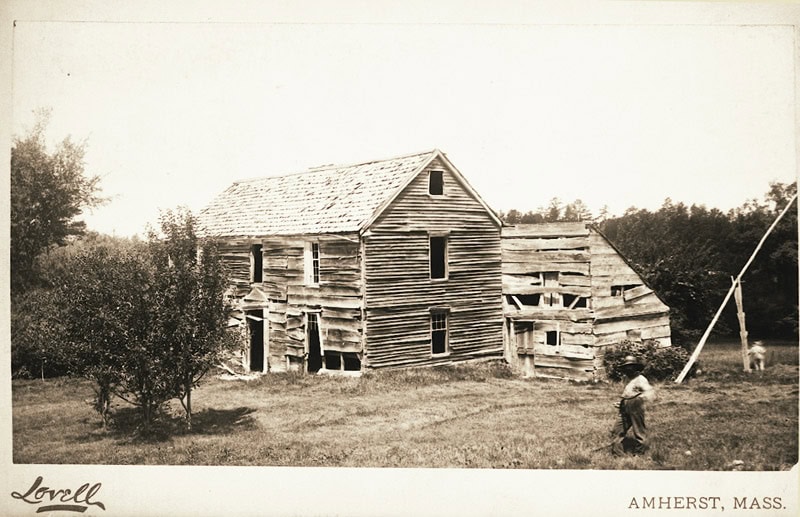
When this petition too was ignored, the farmers of Pelham (most of Scots-Irish heritage) organized a resistance campaign. In the hill towns of Worcester, Hampshire, and Berkshire counties, far from well-organized authorities in the east, self-reliant communities were used to regulating their own affairs (Hampshire included Franklin and Hampden counties at the time). Drawing on a longstanding English tradition of theatrical street protest, they marched to the Court of Common Pleas in Northampton (the court that was next to the meeting house), with fife and drum, and uniforms and muskets if they had them. Their goal was to show their countrymen that they were being mistreated and that they were proud farmers who won their country’s liberty—not a “democratic mob,” who wanted to seize rich people’s wealth.
Northampton Court Closed
On August 29, 1786 a total of 1,500 farmers and veterans surrounded the Northampton Court of Common Pleas on Main Street (about where the Hampshire County Superior Court is on Main Street today), to keep it from hearing cases that would have resulted in property and livestock being seized. The judges adjourned without conducting business. There was no violence.
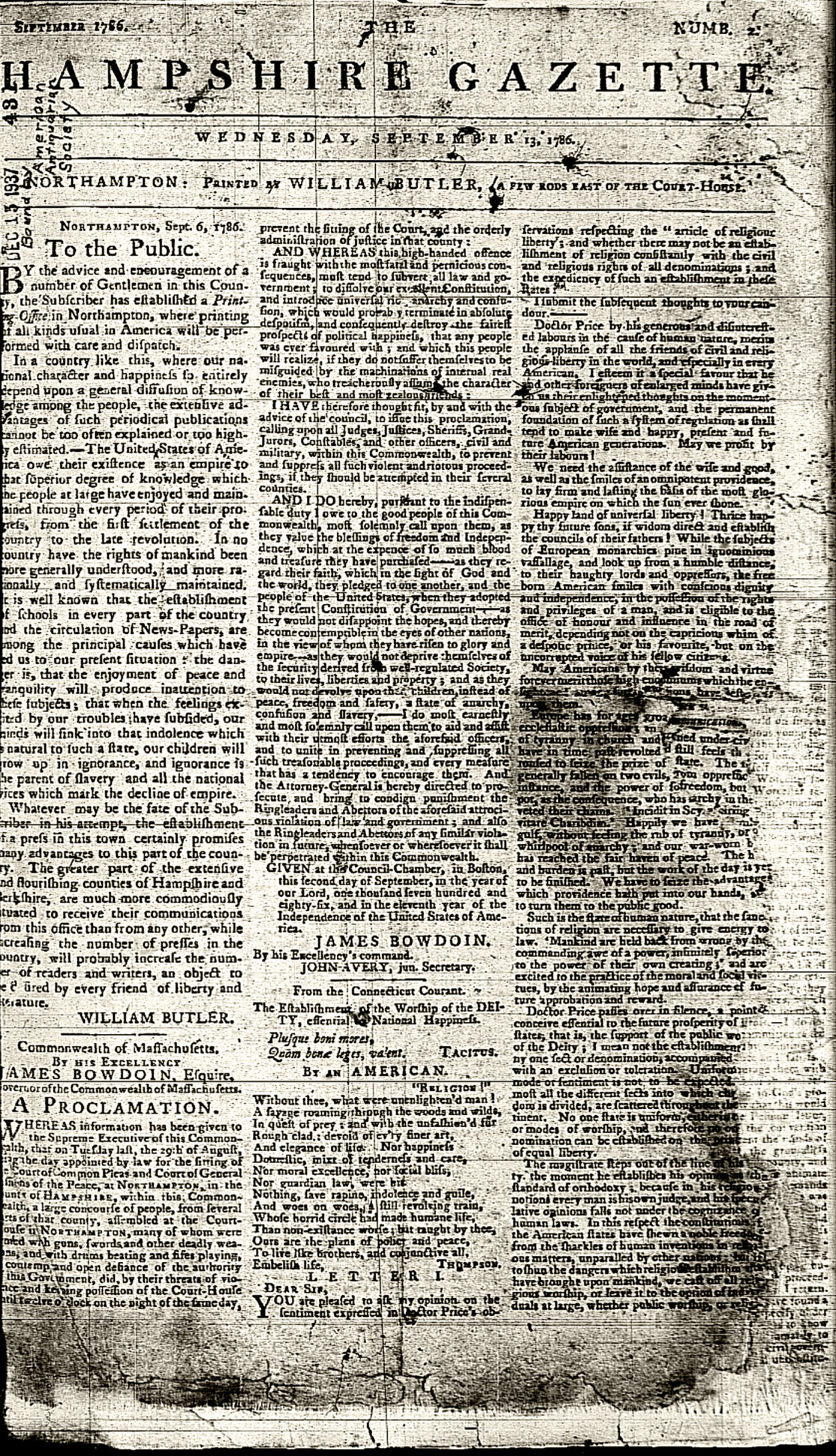
Days later, Governor James Bowdoin published a proclamation stating that the people’s action had introduced “riot, anarchy and confusion” into the state, effectively criminalizing the farmers. In response, farmers in Concord, Taunton, and Worcester closed their courts as well. In Great Barrington, Colonel John Ashley gathered 1,000 militiamen to protect the court, but when Justice William Whiting asked the militiamen to take sides, 800 men sided with the people. That court too was closed without violence.
Government Threats
Over the next five months, from September 1786 through January 1787, the government made increasingly tyrannical threats. Governor Bowdoin and his chief advisor Samuel Adams suspended Habeas Corpus thus allowing them to detain individuals without a court order. They passed a Riot Act that would seize protestors’ property and imprison them for a year, with 39 lashes every three months, while indemnifying deputies for liability if they injured or killed protestors. Revolutionary War hero Henry Knox called for federal troops to impose order in the heart of the disgruntled country.
When the people expressed anger over these tyrannical measures, Daniel Shays, the head of the Pelham militia, was asked to take responsibility for the court closings. As a commissioned officer who had risen through the ranks from ensign to captain during the Revolution, he commanded respect from a broad swath of Massachusetts society, and he kept the peace at court closings in Springfield and then in Worcester, although the Regulators were mostly led by local leaders, without centralized coordination.
Hampshire Gazette begins publication
In between court dates, the crisis played out in newspapers such as Northampton’s Hampshire Gazette, which was founded in September 1786 to give people a place to advocate for their cause. In their editorials, merchants and elites claimed that farmers were “luxurious in their diet, idle and profligate in their manners, encouragers of foreign manufacturers,” while farmers complained that “opulent gentlemen in the capital, and maritime towns,” were “accumulating fortunes by the general distress” and they said that they were being brought under tyranny again. Still, this rhetoric did not lead to violence when the protesters, who called themselves Regulators, (drawing on a long English tradition of the people regulating the business of their regions) obstructed the courts through November and December of that year. Even when the government arrested three Regulators in Groton in late November, the people maintained restraint.
Conflict at the Federal Armory
The crisis came to a head on January 10, 1787, when Governor Bowdoin issued arrest warrants for Shays and sixteen other leaders and prepared to send an army of 3,000 men from Boston under General Benjamin Lincoln.
Daniel Shays of Pelham gathered the Regulators on the 19th, but they waited for almost a week, until Lincoln’s army was only three days away, before he led 2,200 men to the federal arsenal in Springfield on January 25. In a letter Shays published in the Hampshire Gazette, he explained that the Governor and his adherents were resolved to support the courts by the point of the sword, to “crush the people’s power at one bold stroke and render them incapable of opposing the cruel power, Tyranny.”
Shays wrote that they hoped to keep the stockpiled weapons from being used against them, but when they arrived in Springfield, they were repulsed by cannon fire that killed four and wounded twenty. The Regulators never fired a shot. They merely retreated to their cries of ‘murder, murder.’
The Gazette published first-hand accounts of this confrontation, in addition to letters Shays wrote from Pelham to Lincoln in Hadley, negotiating for a truce, and for the bodies of the dead and wounded. When these negotiations proved fruitless, 1,500 men withdrew with Shays from Pelham to Petersham. Lincoln’s army surprised them there after marching 30 miles overnight in a storm that dropped 18 inches of snow. Again, Shays’ men fled without firing a shot, and Shays and 300 supporters fled to Vermont.
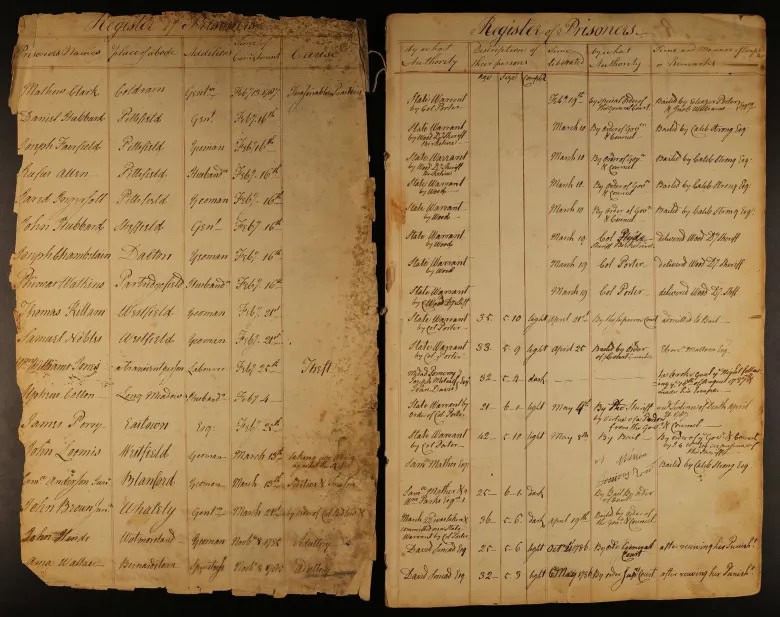
For the next six weeks, intrigues, chases, arrests and sporadic arson convulsed the region, but on April 1, 1787, the people went to the polls, and elected John Hancock to be governor in a two-to-one landslide. By the end of May, Hancock had repealed almost all of Bowdoin’s inflammatory policies.
Public Hanging in Northampton Stopped
After August 1786, the Regulators had mostly been active in Worcester or Springfield, but it returned to Northampton in June 1787, when two Regulators were set to be hanged. The town erected a gallows on “Pancake Plain”—north of Chapel Street and south of Burt’s Pit Road in the vicinity of Ray Ellerbrook athletic field.. Troops came from Boston to keep the peace. A minister preached an execution sermon. On the gallows, the sheriff placed nooses over the men’s heads, then read a stay of execution, delaying the hanging. In the end, no one was hanged, and only a handful of Regulators served time or paid fines for protesting.
Need for a Strong Federal Government
In spite of the people’s victory, these events continue to be called “Shays’ Rebellion” because nationalists like Alexander Hamilton, Governor Bowdoin and war hero Henry Knox had used the disturbances for their own purposes. For years, elites had been trying to win George Washington’s support for a Constitutional Convention to revise the Articles of Confederation. From Boston, Knox reported to Washington that “12 or 15,000 desperate and unprincipled men” were staging “a formidable rebellion against reason, the principle of all government, and the very name of liberty.”
This threat succeeded in drawing Washington out of retirement to strengthen the federal government and create a standing army and federal taxation. “Shays’ Rebellion” thus entered the books as an insurrection that proved the need for a strong government to control dangerous popular movements—instead of as a sustained, nonviolent—and successful—campaign that showed the people’s power.
From Paris, Thomas Jefferson exclaimed that he had never seen a rebellion so honorably conducted and said that America should never be twenty years without such a campaign, to rein in powerful interests.
Daniel Bullen is the author of Daniel Shays’s Honorable Rebellion. (2021)
FURTHER READING
Bullen, Daniel. Daniel Shays’s Honorable Rebellion. Yardley, PA: Westholme Publishing, 2021.
Goldscheider, Tom. “Shays’ Rebellion: Reclaiming the Revolution,” Historical Journal of Massachusetts, Vol. 43 (1), Winter 2015.
Richards, Leonard L. Shays’s Rebellion: The American Revolution’s Final Battle. University of Pennsylvania Press. 2002.
Szatmary, David P. Shays’ Rebellion: The Making of an Agrarian Insurrection. University of Massachusetts Press, 1980.
EDUCATIONAL WEBSITES
Daniel Bullen, Daniel Shays’s Honorable Rebellion‘s companion website.
Historic Northampton, History of the Hampshire Gazette.
“Shays’ Rebellion and the Making of a Nation” (educational website).