The 1696 Encounter Between Nonotuck and English Hunters
In all of the deeds transacted between Nonotuck and English people in the mid-1600s, the Native signatories reserved full rights to freely hunt, fish, and harvest wild foods on the lands identified in those deeds.1 But in practice, colonial leaders never intended to honor those rights, and Native people who tried to exercise them did so at their peril. So, when English settlers went off to hunt in forested areas that Native people depended upon for sustenance, conflicts were inevitable.
On October 5, 1696, three English settlers from Hadley — Richard Church, Samuel Bowen, and Ebenezer Smith — went hunting in the forested lands north of the town, near Mount Warner. Around sunset, after his companions split off, Church appears to have crossed paths with four Native men — Maqualos, Mahweness, Wenepuck, and Pemequansett — who were started to see an Englishman hunting in an area that they considered to be their rightful territory. An altercation ensued, and Church was killed, with a gunshot to the head and an arrow to the body.2
When Church’s companions realized that he had not returned home, a search party was formed. Forty colonists from Northampton and Hadley, accompanied by 9 Nipmuc men, located Church’s body and followed the tracks until they came across the four Native men, walking through the woods near Mount Toby, nine miles north of Hadley. The search party took Pemequansett captive, and shot and wounded Mahweness, who escaped with Wenepuck and Mahqualos. When the three came into Hatfield on their own, they were arrested.
All four Native men denied their guilt when they were initially questioned by three magistrates and two ministers. The youngest of the Native men, 18 year old Pemequansett, was then ordered to go with several English men to the place where Church’s body was found. There, after interrogation, he stated that he and Wenepuck, while standing at a considerable distance away, saw Mahweness and Mahqualos shoot the man. Two of the magistrates, Justices Hawley and Parsons, then took Mahqualos and Wenepuck to the same place, where they identified the same trees and blamed Mahweness. Mahweness, in his turn, blamed Mahqualos.3
On October 21, 1696, a special court session of Oyer and Terminer was held in Northampton, where testimony from the English search party and other witnesses was heard, and the four Native suspects were examined. The members of the Native community living near Hatfield (about 50 men, women, and children) were disarmed and brought to Northampton, where they were required to attend the proceedings. Members of the search party described the scene, and recounted taking the Native men into the woods to examine them separately. An indictment was prepared against Mahweness, and a jury of 12 English men found him guilty of murder and sentenced him to be shot. The court records state that when the Hatfield Native community members were asked: “what they has to say why sentence of Death ought not to pass against him; they by their chief men answered that it was right & ought to be so.”
The same indictment was then brought against Mahqualos. One English witness, Martha Wait of Hatfield, testified that “about a fortnight before the man was killed the said Mahqualos said he would kill an English man in Hadley because they were unwilling they should hunt in their woods.” 4 Mahqualos was also found guilty and sentenced to be shot. Mahweness and Mahqualos were publicly executed by being shot on October 23, 1696, around 2 pm.5 They were the first people executed by an English court in western Massachusetts.
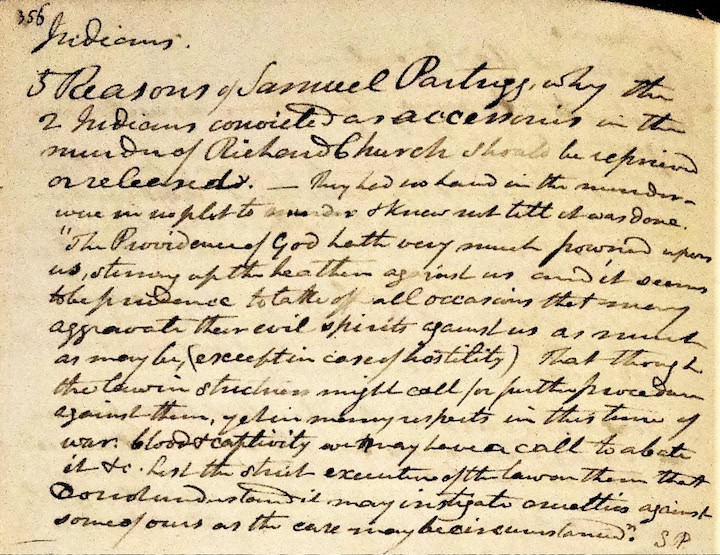
Pemequansett and Wenepuck were tried separately as accessories. Samuel Partrigg testified that “They had no hand in the murder — were in no plot to murder & knew not till it was done.” 6 They were turned over to the Sheriff and placed in confinement.
In the wake of the executions there were protests from the Nonotuck and other Native refugees living in Schaghticoke, New York. The sachem Soquons had doubts about the verdict, and he wrote to New York Governor Fletcher, stating that all four men were innocent.7 Although the English had denied using any force to interrogate witnesses, Fletcher was told that the English search party had lost track of the actual culprits, mis-identified the suspects, and then tortured and whipped Wenepuck and Pemequansett to extract confessions from them.8
In an April 5, 1697 letter to Massachusetts Governor Stoughton, Fletcher further stated that another Native man had killed the murderer. He wrote that:
“English & Indians followed the track, found the buttons by way of the coat of the murdered man [Church]; & overtook an Onogungo [Abenaki] Indian9 who confessed the murder, & that the Indian before him had the [Abenaki] man’s clothes, gun & scalp, which Indian the party knocked on the head.”
Stoughton was skeptical; he suggested that perhaps the Nipmuc scouts in the search party had actually tried to help the four accused men to escape, and were now making excuses for them. Fletcher insisted that he had further eyewitness testimony from a Native man named Cotonaugh, which “proves the innocence of the executed Indians.” He pressed for the release of Pemaquansett and Wenepuck, since they, and the entire community, “have promised to be quiet & do no wrong.”10
Even after the trials and executions, Church’s murder was used as an excuse by English colonists to push for the removal of the Hatfield Nonotuck community. Governor Stoughton wrote, on May 17, 1697, that he “Thinks the River Indians ought not to complain any longer about execution of the two — says many of these Indians are our former enemies and owe us a grudge.”11 Shortly thereafter, Samuel Partrigg reported that only 40 Native people were still remaining in Hatfield (8 men, 9 women, and 23 children); “We propose to have them removed, to Albany or elsewhere.” He also noted that one of the Nipmuc Indians, Peter Aspinal, had recovered the community’s firearms from the Sheriff’s possession and, while he was at it, helped Pemaquansett and Wenepuck escape, and led them to safety at Schaghticoke.12
Endnotes
- See examples in Harry Andrew Wright, Indian Deeds of Hampden County (Springfield, MA: Harry Andrew Wright, 1905). ↩︎
- A heavily biased account of this incident can be found in James Russell Trumbull, History of Northampton (Northampton, MA: Gazette Printing Company 1898), 1898), Volume I, 441-443. ↩︎
- Records of the Hampshire County Court, County Oyer and Terminer held in Northampton, Massachusetts, October 21, 1696, in Sylvester Judd Manuscript, Massachusetts Series (Forbes Library, Northampton, Massachusetts c. 1850s), Volume I, 348-349. ↩︎
- Sworn testimony of Martha Wait of Hatfield, from the Records of the Hampshire County Court, County Oyer and Terminer held in Northampton, Massachusetts, October 21, 1696, in Judd Manuscript, Massachusetts Series, Volume I, 354. ↩︎
- From the Records of the Hampshire County Court, County Oyer and Terminer held in Northampton, Massachusetts, October 21, 1696, in Judd Manuscript, Massachusetts Series, Volume I, 348-351. ↩︎
- “5 Reasons of Samuel Patrigg, why the 2 Indians convicted as accessories in the murder of Richard Church should be reprieved or released.” Note appended to the Records of the Hampshire County Court, October 1696, in Judd Manuscript, Massachusetts Series, Volume I, 356. ↩︎
- James Spady, “As If In a Great Darkness: Native American Refugees of the Middle Connecticut River Valley in the Aftermath of King Philip’s War,” Historical Journal of Massachusetts 23 (2), 135. ↩︎
- March 4, 1697 report from John Pynchon et al. Note appended to the Records of the Hampshire County Court, October 1696-1697, in Judd Manuscript, Massachusetts Series, Volume I, 352. ↩︎
- Onogungo is one of many terms used in the 1690s to 1740s to refer to Abenaki Indians. Variant spellings include Onogungos used by the Governor of Canada in 1695, Onogonguas used by Captain Stoddart in 1753, and Onogongoes used by Col. Schuyler in 1724. For multiple other examples, see Frederick Webb Hodge, Handbook of American Indians North of Mexico (Washington, DC: Smithsonian Institution Bureau of American Ethnology 1912), 5. ↩︎
- April 23, 1697 letter from Fletcher to Stoughton, in Judd Manuscript, Massachusetts Series, Volume I , 358. ↩︎
- May 17, 1697 letter from Stoughton to Fletcher, in Judd Manuscript, Massachusetts Series, Volume I, 358. ↩︎
- Undated (c. May 1697) letter from Samuel Partrigg to Stoughton, in Judd Manuscript, Massachusetts Series, Volume I, 358. ↩︎