The Mill River Flood Disaster of 1874
Introduction
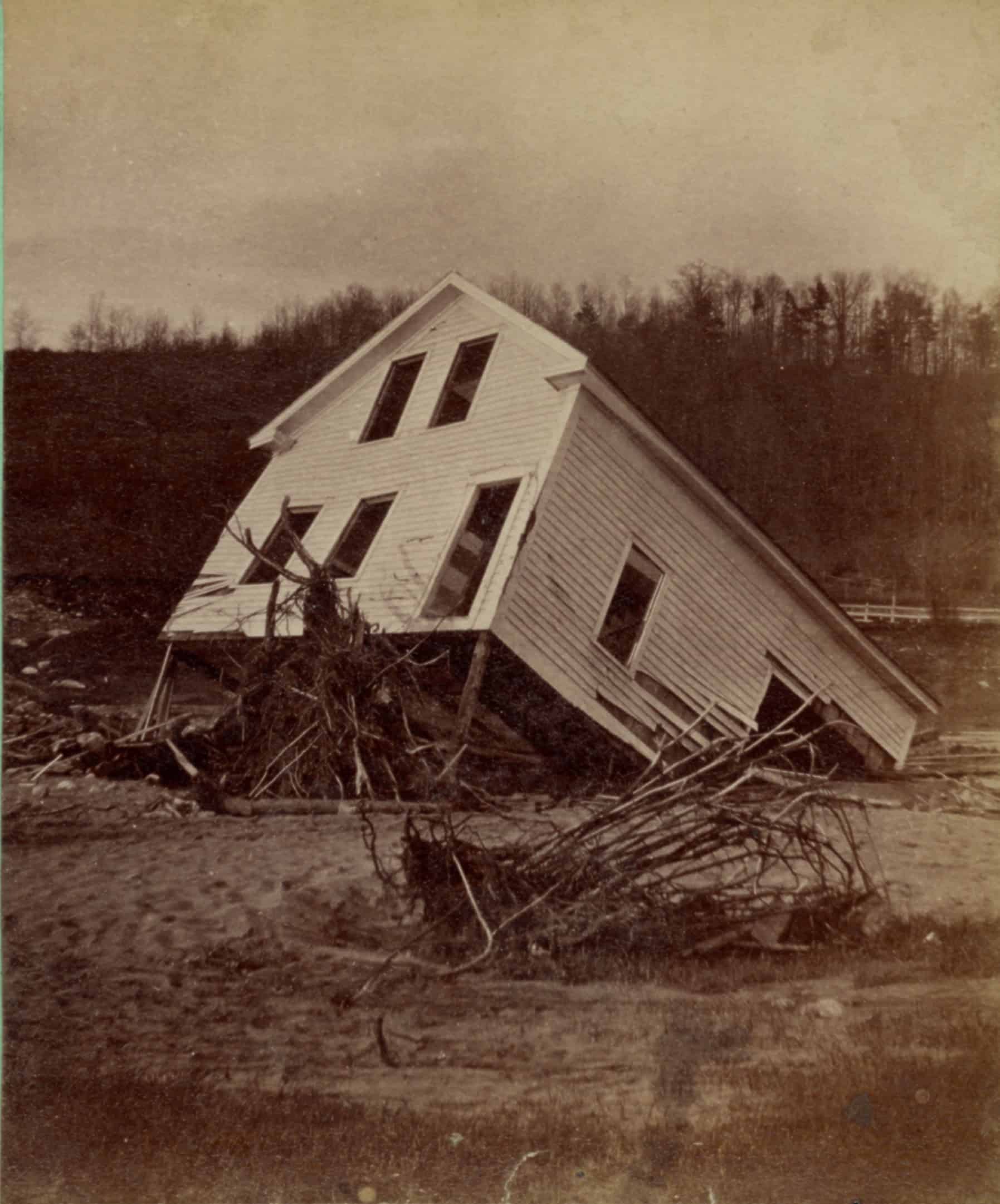
The sudden collapse of the Williamsburg Reservoir Dam in Williamsburg, Massachusetts, let loose a flood that swept away parts of Williamsburg, Skinnerville, Haydenville, and Leeds, and killed 139 people, all within an hour. It was the largest dam disaster in the U.S. up until that time.
The Mill River Flood 150 Year Commemoration
May 16, 1874
It happened early on the morning of May 16, 1874, in the hills above the towns of Williamsburg and Northampton, when the reservoir dam suddenly burst, sending an avalanche of water down a narrow valley lined with factories, farms, and homes. Within an hour, 139 people were dead, and four mill villages—Williamsburg village, Skinnerville, Haydenville, and Leeds—were washed away.
When the Williamsburg Reservoir Company set out to build a reservoir dam to increase their waterpower in 1864, one civil engineer quoted them a price of $100,000. Frustrated with that cost, the company, a group of 11 men who operated factories along the Mill River, opted to dictate its own design to an incautious local engineer who had never designed a dam. The contractors they hired for $22,000 to construct the dam made the inadequate design worse. Without regulations on dam construction, the Reservoir Company was free to design and build the dam as they wished. Anxious Valley residents had to trust the reassurances of the manufacturers that the dam would hold. The result of this lack of care and regulation was the Mill River Flood, the first major dam disaster in the United States and one of the greatest calamities of the 19th century.
The Mill River Flood immediately became one of the nation’s biggest news stories. Newspapers and magazines reported survivors’ daring escapes from the floodwaters and described the horrors of the search for the dead among acres of debris. Investigations showed that the dam had collapsed because it was poorly and negligently constructed, but like many other disasters of the 19th century, no one was held accountable financially, although five parties were named at fault. The flood prompted Massachusetts and nearby states to pass dam-safety laws. Americans in 1874 saw the Mill River Flood not only as a terrible tragedy, but also as one example out of hundreds of contemporary disasters caused by the carelessness and dishonesty of self-interested manufacturers and businessmen.
Short Videos on the Flood
Watch these short videos from historian Elizabeth Sharpe to learn more about the 1874 Mill River Flood, its causes, and its immediate aftermath. Elizabeth Sharpe is the author of In the Shadow of the Dam: The Aftermath of the Mill River Flood of 1874, and one of the co-directors at Historic Northampton. She holds a PhD from the University of Delaware.
The 1874 Mill River Flood
In this video, Elizabeth Sharpe explores the causes of the 1874 Mill River Flood, the destruction it caused, and the factors that made the disaster so deadly. She also discusses the significance of the Mill River and the 1874 flood within the broader context of 19th century American industrialization.
Picking up the Pieces after the Flood
In this video, Elizabeth Sharpe explores the immediate aftermath of the Mill River Flood and the cleanup efforts that took place in the days following the disaster. Discover how residents of the Mill Valley rebuilt their communities in the wake of this devastating event.
The Trial of the Dam
In this video, Elizabeth Sharpe discusses the coroner’s inquest and trial following the 1874 Mill River flood disaster, the influence of laissez-faire capitalism on this event and the aftermath, and how the heroes of the event were or were not honored.
Events Designed by These Local Organizations
Historic Northampton | Leeds Civic Association | Smith College Department of Landscape Studies | Mill River Greenway Initiative | Meekins Library | Williamsburg Woodland Trails

Thank you to our sponsors for their generosity
Holmberg & Howe Land Surveyors | Loven Excavating & Construction, Inc. | National Grid | Whalen Insurance | Finck & Perras Insurance Agency | Florence Bank | Daily Hampshire Gazette | Nasami Farm | Arthur King Fund | Greenfield Savings Bank |Berkshire Design Group, Inc. | O’Reilly Talbot & Okun Associates, Inc. | Florence Casket Company